## Diagram: Signed Binary Multiplication
### Overview
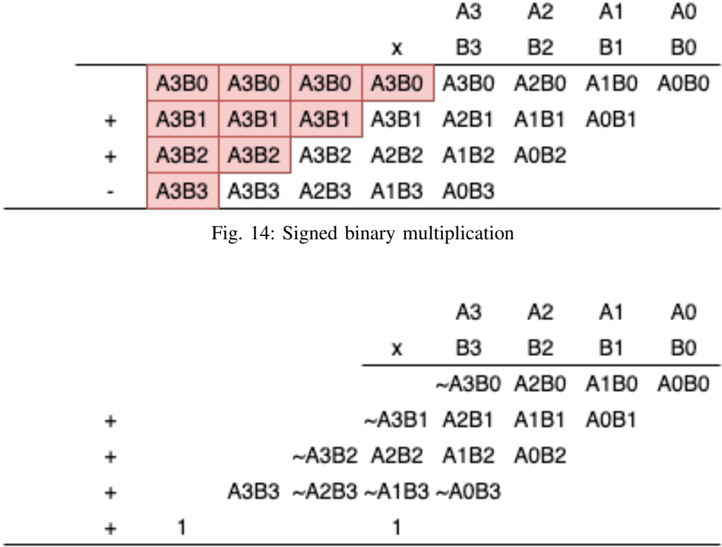
The image presents two diagrams illustrating signed binary multiplication. The first diagram shows a multiplication process with terms like A3B0, A3B1, etc., some of which are highlighted in red. The second diagram shows a similar multiplication process, but with some terms complemented (indicated by the tilde symbol ~).
### Components/Axes
**First Diagram:**
* **Top Row:** A3, A2, A1, A0 (likely representing bits of one number)
* **Second Row:** x, B3, B2, B1, B0 (likely representing bits of the other number)
* **Subsequent Rows:** Products of the bits, with offsets similar to manual multiplication.
* **Operators:** +, - (indicating addition and subtraction)
* **Highlighted Cells:** A3B0, A3B1, A3B2, A3B3 (in red)
**Second Diagram:**
* **Top Row:** A3, A2, A1, A0
* **Second Row:** x, B3, B2, B1, B0
* **Subsequent Rows:** Products of the bits, with offsets. Some terms are complemented.
* **Operators:** +
* **Constants:** 1
**Caption:**
* Fig. 14: Signed binary multiplication
### Detailed Analysis
**First Diagram:**
* The first row of products is: A3B0, A2B0, A1B0, A0B0
* The second row of products is: A3B1, A2B1, A1B1, A0B1
* The third row of products is: A3B2, A2B2, A1B2, A0B2
* The fourth row of products is: A3B3, A2B3, A1B3, A0B3
* The operators are +, +, - for the second, third, and fourth rows respectively.
* The terms A3B0, A3B1, A3B2, and A3B3 in the leftmost columns are highlighted in red.
**Second Diagram:**
* The first row of products is: ~A3B0, A2B0, A1B0, A0B0
* The second row of products is: ~A3B1, A2B1, A1B1, A0B1
* The third row of products is: ~A3B2, A2B2, A1B2, A0B2
* The fourth row of products is: A3B3, ~A2B3, ~A1B3, ~A0B3
* The operators are + for all rows.
* Two additional rows contain the constant '1'.
### Key Observations
* The first diagram shows a standard multiplication setup, with some terms highlighted.
* The second diagram introduces complemented terms (~A3B0, ~A3B1, etc.), suggesting a method for handling negative numbers in binary multiplication.
* The caption indicates that the diagrams illustrate signed binary multiplication.
### Interpretation
The diagrams likely demonstrate a specific algorithm for signed binary multiplication, possibly Booth's algorithm or a similar technique. The highlighted terms in the first diagram and the complemented terms in the second diagram are key components of this algorithm. The '1' constants in the second diagram might represent carry bits or correction factors needed for the signed multiplication. The change in sign on the fourth row of the first diagram suggests a subtraction operation is being performed. The tilde symbol represents the complement of the number.