\n
## Diagram: System Architecture - Interface, Game Abstraction, and Console
### Overview
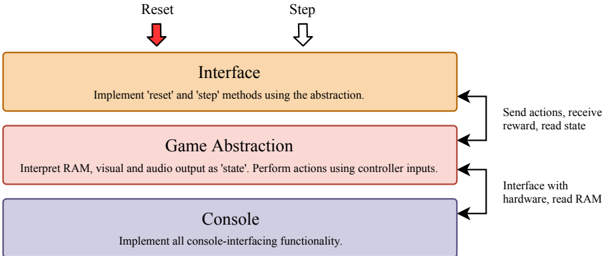
The image depicts a layered system architecture diagram illustrating the interaction between an Interface, a Game Abstraction layer, and a Console layer. Arrows indicate the flow of control and data between these layers. The diagram appears to represent a software or system design, likely related to game development or simulation.
### Components/Axes
The diagram consists of three rectangular blocks stacked vertically, representing the three layers:
* **Interface:** (Top layer, light orange color)
* **Game Abstraction:** (Middle layer, light red color)
* **Console:** (Bottom layer, light blue color)
Two arrows are positioned above the Interface layer:
* **Reset:** (Red arrow pointing downwards)
* **Step:** (Grey arrow pointing downwards)
Text labels are associated with each layer, describing their function. Arrows connecting the layers indicate data flow and are labeled with descriptions of the interaction.
### Detailed Analysis or Content Details
The diagram shows a hierarchical structure with information flowing downwards and upwards.
* **Interface Layer:**
* Text: "Implement 'reset' and 'step' methods using the abstraction."
* Receives input from "Reset" and "Step" actions.
* Sends actions, receives reward, and reads state to the "Game Abstraction" layer.
* **Game Abstraction Layer:**
* Text: "Interpret RAM, visual and audio output as 'state'. Perform actions using controller inputs."
* Receives actions, reward, and state from the "Interface" layer.
* Interfaces with hardware and reads RAM to the "Console" layer.
* **Console Layer:**
* Text: "Implement all console-interfacing functionality."
* Receives hardware interface and RAM read requests from the "Game Abstraction" layer.
The arrows connecting the layers are labeled as follows:
* Interface to Game Abstraction: "Send actions, receive reward, read state"
* Game Abstraction to Console: "Interface with hardware, read RAM"
### Key Observations
The diagram emphasizes a clear separation of concerns between the layers. The "Interface" layer provides the high-level control (reset and step), the "Game Abstraction" layer handles the game logic and state, and the "Console" layer manages the low-level hardware interaction. The flow of control is primarily top-down, with the Interface initiating actions and the Console providing the underlying functionality.
### Interpretation
This diagram illustrates a common architectural pattern used in game development and simulation environments. The separation into these layers allows for modularity, reusability, and easier testing. The "Interface" layer acts as an abstraction, allowing different interfaces (e.g., a human player, an AI agent) to interact with the game without needing to know the details of the underlying implementation. The "Game Abstraction" layer encapsulates the game logic and state, while the "Console" layer handles the platform-specific details.
The "Reset" and "Step" actions suggest a discrete-time simulation or game loop. "Reset" likely initializes the game to a starting state, while "Step" advances the simulation by one time step. The flow of data (actions, rewards, state) between the layers is crucial for the game to function correctly. The diagram suggests a system where the Interface provides commands, the Game Abstraction processes them and updates the state, and the Console provides the necessary hardware support.