\n
## Line Chart: Accuracy vs. Step Padding
### Overview
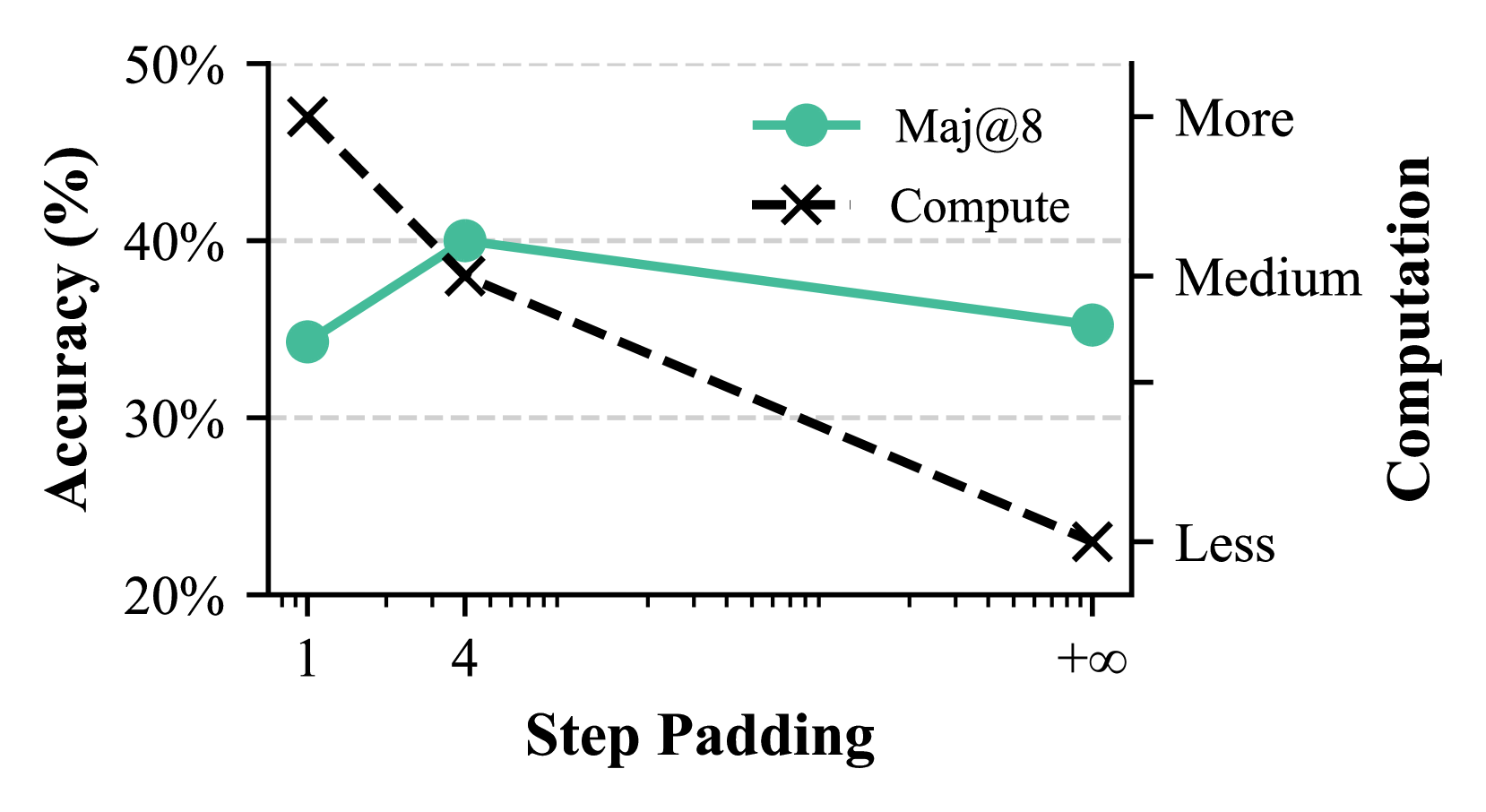
This line chart illustrates the relationship between "Step Padding" on the x-axis and "Accuracy (%)" on the y-axis, for two different metrics: "Maj@8" and "Compute". A third axis on the right represents "Computation" (Less, Medium, More). The chart shows how accuracy changes as step padding increases, and how this change differs between the two metrics.
### Components/Axes
* **X-axis:** "Step Padding" with markers at 1, 4, and +∞ (infinity).
* **Y-axis:** "Accuracy (%)" ranging from 20% to 50%, with tick marks at 20%, 30%, 40%, and 50%.
* **Right Y-axis:** "Computation" with labels "Less", "Medium", and "More", positioned vertically.
* **Legend:** Located in the top-right corner, containing:
* "Maj@8" - represented by a teal circle with a teal line.
* "Compute" - represented by a black 'x' with a dashed black line.
* **Horizontal dashed lines:** at 30%, 40% and 20% accuracy.
### Detailed Analysis
**Maj@8 (Teal Line):**
The teal line representing "Maj@8" starts at approximately 34% accuracy at Step Padding = 1. It increases to a peak of approximately 42% accuracy at Step Padding = 4, then decreases slightly to approximately 36% accuracy at Step Padding = +∞. The trend is initially upward, then slightly downward.
* Step Padding = 1: Accuracy ≈ 34%
* Step Padding = 4: Accuracy ≈ 42%
* Step Padding = +∞: Accuracy ≈ 36%
**Compute (Black Dashed Line):**
The black dashed line representing "Compute" starts at approximately 47% accuracy at Step Padding = 1. It decreases steadily to approximately 36% accuracy at Step Padding = 4, and continues to decrease to approximately 23% accuracy at Step Padding = +∞. The trend is consistently downward.
* Step Padding = 1: Accuracy ≈ 47%
* Step Padding = 4: Accuracy ≈ 36%
* Step Padding = +∞: Accuracy ≈ 23%
**Computation Axis:**
The "Computation" axis is qualitatively linked to the x-axis. Step Padding of 1 is associated with "More" computation, Step Padding of 4 is associated with "Medium" computation, and Step Padding of +∞ is associated with "Less" computation.
### Key Observations
* "Maj@8" accuracy *increases* with step padding up to a point (Step Padding = 4), then decreases.
* "Compute" accuracy *decreases* consistently with increasing step padding.
* There is an inverse relationship between computation and step padding. As step padding increases, the amount of computation decreases.
* "Compute" starts with a significantly higher accuracy than "Maj@8" at Step Padding = 1, but ends with a lower accuracy at Step Padding = +∞.
### Interpretation
The chart suggests a trade-off between accuracy and computational cost. Increasing step padding initially improves "Maj@8" accuracy, likely by allowing for more refined calculations, but eventually leads to diminishing returns. However, increasing step padding consistently reduces the accuracy of "Compute", and also reduces the computational burden.
The diverging trends of "Maj@8" and "Compute" indicate that these metrics are sensitive to step padding in different ways. "Maj@8" benefits from a moderate amount of step padding, while "Compute" is negatively impacted by it. The relationship to the "Computation" axis suggests that the benefits of step padding for "Maj@8" come at the cost of increased computation, while the drawbacks for "Compute" are associated with reduced computation.
The initial high accuracy of "Compute" could indicate that it is a simpler metric that is less sensitive to the nuances captured by step padding. The eventual lower accuracy of "Compute" at higher step padding values suggests that it may lose information as the step size increases. The peak in "Maj@8" accuracy at Step Padding = 4 suggests an optimal balance between computational cost and accuracy for this metric.