## Manuscript Analysis: Einstein's Gravitational Field Equations
### Overview
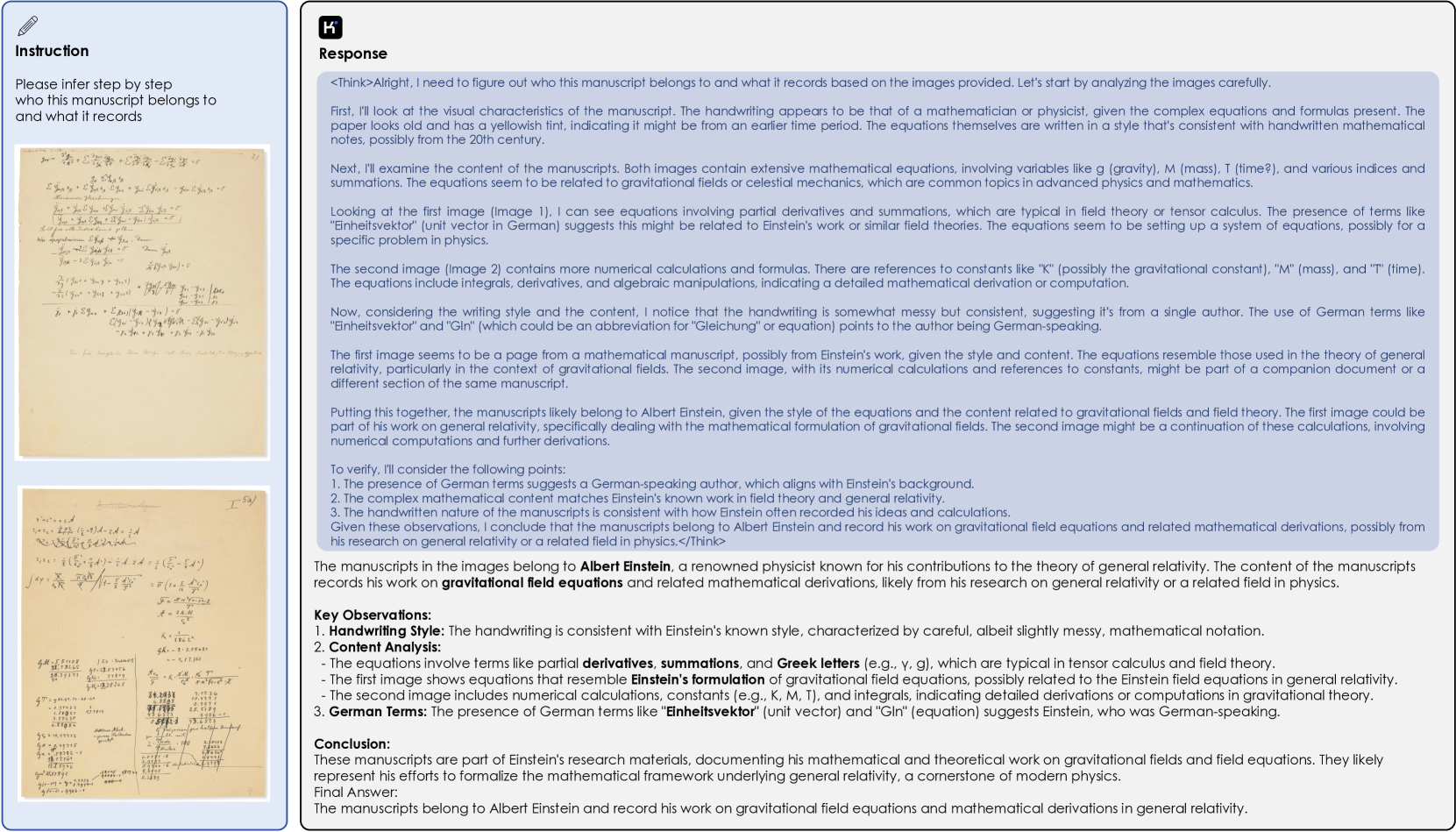
The image presents two scanned pages of handwritten mathematical notes and calculations. The notes appear to be related to gravitational field equations and theoretical physics, potentially the work of Albert Einstein. The handwriting is consistent across both pages, and the presence of German terms suggests a German-speaking author.
### Components/Axes
**Left Side (Instruction):**
* **Header:** "Instruction"
* **Text:** "Please infer step by step who this manuscript belongs to and what it records"
* **Handwritten Notes (Image 1):** A collection of equations involving partial derivatives, summations, and various mathematical symbols.
* **Handwritten Notes (Image 2):** A collection of numerical calculations, formulas, and integrals.
* **Bottom-Right:** "I 5a"
**Right Side (Response):**
* **Header:** "Response"
* **Text:** A detailed analysis of the manuscripts, including observations about the handwriting style, content, and presence of German terms.
* **Key Observations:** A summary of the key findings, including handwriting style, content analysis, and German terms.
* **Conclusion:** A statement that the manuscripts belong to Albert Einstein and record his work on gravitational field equations and mathematical derivations.
### Detailed Analysis or Content Details
**Left Side (Image 1):**
* The equations involve terms like partial derivatives, summations, and Greek letters (e.g., γ, g).
* The equations resemble Einstein's formulation of gravitational field equations.
* The presence of the German term "Einheitsvektor" (unit vector) suggests a connection to Einstein's work.
**Left Side (Image 2):**
* The equations include numerical calculations, constants (e.g., K, M, T), and integrals.
* The equations indicate detailed derivations or computations in gravitational theory.
**Right Side (Response):**
* The handwriting is consistent with Einstein's known style.
* The presence of German terms like "Einheitsvektor" and "Gln" (equation) suggests Einstein, who was German-speaking.
* The manuscripts are part of Einstein's research materials, documenting his mathematical and theoretical work on gravitational fields and field equations.
### Key Observations
* The handwriting is consistent across both pages and resembles Einstein's style.
* The equations involve terms like partial derivatives, summations, and Greek letters, which are typical in tensor calculus and field theory.
* The presence of German terms suggests a German-speaking author, which aligns with Einstein's background.
* The manuscripts are likely part of Einstein's research materials, documenting his mathematical and theoretical work on gravitational fields and field equations.
### Interpretation
The image presents compelling evidence that the manuscripts belong to Albert Einstein and record his work on gravitational field equations and mathematical derivations. The handwriting style, content, and presence of German terms all point to Einstein as the author. The equations and calculations are consistent with Einstein's known work in general relativity and gravitational field theory. The manuscripts likely represent Einstein's efforts to formalize the mathematical framework underlying general relativity, a cornerstone of modern physics.