## Screenshot: AI Assistant Interface Analyzing Handwritten Manuscripts
### Overview
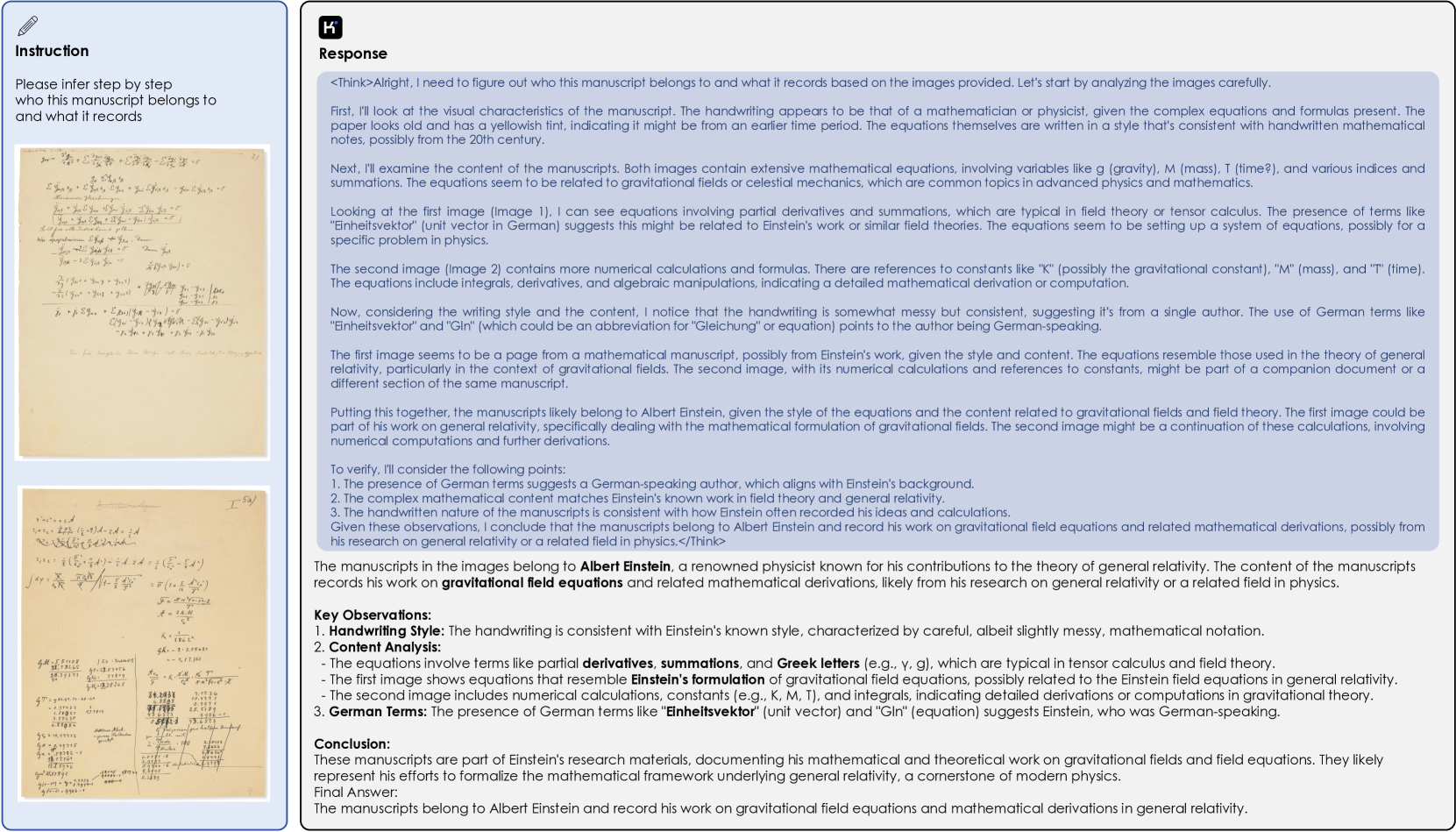
The image is a screenshot of a graphical user interface (GUI) for an AI assistant. The interface is divided into two main vertical panels. The left panel, titled "Instruction," contains a user query and two embedded images of handwritten mathematical manuscripts. The right panel, titled "Response," displays the AI's detailed, step-by-step analysis and final conclusion regarding the authorship and content of those manuscripts. The overall aesthetic is clean and functional, with a light gray background and distinct panel borders.
### Components/Axes
The interface has no chart axes. Its primary components are:
1. **Left Panel ("Instruction"):**
* **Header:** Contains a pencil icon and the bold text "Instruction".
* **User Query Text:** "Please infer step by step who this manuscript belongs to and what it records".
* **Embedded Images:** Two rectangular images showing pages of aged, yellowish paper filled with handwritten mathematical equations and notes.
2. **Right Panel ("Response"):**
* **Header:** Contains a stylized "H" icon and the bold text "Response".
* **Main Content Area:** A large text block containing the AI's analysis. This is subdivided into:
* A `<Think>` section (enclosed in tags) detailing the internal reasoning process.
* A final, formatted answer section with bold headings ("Key Observations:", "Conclusion:", "Final Answer:").
### Detailed Analysis / Content Details
**A. Left Panel - Manuscript Images:**
* **Image 1 (Top):** Shows a page of handwritten notes. The equations involve partial derivatives (denoted by `∂`), summations (Σ), and variables like `g`, `M`, `T`. The term "Einheitsvektor" (German for "unit vector") is visible. The handwriting is cursive and somewhat dense.
* **Image 2 (Bottom):** Shows another page with more numerical calculations and algebraic manipulations. It includes integrals, references to constants labeled "K", "M", "T", and what appears to be a small graph or diagram in the lower right corner. The handwriting style is consistent with the first image.
**B. Right Panel - AI Response Text (Transcription of Key Sections):**
* **User Query:** "Please infer step by step who this manuscript belongs to and what it records"
* **AI's `<Think>` Section (Summary of Reasoning):**
* The handwriting suggests a mathematician or physicist from the 20th century.
* The content involves gravitational fields, celestial mechanics, tensor calculus, and field theory.
* German terms like "Einheitsvektor" and "Gln" (likely for "Gleichung"/equation) point to a German-speaking author.
* The style and content are consistent with Albert Einstein's work on general relativity and gravitational field equations.
* The two images likely represent different sections of the same research manuscript.
* **AI's Final Answer (Formatted Output):**
* **Assertion:** "The manuscripts in the images belong to **Albert Einstein**... The content... records his work on **gravitational field equations** and related mathematical derivations..."
* **Key Observations:**
1. **Handwriting Style:** Consistent with Einstein's known style.
2. **Content Analysis:** Equations involve partial derivatives, summations, Greek letters (γ, g), resembling Einstein's formulation of gravitational field equations. The second image shows detailed numerical derivations.
3. **German Terms:** Presence of "Einheitsvektor" and "Gln" suggests a German-speaking author.
* **Conclusion:** "These manuscripts are part of Einstein's research materials, documenting his mathematical and theoretical work on gravitational fields and field equations... a cornerstone of modern physics."
* **Final Answer:** "The manuscripts belong to Albert Einstein and record his work on gravitational field equations and mathematical derivations in general relativity."
### Key Observations
1. **Structured AI Reasoning:** The response explicitly shows a chain-of-thought process (`<Think>` tags) before delivering the final answer, demonstrating a step-by-step analytical approach.
2. **Multimodal Analysis:** The AI successfully integrates visual analysis (handwriting style, paper age) with textual and mathematical content analysis (equations, German terms) to form its conclusion.
3. **Specific Attribution:** The analysis does not merely suggest a field of study but makes a definitive attribution to a specific historical figure (Albert Einstein) based on correlating multiple lines of evidence.
4. **Content Focus:** The extracted information centers entirely on the *metadata* of the manuscripts (author, subject) rather than a full transcription of the complex mathematical equations themselves, which are described generically.
### Interpretation
This screenshot captures a meta-demonstration of an AI's capability to perform expert-level document analysis. The "data" here is not numerical but forensic and historical.
* **What it demonstrates:** The AI acts as a digital historian and physicist's assistant. It synthesizes paleographic clues (handwriting), linguistic analysis (German technical terms), and domain-specific knowledge (theoretical physics, general relativity) to authenticate and contextualize primary source documents.
* **Relationship between elements:** The user's open-ended query ("infer step by step") directly triggers the AI's structured, evidence-based reasoning process displayed in the response. The two manuscript images serve as the primary evidence, and the AI's text is the analytical report derived from that evidence.
* **Notable pattern:** The AI's conclusion is built on a convergence of independent indicators: the *language* (German), the *scientific content* (gravitational field equations), and the *physical artifact's style* (handwriting). This mirrors how a human expert would approach the problem, lending credibility to the output.
* **Underlying purpose:** The image showcases the AI's utility in academic and research contexts, specifically for digitizing, interpreting, and attributing historical scientific documents, potentially accelerating scholarship in the history of science.