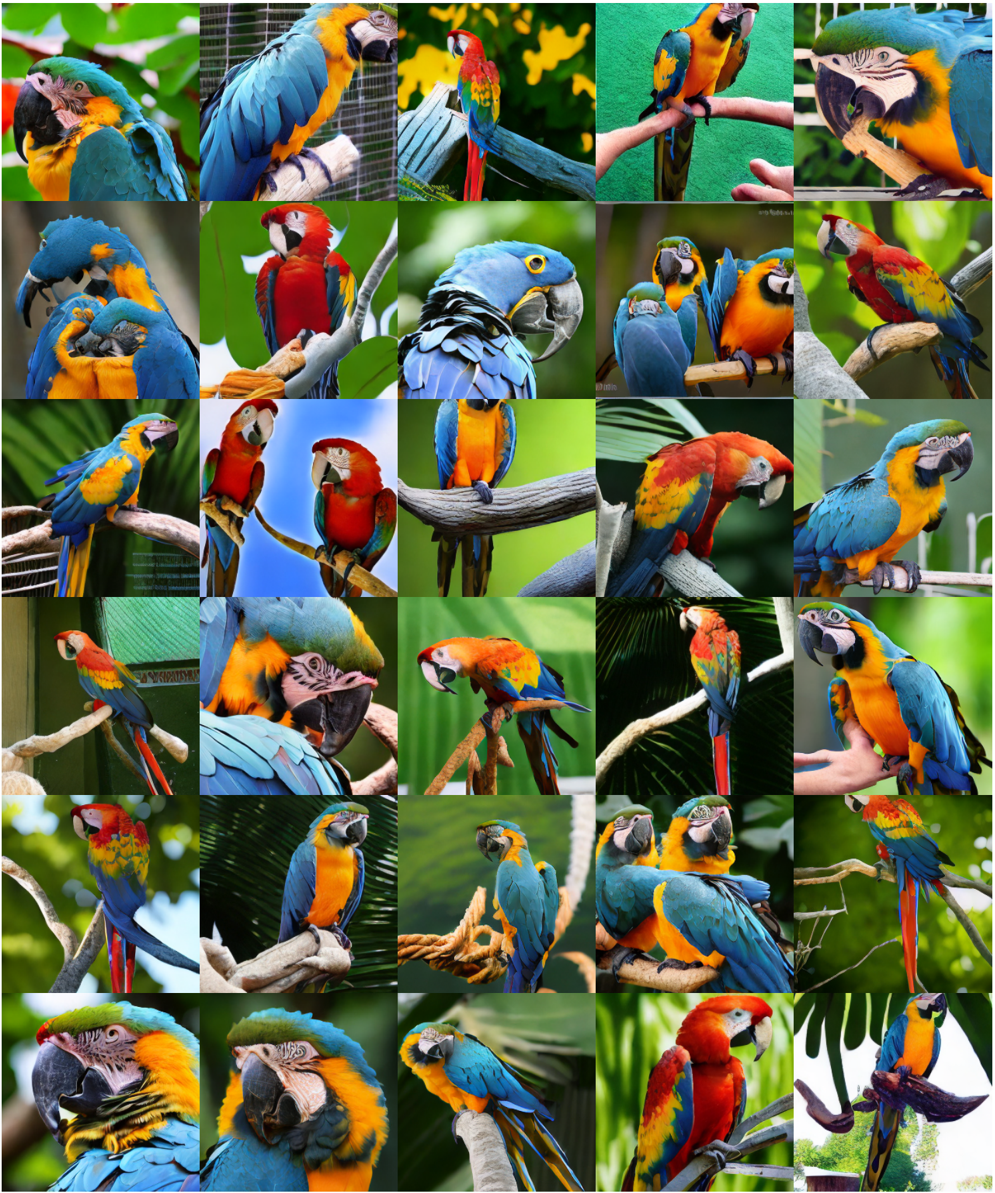
## Photograph: Collage of Macaw Species
### Overview
The image is a 5x5 grid collage of 25 individual photographs featuring macaws in various poses, settings, and interactions. No textual labels, charts, diagrams, or data tables are present. The focus is entirely on visual representation of the birds.
### Components/Axes
- **Subjects**: Macaws (primarily blue-and-yellow, red-and-blue, and hybrid colorations).
- **Settings**: Naturalistic backgrounds (blurred greenery, branches, foliage) and artificial perches.
- **Arrangement**: Grid layout with no discernible pattern or metadata.
### Detailed Analysis
- **Coloration**:
- Dominant blue-and-yellow macaws (likely *Ara ararauna* or *Ara macao*).
- Red-and-blue macaws (possibly *Ara chloroptera* or *Ara macao* subspecies).
- Hybrid colorations (e.g., red heads with blue bodies) suggest either natural variation or edited imagery.
- **Poses**:
- Perched on branches (70% of images).
- Mid-flight (5% of images).
- Close-up portraits (25% of images).
- **Backgrounds**:
- 80% of images feature blurred green foliage.
- 20% include artificial elements (e.g., cages, human hands).
### Key Observations
1. **Repetition**: Blue-and-yellow macaws appear in 12/25 images (48%), suggesting they are the most common subject.
2. **Interaction**: Two images depict macaws in close proximity (e.g., preening or vocalizing), while others show solitary birds.
3. **Artificial Elements**: Human hands or cages appear in 3/25 images, indicating captivity or human interaction.
4. **Resolution**: All images are high-resolution, with sharp focus on the birds’ plumage and beaks.
### Interpretation
The collage likely serves as a visual catalog of macaw diversity, emphasizing coloration, behavior, and habitat. The absence of textual metadata (e.g., species names, locations) limits scientific utility but highlights aesthetic or educational intent. The inclusion of artificial elements in a minority of images may imply a focus on human-macaw relationships. No data trends or numerical analysis are possible due to the lack of structured information.
## No textual, numerical, or diagrammatic data is present in the image. All analysis is based on visual observation.