## Diagram: Harry Potter Knowledge Graph (Partial)
### Overview
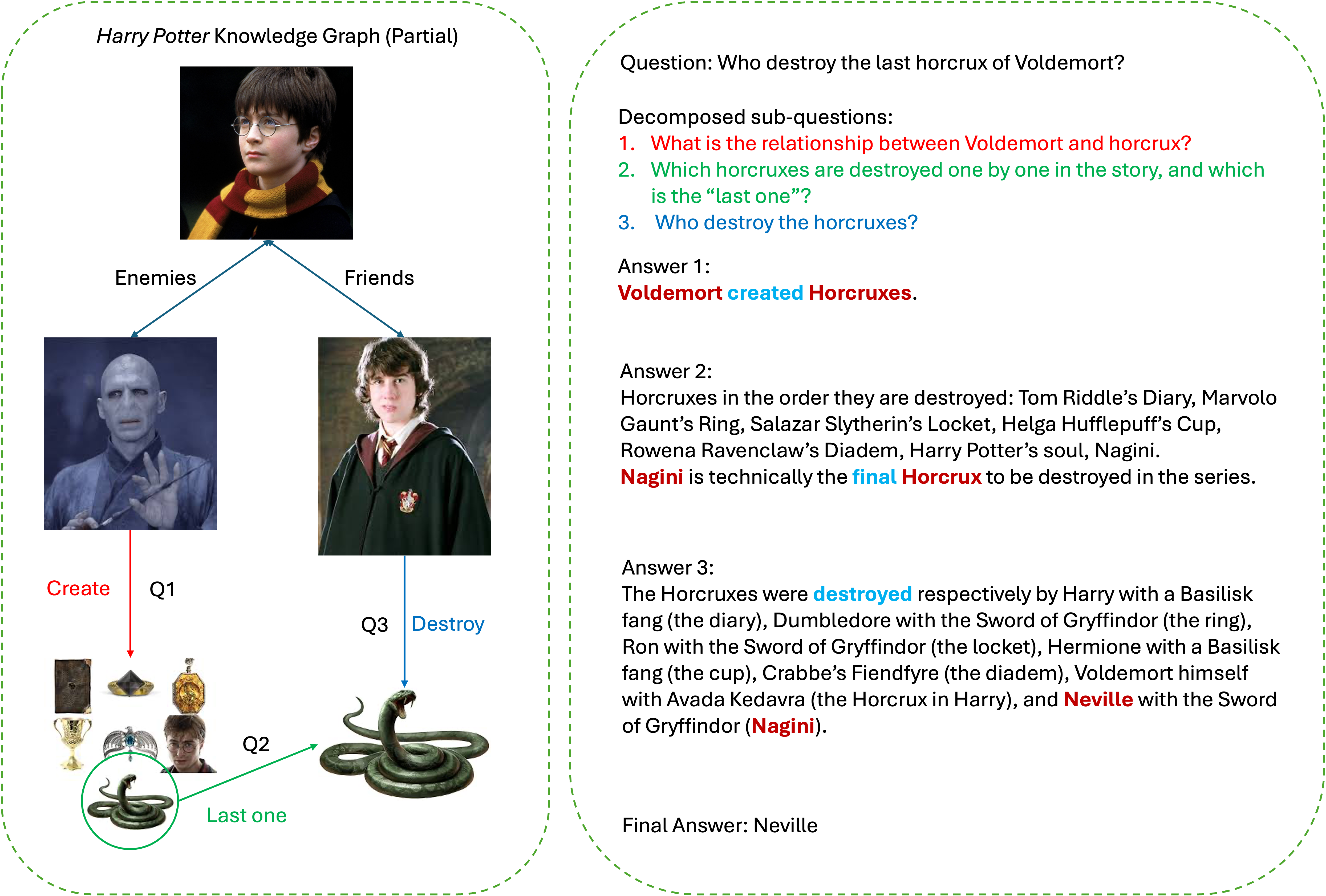
The image presents a partial knowledge graph related to the Harry Potter series, specifically focusing on Voldemort's Horcruxes. It visually represents relationships between characters (Voldemort, Harry Potter, Neville) and concepts (Horcruxes, creation, destruction). The diagram is accompanied by a question and a breakdown of sub-questions with corresponding answers.
### Components/Axes
The diagram is divided into two main sections: a visual graph on the left and a textual question/answer section on the right.
**Visual Graph:**
* **Nodes:** Represent entities like Voldemort, Harry Potter, Horcruxes (represented by objects), and concepts like "Create" and "Destroy".
* **Edges:** Represent relationships between entities, labeled as "Enemies", "Friends", and "Create".
* **Question Markers:** Q1, Q2, Q3 are placed near specific nodes to indicate their relevance to the sub-questions.
* **"Last one" label:** Indicates the final Horcrux.
* **Green Oval:** Encloses the Horcrux destruction process.
**Textual Section:**
* **Question:** "Who destroy the last horcrux of Voldemort?" (Note: "horcrux" is misspelled in the original image)
* **Decomposed Sub-questions:** Three sub-questions are listed, numbered 1-3.
* **Answers:** Corresponding answers are provided for each sub-question.
* **Final Answer:** "Neville" is stated as the final answer.
### Detailed Analysis or Content Details
**Visual Graph Details:**
* **Voldemort:** Depicted on the left, connected to Harry Potter via "Enemies" and to a green object (Horcrux) via "Create".
* **Harry Potter:** Depicted in the center-left, connected to Voldemort via "Enemies" and to another character (likely Ron Weasley) via "Friends".
* **Horcrux (Creation):** A green object (appears to be a small chest) is linked to Voldemort via the "Create" edge. This is labeled "Q1".
* **Horcrux (Destruction):** A snake (Nagini) is depicted within a green oval, linked to the "Destroy" edge. This is labeled "Q3".
* **"Last one" label:** Points to the snake (Nagini). This is labeled "Q2".
**Textual Section Details:**
* **Answer 1:** "Voldemort created Horcruxes."
* **Answer 2:** "Horcruxes in the order they are destroyed: Tom Riddle’s Diary, Marvolo Gaunt’s Ring, Salazar Slytherin’s Locket, Helga Hufflepuff’s Cup, Rowena Ravenclaw’s Diadem, Harry Potter’s soul, Nagini. Nagini is technically the final Horcrux to be destroyed in the series."
* **Answer 3:** "The Horcruxes were destroyed respectively by Harry with a Basilisk fang (the diary), Dumbledore with the Sword of Gryffindor (the ring), Ron with the Sword of Gryffindor (the locket), Hermione with a Basilisk fang (the cup), Crabbe’s Fiendfyre (the diadem), Voldemort himself with Avada Kedavra (the Horcrux in Harry), and Neville with the Sword of Gryffindor (Nagini)."
* **Final Answer:** "Neville"
### Key Observations
* The diagram clearly establishes Voldemort as the creator of Horcruxes.
* Nagini is explicitly identified as the last Horcrux to be destroyed.
* The answers provide a detailed sequence of Horcrux destruction and the individuals responsible.
* The diagram uses visual cues (Q1, Q2, Q3) to link the graph elements to the sub-questions.
* The text explicitly states that Nagini is the final Horcrux.
### Interpretation
The diagram and accompanying text serve as a concise knowledge representation of a key plot point in the Harry Potter series – the creation and destruction of Voldemort’s Horcruxes. The visual graph provides a high-level overview of the relationships, while the textual section offers specific details and a definitive answer to the central question. The decomposition into sub-questions demonstrates a logical approach to problem-solving, breaking down a complex issue into smaller, manageable parts. The diagram highlights the importance of Neville Longbottom in the final defeat of Voldemort, as he is the one who destroys the last Horcrux (Nagini). The use of images of characters and objects enhances understanding and recall. The diagram is a simplified representation of a complex network of relationships, focusing on the core elements relevant to the question. The misspelling of "horcrux" throughout the text is a minor inconsistency.