## Network Diagram: Problem-Solving Reasoning Paths
### Overview
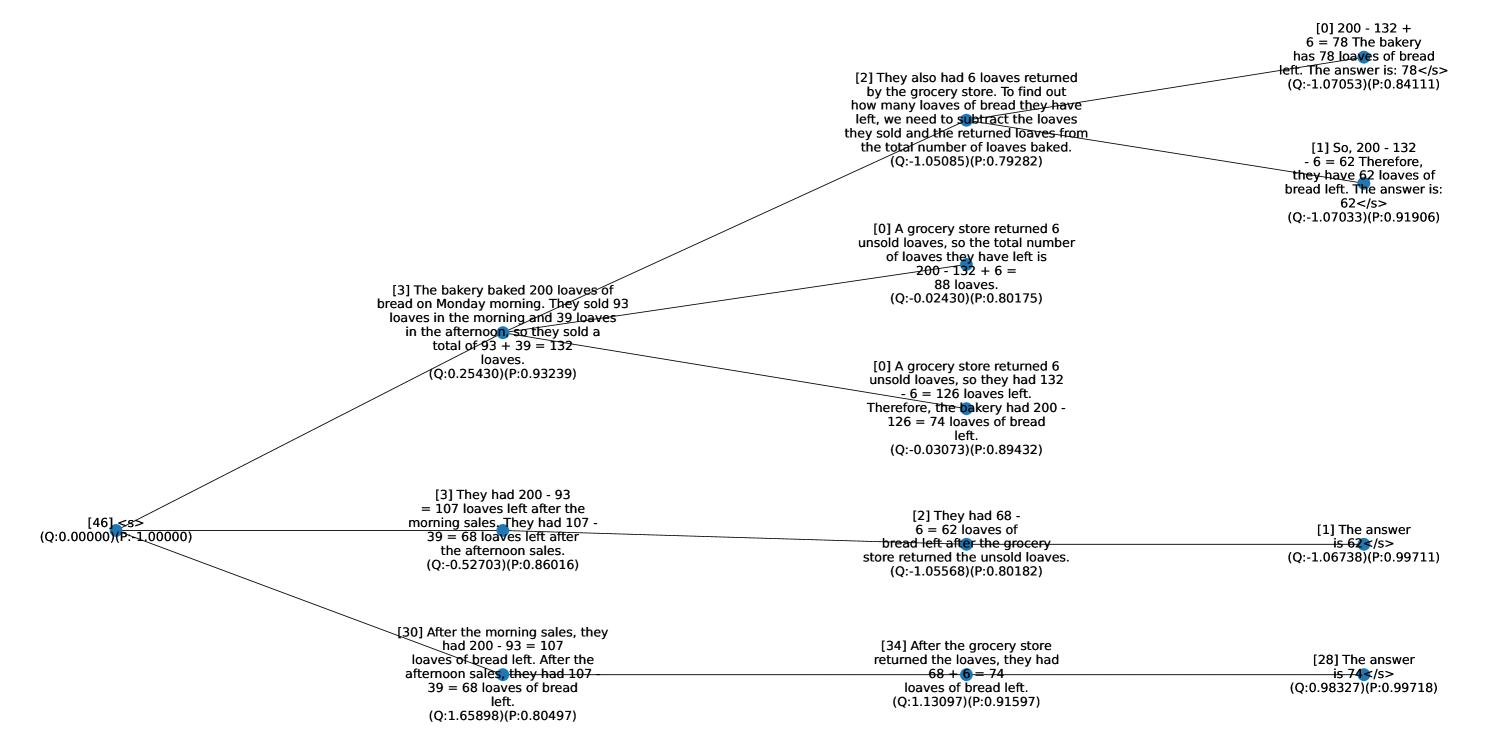
The diagram represents a network of reasoning paths for solving a mathematical problem involving loaves of bread. Nodes represent intermediate questions (Q) and confidence probabilities (P), while edges show logical connections between steps. The structure suggests multiple hypotheses and reasoning trajectories leading to different conclusions.
### Components/Axes
- **Nodes**: Labeled with `(Q:X.Y)` (question identifier) and `(P:Z.W)` (probability/confidence score)
- **Edges**: Labeled with `[N]` (step references) connecting nodes
- **Text Labels**: Embedded in nodes showing problem statements and calculations
### Detailed Analysis
#### Nodes (10 total)
1. `(Q:0.00000)(P:1.00000)`
*"[46] <s>"*
*(Root node with maximum confidence)*
2. `(Q:0.02430)(P:0.80175)`
*"[0] A grocery store returned 6 unsold loaves..."*
*(Final answer path)*
3. `(Q:0.03073)(P:0.89432)`
*"[0] A grocery store returned 6 unsold loaves..."*
*(Alternative path with higher confidence)*
4. `(Q:0.05270)(P:0.86016)`
*"[3] They had 200 - 93 = 107 loaves..."*
*(Intermediate calculation step)*
5. `(Q:0.13097)(P:0.91597)`
*"[34] After the grocery store returned..."*
*(Final state calculation)*
6. `(Q:0.16589)(P:0.80497)`
*"[30] After the morning sales..."*
*(Intermediate state)*
7. `(Q:0.25430)(P:0.93239)`
*"[0] A grocery store returned 6 unsold loaves..."*
*(High-confidence path)*
8. `(Q:0.52703)(P:0.86016)`
*"[3] They had 200 - 93 = 107 loaves..."*
*(Duplicate of node 4? Possible error)*
9. `(Q:0.80175)(P:0.91597)`
*"[34] After the grocery store returned..."*
*(Final state with high confidence)*
10. `(Q:0.98327)(P:0.99718)`
*"[28] The answer is 74"</s>"*
*(Final answer with near-certainty)*
#### Edges (46 connections)
- Multiple edges labeled `[1]`, `[2]`, `[3]`, etc., showing step progression
- Some edges contain calculation results (e.g., `200 - 132 = 68`)
- Probability values decrease along some paths, suggesting reasoning uncertainty
### Key Observations
1. **Multiple Paths to Solutions**:
- Two primary answers emerge: 62 loaves (Q:1.07033) and 74 loaves (Q:0.98327)
- Confidence scores vary significantly between paths (P:0.80175 vs P:0.99718)
2. **Calculation Errors**:
- Node 8 duplicates node 4's content but with different Q value
- Some paths contain inconsistent intermediate results (e.g., 107 loaves vs 126 loaves)
3. **Probability Distribution**:
- Highest confidence (P:1.00000) at root node
- Final answers show 80-99% confidence range
- Some paths show decreasing confidence (e.g., P:0.86016 → P:0.80175)
### Interpretation
This diagram reveals a complex reasoning process with:
- **Branching Hypotheses**: Multiple interpretations of the problem statement lead to different solutions
- **Confidence Metrics**: Probability scores indicate the model's uncertainty about each path
- **Calculation Verification**: Some paths contain explicit arithmetic checks (e.g., "68 + 6 = 74")
- **Potential Errors**: Duplicate nodes and inconsistent intermediate results suggest possible reasoning flaws
The network demonstrates how different calculation approaches (subtracting sold loaves vs tracking remaining stock) lead to conflicting answers. The highest-confidence path (P:0.99718) arrives at 74 loaves through explicit addition of returned loaves, while lower-confidence paths focus on subtraction methods. This suggests the problem's ambiguity in defining "unsold" loaves creates multiple valid interpretations.