## Diagram: Image Generation Methods
### Overview
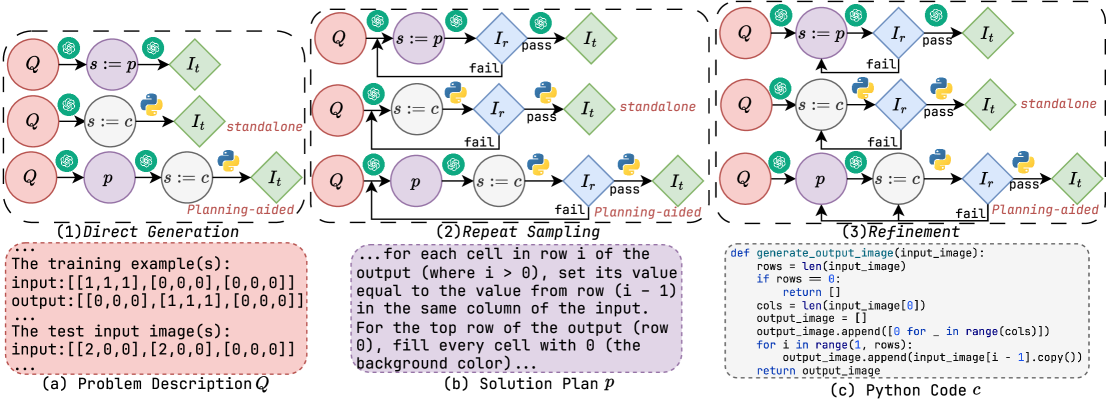
The image presents three different methods for image generation: Direct Generation, Repeat Sampling, and Refinement. Each method is illustrated as a flowchart, showing the process from problem description (Q) to the target image (It), potentially involving a solution plan (P) and iterative refinement (Ir). The image also includes examples of training data, a description of the repeat sampling method, and Python code for the refinement method.
### Components/Axes
* **Nodes:**
* Q (Problem Description): Represented as a red circle.
* P (Solution Plan): Represented as a purple circle.
* It (Target Image): Represented as a green diamond.
* Ir (Iterative Refinement): Represented as a blue diamond.
* s := p (Solution equals plan): Represented as a gray circle.
* s := c (Solution equals code): Represented as a gray circle.
* **Icons:**
* ChatGPT Logo: Indicates the use of a language model.
* Python Logo: Indicates the use of Python code.
* **Flow:** Arrows indicate the flow of the process.
* **Decision Points:** Diamonds (Ir) indicate decision points with "pass" and "fail" outcomes.
* **Text Blocks:**
* (a) Problem Description Q
* (b) Solution Plan P
* (c) Python Code c
### Detailed Analysis
#### (1) Direct Generation
* **Flow:**
* Q (red circle with ChatGPT icon) -> s := p (gray circle with ChatGPT icon) -> It (green diamond with Python icon), labeled "Planning-aided"
* Q (red circle with ChatGPT icon) -> s := c (gray circle with ChatGPT icon) -> It (green diamond), labeled "standalone"
* Q (red circle with ChatGPT icon) -> P (purple circle) -> s := c (gray circle with ChatGPT icon) -> It (green diamond with Python icon), labeled "Planning-aided"
* **Text:**
* The training example(s):
* input: `[[1,1,1], [0,0,0], [0,0,0]]`
* output: `[[0,0,0], [1,1,1], [0,0,0]]`
* The test input image(s):
* input: `[[2,0,0], [2,0,0], [0,0,0]]`
#### (2) Repeat Sampling
* **Flow:**
* Q (red circle with ChatGPT icon) -> s := p (gray circle with ChatGPT icon) -> Ir (blue diamond with ChatGPT icon), labeled "pass" -> It (green diamond with Python icon), labeled "Planning-aided"
* Ir (blue diamond with ChatGPT icon), labeled "fail" -> Q (red circle with ChatGPT icon)
* Q (red circle with ChatGPT icon) -> s := c (gray circle with ChatGPT icon) -> Ir (blue diamond with Python icon), labeled "pass" -> It (green diamond), labeled "standalone"
* Ir (blue diamond with Python icon), labeled "fail" -> Q (red circle with ChatGPT icon)
* Q (red circle with ChatGPT icon) -> P (purple circle with ChatGPT icon) -> s := c (gray circle with ChatGPT icon) -> Ir (blue diamond with Python icon), labeled "pass" -> It (green diamond with Python icon), labeled "Planning-aided"
* Ir (blue diamond with Python icon), labeled "fail" -> Q (red circle with ChatGPT icon)
* **Text:**
* "...for each cell in row i of the output (where i > 0), set its value equal to the value from row (i - 1) in the same column of the input. For the top row of the output (row 0), fill every cell with 0 (the background color)..."
#### (3) Refinement
* **Flow:**
* Q (red circle with ChatGPT icon) -> s := p (gray circle with ChatGPT icon) -> Ir (blue diamond with ChatGPT icon), labeled "pass" -> It (green diamond with Python icon), labeled "Planning-aided"
* Ir (blue diamond with ChatGPT icon), labeled "fail" -> Q (red circle with ChatGPT icon)
* Q (red circle with ChatGPT icon) -> s := c (gray circle with ChatGPT icon) -> Ir (blue diamond with Python icon), labeled "pass" -> It (green diamond), labeled "standalone"
* Ir (blue diamond with Python icon), labeled "fail" -> Q (red circle with ChatGPT icon)
* Q (red circle with ChatGPT icon) -> P (purple circle with ChatGPT icon) -> s := c (gray circle with ChatGPT icon) -> Ir (blue diamond with Python icon), labeled "pass" -> It (green diamond with Python icon), labeled "Planning-aided"
* Ir (blue diamond with Python icon), labeled "fail" -> Q (red circle with ChatGPT icon)
* **Python Code:**
```python
def generate_output_image(input_image):
rows = len(input_image)
if rows == 0:
return []
cols = len(input_image[0])
output_image = []
output_image.append([0 for _ in range(cols)])
for i in range(1, rows):
output_image.append(input_image[i - 1].copy())
return output_image
```
### Key Observations
* Each method starts with a problem description (Q).
* Direct Generation directly produces the target image (It), either using a solution plan (P) or code (c).
* Repeat Sampling and Refinement involve iterative refinement (Ir) with a "pass" or "fail" outcome, looping back to the problem description (Q) if refinement fails.
* The ChatGPT and Python logos indicate the tools used in each step.
* "Planning-aided" and "standalone" labels indicate whether the method relies on a pre-defined plan or operates independently.
### Interpretation
The diagram illustrates three distinct approaches to image generation, highlighting the role of planning, coding, and iterative refinement. Direct Generation represents a straightforward approach, while Repeat Sampling and Refinement incorporate feedback loops to improve the generated image. The use of ChatGPT and Python suggests a combination of AI-driven planning and programmatic execution. The training and test examples provide context for the type of image generation task being addressed. The Python code for the refinement method offers a concrete implementation of the iterative process. The "Planning-aided" and "standalone" labels suggest different levels of automation and human intervention in the image generation process.
```