\n
## Mathematical Diagram: Commutative Diagram of K-Theory Objects and Stabilizer Maps
### Overview
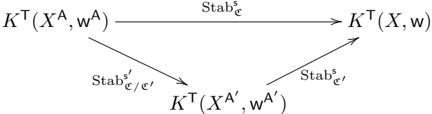
The image displays a mathematical commutative diagram, likely from a field such as algebraic topology, representation theory, or K-theory. It consists of three nodes (mathematical objects) connected by three directed arrows (morphisms or maps), forming a triangular structure. The diagram illustrates relationships between different K-theory objects parameterized by spaces (X) and weights (w), with maps labeled by stabilizer groups.
### Components/Axes
The diagram has no traditional axes or legends. Its components are:
1. **Nodes (Mathematical Objects):**
* **Top-Left Node:** \( K^{\mathbf{T}}(X^{\mathbf{A}}, \mathbf{w}^{\mathbf{A}}) \)
* **Top-Right Node:** \( K^{\mathbf{T}}(X, \mathbf{w}) \)
* **Bottom-Center Node:** \( K^{\mathbf{T}}(X^{\mathbf{A}'}, \mathbf{w}^{\mathbf{A}'}) \)
2. **Arrows (Maps/Morphisms):**
* **Top Horizontal Arrow:** Points from the top-left node to the top-right node. It is labeled above the arrow with \( \mathrm{Stab}_{\mathbf{e}}^{\mathbf{s}} \).
* **Left Diagonal Arrow:** Points from the top-left node to the bottom-center node. It is labeled to the left of the arrow with \( \mathrm{Stab}_{\mathbf{e}/\mathbf{e}'}^{\mathbf{s}'} \).
* **Right Diagonal Arrow:** Points from the bottom-center node to the top-right node. It is labeled to the right of the arrow with \( \mathrm{Stab}_{\mathbf{e}'}^{\mathbf{s}'} \).
### Detailed Analysis
* **Notation Transcription:**
* All nodes share the common form \( K^{\mathbf{T}}(\cdot, \cdot) \). The superscript **T** is bold. The arguments are pairs: a space (X) and a weight (w), both with superscripts.
* The superscripts on X and w are: **A** (top-left), none (top-right), and **A'** (bottom-center). The prime symbol (') is clearly visible.
* The map labels use the notation "Stab", likely an abbreviation for "Stabilizer". The subscripts and superscripts are:
* Top map: Subscript **e**, Superscript **s**.
* Left map: Subscript **e/e'**, Superscript **s'**.
* Right map: Subscript **e'**, Superscript **s'**.
* All letters in subscripts and superscripts (**T**, **A**, **e**, **s**, etc.) are rendered in a bold, sans-serif font, distinct from the italicized variables in the node arguments.
* **Spatial Layout & Flow:**
* The diagram is arranged in a triangular, commutative layout.
* The flow suggests a relationship where the map from the top-left node to the top-right node (\( \mathrm{Stab}_{\mathbf{e}}^{\mathbf{s}} \)) can be factored through the bottom node. One path is the direct top arrow. The alternative path is the composition of the left arrow (\( \mathrm{Stab}_{\mathbf{e}/\mathbf{e}'}^{\mathbf{s}'} \)) followed by the right arrow (\( \mathrm{Stab}_{\mathbf{e}'}^{\mathbf{s}'} \)).
* The central positioning of the bottom node and the converging arrows highlight its role as an intermediate or related object.
### Key Observations
1. **Commutative Structure:** The diagram is a classic commutative triangle. The core mathematical statement is that the composition of the left and right maps equals the top map: \( \mathrm{Stab}_{\mathbf{e}}^{\mathbf{s}} = \mathrm{Stab}_{\mathbf{e}'}^{\mathbf{s}'} \circ \mathrm{Stab}_{\mathbf{e}/\mathbf{e}'}^{\mathbf{s}'} \).
2. **Parameter Variation:** The nodes represent variations of a base object \( K^{\mathbf{T}}(X, \mathbf{w}) \). The top-left and bottom-center nodes are "primed" or "A"-modified versions, suggesting a change in the underlying space or weight data.
3. **Map Label Pattern:** The stabilizer maps are indexed by pairs of parameters (**e**, **s**). The left map's subscript **e/e'** suggests a quotient or relative relationship between the parameters **e** and **e'**. The right map uses the primed parameter **e'**. Both the left and right maps share the same superscript **s'**, indicating a common secondary parameter for this path.
### Interpretation
This diagram succinctly captures a relationship in equivariant K-theory or a related field. The objects \( K^{\mathbf{T}} \) are likely equivariant K-theory groups for a space with an action of a torus **T**. The parameters (X, w) define the specific space and possibly a weight or a line bundle.
The maps labeled "Stab" are induced by considering stabilizer subgroups. The diagram's commutativity implies a consistency condition: studying the stabilizer **e** of the original object is equivalent to first passing to a stabilizer **e/e'** for a modified object and then applying the stabilizer **e'**. This is a typical pattern in localization theorems or when comparing fixed-point sets under different group actions.
The notation is precise and dense. The use of bold for group names (**T**) and stabilizer parameters (**e**, **s**) versus italics for spaces (X) and weights (w) follows common mathematical typesetting conventions to distinguish between different types of entities. The diagram serves as a visual proof or definition of a relationship between these algebraic-topological constructions.