\n
## Diagram: Syllogism and Existential Import
### Overview
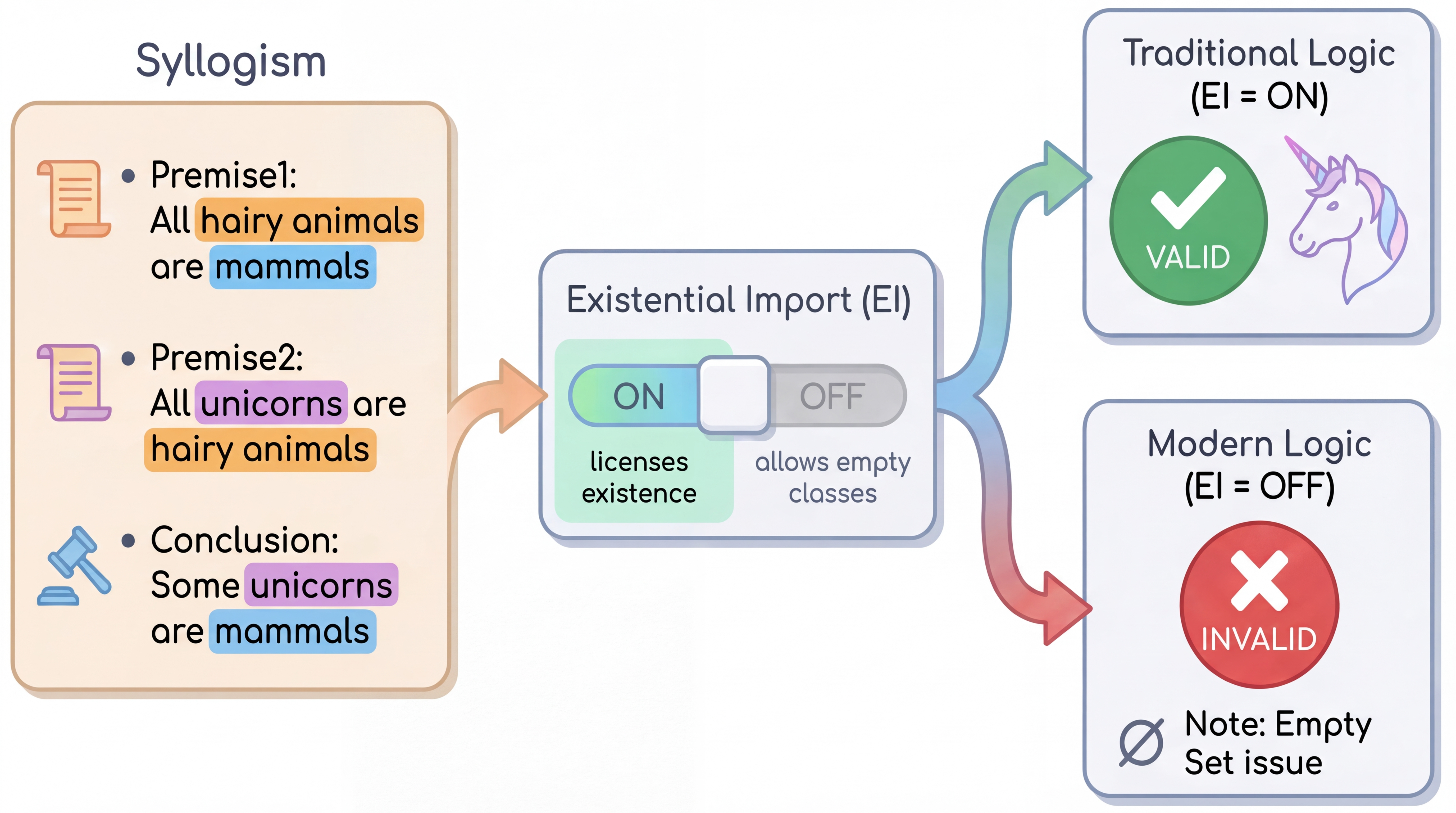
This diagram illustrates the impact of Existential Import (EI) on the validity of a syllogism. It demonstrates how a syllogism that is valid under traditional logic (EI = ON) can become invalid under modern logic (EI = OFF). The diagram uses a visual flow to show how the choice of EI setting affects the conclusion drawn from the premises.
### Components/Axes
The diagram consists of four main components:
1. **Syllogism (Peach Rectangle):** Contains the premises and conclusion of a syllogistic argument.
2. **Existential Import (EI) Switch (Light Purple Rectangle):** A toggle switch representing the setting for Existential Import, with options "ON" and "OFF".
3. **Traditional Logic (Light Green Rectangle):** Represents the outcome when EI is ON, showing a "VALID" result with a unicorn illustration.
4. **Modern Logic (Light Red Rectangle):** Represents the outcome when EI is OFF, showing an "INVALID" result with a red "X" and a note about an "Empty Set issue".
Arrows indicate the flow of logic from the syllogism to the EI switch and then to either Traditional or Modern Logic.
### Content Details
* **Syllogism:**
* Premise 1: "All hairy animals are mammals" (Text in dark blue)
* Premise 2: "All unicorns are hairy animals" (Text in dark orange)
* Conclusion: "Some unicorns are mammals" (Text in dark purple)
* **Existential Import (EI):**
* ON: "licenses existence" (Text in dark green)
* OFF: "allows empty classes" (Text in dark red)
* **Traditional Logic (EI = ON):**
* Status: "VALID" (Text in dark green)
* Illustration: A white unicorn head.
* **Modern Logic (EI = OFF):**
* Status: "INVALID" (Text in dark red)
* Note: "Empty Set issue" (Text in black)
The arrows are colored to indicate the flow:
* Syllogism to EI Switch: Light orange arrow.
* EI Switch to Traditional Logic: Light green arrow.
* EI Switch to Modern Logic: Light red arrow.
### Key Observations
The diagram highlights a critical difference between traditional and modern logic. Traditional logic assumes that terms in a syllogism refer to existing entities (EI = ON). Modern logic allows for the possibility of empty classes (EI = OFF), meaning a term can refer to nothing. The syllogism presented is valid under traditional logic because it assumes unicorns exist. However, it becomes invalid under modern logic because the class of "unicorns" could be empty, rendering the conclusion "Some unicorns are mammals" false.
### Interpretation
This diagram demonstrates a fundamental shift in logical reasoning. The introduction of modern logic and the rejection of Existential Import necessitate a more cautious approach to syllogistic arguments. The diagram illustrates that the validity of a syllogism is not solely determined by its structure but also by the underlying assumptions about the existence of the entities involved. The "Empty Set issue" note is crucial; it points to the core problem: if there are no unicorns, the premises can be true while the conclusion is false. This has significant implications for formal reasoning and the interpretation of logical arguments in various fields, including mathematics, philosophy, and computer science. The use of color-coding and visual flow effectively conveys the relationship between the different components and the impact of EI on the syllogism's validity.