## Bar Chart: The Accuracy of Different Operation Sets
### Overview
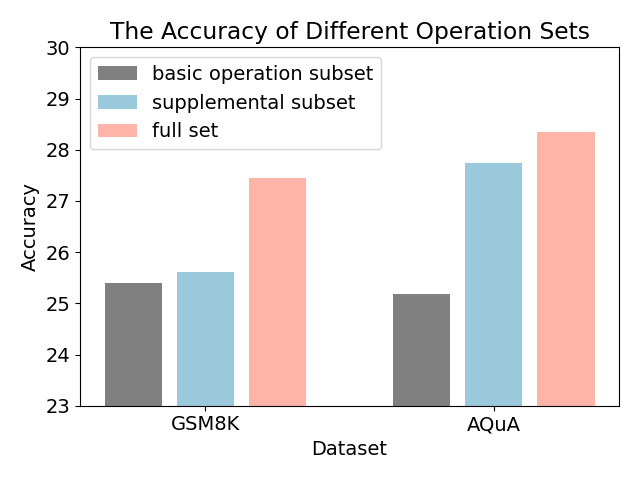
The chart compares the accuracy of three operation sets ("basic operation subset," "supplemental subset," and "full set") across two datasets ("GSM8K" and "AQuA"). Accuracy is measured on a scale from 23 to 30, with the "full set" consistently achieving the highest performance.
### Components/Axes
- **X-axis (Dataset)**: Two categories: "GSM8K" (left) and "AQuA" (right).
- **Y-axis (Accuracy)**: Numerical scale from 23 to 30, labeled "Accuracy."
- **Legend**:
- Gray: "basic operation subset"
- Blue: "supplemental subset"
- Orange: "full set"
- **Bar Groups**: Each dataset has three adjacent bars corresponding to the three operation sets.
### Detailed Analysis
- **GSM8K Dataset**:
- Basic operation subset: ~25.3 (gray bar)
- Supplemental subset: ~25.6 (blue bar)
- Full set: ~27.5 (orange bar)
- **AQuA Dataset**:
- Basic operation subset: ~25.1 (gray bar)
- Supplemental subset: ~27.7 (blue bar)
- Full set: ~28.3 (orange bar)
### Key Observations
1. The "full set" operation achieves the highest accuracy in both datasets, with a ~2.2-point advantage over the "supplemental subset" in GSM8K and a ~0.6-point advantage in AQuA.
2. The "supplemental subset" outperforms the "basic operation subset" in both datasets (~0.3 points in GSM8K, ~2.1 points in AQuA).
3. AQuA shows higher overall accuracy than GSM8K for all operation sets, with the largest gap in the "supplemental subset" (~2.1 points).
### Interpretation
The data suggests that expanding the operation set from "basic" to "full" significantly improves accuracy, particularly in the AQuA dataset. The "supplemental subset" bridges much of the performance gap between basic and full sets, indicating that additional operations contribute meaningfully to results. The consistent superiority of the "full set" implies that comprehensive operation coverage is critical for high-accuracy performance, with AQuA's complexity potentially amplifying this effect. The smaller improvement from "supplemental" to "full" in AQuA (~0.6 points) versus GSM8K (~2.2 points) may reflect diminishing returns in more complex tasks or dataset-specific operational efficiencies.