## Screenshot: Lean Theorem Proof in Proof Assistant
### Overview
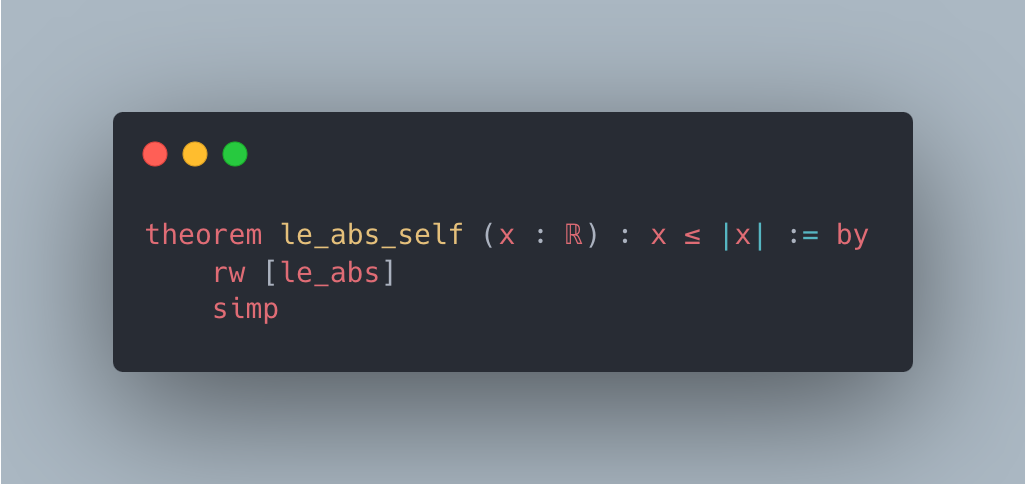
The image shows a code snippet from a proof assistant environment (likely Lean 4) displaying a theorem declaration and its proof. The code is syntax-highlighted with color-coded elements, and the window interface includes standard control buttons.
### Components/Axes
- **Window Controls**: Top-left corner contains three circular buttons:
- Red (close)
- Yellow (minimize)
- Green (maximize)
- **Code Structure**:
- **Theorem Declaration**: `theorem le_abs_self (x : R) : x ≤ |x| := by`
- **Proof Steps**:
- `rw [le_abs]`
- `simp`
### Detailed Analysis
- **Theorem Name**: `le_abs_self` (likely short for "less than or equal to absolute value self")
- **Parameters**: `(x : R)` declares `x` as a real number (`R`).
- **Type Annotations**:
- `x ≤ |x|` asserts that `x` is less than or equal to its absolute value.
- `|x|` denotes the absolute value of `x`.
- **Proof Strategy**:
- `by` introduces a proof block.
- `rw [le_abs]` applies the `le_abs` lemma (likely a built-in or previously defined lemma about absolute values).
- `simp` simplifies the goal using available simplifications.
### Key Observations
- The theorem states a fundamental property of absolute values: for any real number `x`, `x` is bounded above by its absolute value.
- The proof uses two steps:
1. **Rewrite**: Invokes `le_abs` to establish the inequality.
2. **Simplification**: Finalizes the proof with `simp`.
### Interpretation
This code demonstrates a basic property of absolute values in real numbers. The theorem `le_abs_self` formalizes the intuition that no real number exceeds its absolute value. The proof leverages the `le_abs` lemma (a standard result in real analysis) and simplification tactics common in proof assistants. The use of `rw` (rewrite) and `simp` reflects the declarative nature of proof assistants, where proofs are constructed by applying logical rules and simplifications rather than step-by-step computation. The absence of numerical data or visualizations emphasizes the formal, symbolic nature of the proof.