## Bar Chart: Sound Localization and Matching Accuracy
### Overview
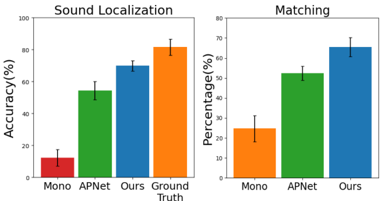
The image presents two bar charts comparing the performance of different methods (Mono, APNet, Ours) against Ground Truth in Sound Localization and Matching tasks. The charts display accuracy and percentage metrics, respectively, with error bars indicating variability.
### Components/Axes
**Left Chart (Sound Localization):**
* **Title:** Sound Localization
* **Y-axis:** Accuracy (%)
* Scale: 0 to 100
* **X-axis:** Methods (Mono, APNet, Ours, Ground Truth)
* **Bars:**
* Mono (Red)
* APNet (Green)
* Ours (Blue)
* Ground Truth (Orange)
**Right Chart (Matching):**
* **Title:** Matching
* **Y-axis:** Percentage (%)
* Scale: 0 to 80
* **X-axis:** Methods (Mono, APNet, Ours)
* **Bars:**
* Mono (Orange)
* APNet (Green)
* Ours (Blue)
### Detailed Analysis
**Left Chart (Sound Localization):**
* **Mono (Red):** Accuracy is approximately 13% with an error bar extending from roughly 10% to 16%.
* **APNet (Green):** Accuracy is approximately 55% with an error bar extending from roughly 50% to 60%.
* **Ours (Blue):** Accuracy is approximately 70% with an error bar extending from roughly 67% to 73%.
* **Ground Truth (Orange):** Accuracy is approximately 82% with an error bar extending from roughly 79% to 85%.
**Right Chart (Matching):**
* **Mono (Orange):** Percentage is approximately 25% with an error bar extending from roughly 20% to 30%.
* **APNet (Green):** Percentage is approximately 52% with an error bar extending from roughly 49% to 55%.
* **Ours (Blue):** Percentage is approximately 65% with an error bar extending from roughly 62% to 68%.
### Key Observations
* In Sound Localization, Ground Truth achieves the highest accuracy, followed by "Ours," APNet, and Mono.
* In Matching, "Ours" achieves the highest percentage, followed by APNet and Mono.
* The "Ours" method consistently outperforms Mono and APNet in both tasks.
* Error bars suggest some variability in the results, but the overall trends are clear.
### Interpretation
The data suggests that the "Ours" method is a significant improvement over Mono and APNet for both Sound Localization and Matching tasks. While "Ours" does not reach the performance of Ground Truth in Sound Localization, it demonstrates a substantial increase in accuracy compared to the other methods. The error bars indicate that the observed differences are likely statistically significant. The charts highlight the effectiveness of the "Ours" method in these specific tasks.