\n
## Bar Charts: Sound Localization and Matching Performance
### Overview
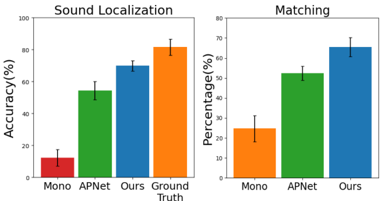
The image presents two bar charts side-by-side. The left chart displays "Sound Localization" accuracy in percentage, comparing different methods: Mono, APNet, Ours, and Ground Truth. The right chart shows "Matching" performance in percentage, comparing Mono, APNet, and Ours. Each bar includes error bars representing variance.
### Components/Axes
**Left Chart (Sound Localization):**
* **Title:** Sound Localization
* **X-axis Label:** Methods (Mono, APNet, Ours, Ground Truth)
* **Y-axis Label:** Accuracy (%)
* **Y-axis Scale:** 0 to 100, with increments of 10.
**Right Chart (Matching):**
* **Title:** Matching
* **X-axis Label:** Methods (Mono, APNet, Ours)
* **Y-axis Label:** Percentage (%)
* **Y-axis Scale:** 0 to 90, with increments of 10.
### Detailed Analysis or Content Details
**Sound Localization Chart:**
* **Mono:** The bar is red, and its height is approximately 15% ± 5%. The bar slopes upward.
* **APNet:** The bar is green, and its height is approximately 52% ± 5%. The bar slopes upward.
* **Ours:** The bar is blue, and its height is approximately 68% ± 5%. The bar slopes upward.
* **Ground Truth:** The bar is orange, and its height is approximately 82% ± 5%. The bar slopes upward.
**Matching Chart:**
* **Mono:** The bar is red, and its height is approximately 25% ± 5%. The bar slopes upward.
* **APNet:** The bar is green, and its height is approximately 62% ± 5%. The bar slopes upward.
* **Ours:** The bar is blue, and its height is approximately 74% ± 5%. The bar slopes upward.
### Key Observations
* In both charts, the "Ours" method consistently outperforms "Mono" and "APNet".
* The "Ground Truth" in the Sound Localization chart represents the highest achievable accuracy.
* The error bars suggest some variability in the results for each method.
* The performance gap between "Mono" and the other methods is substantial.
### Interpretation
The data suggests that the proposed method ("Ours") significantly improves both sound localization accuracy and matching performance compared to the baseline methods ("Mono" and "APNet"). The "Ground Truth" serves as an upper bound for sound localization accuracy, indicating that there is still room for improvement even with the "Ours" method. The consistent upward trend of the bars indicates a clear positive correlation between the method and the performance metric. The error bars indicate that the results are not deterministic, and there is some variance in the performance of each method. The large difference between "Mono" and the other methods suggests that the improvements made in "APNet" and "Ours" are substantial and meaningful. The two charts are related in that they both evaluate the performance of the same methods, but on different tasks (sound localization and matching). This suggests that the "Ours" method is generally effective for both tasks.