## Line Chart: Model Accuracy on Math Problems
### Overview
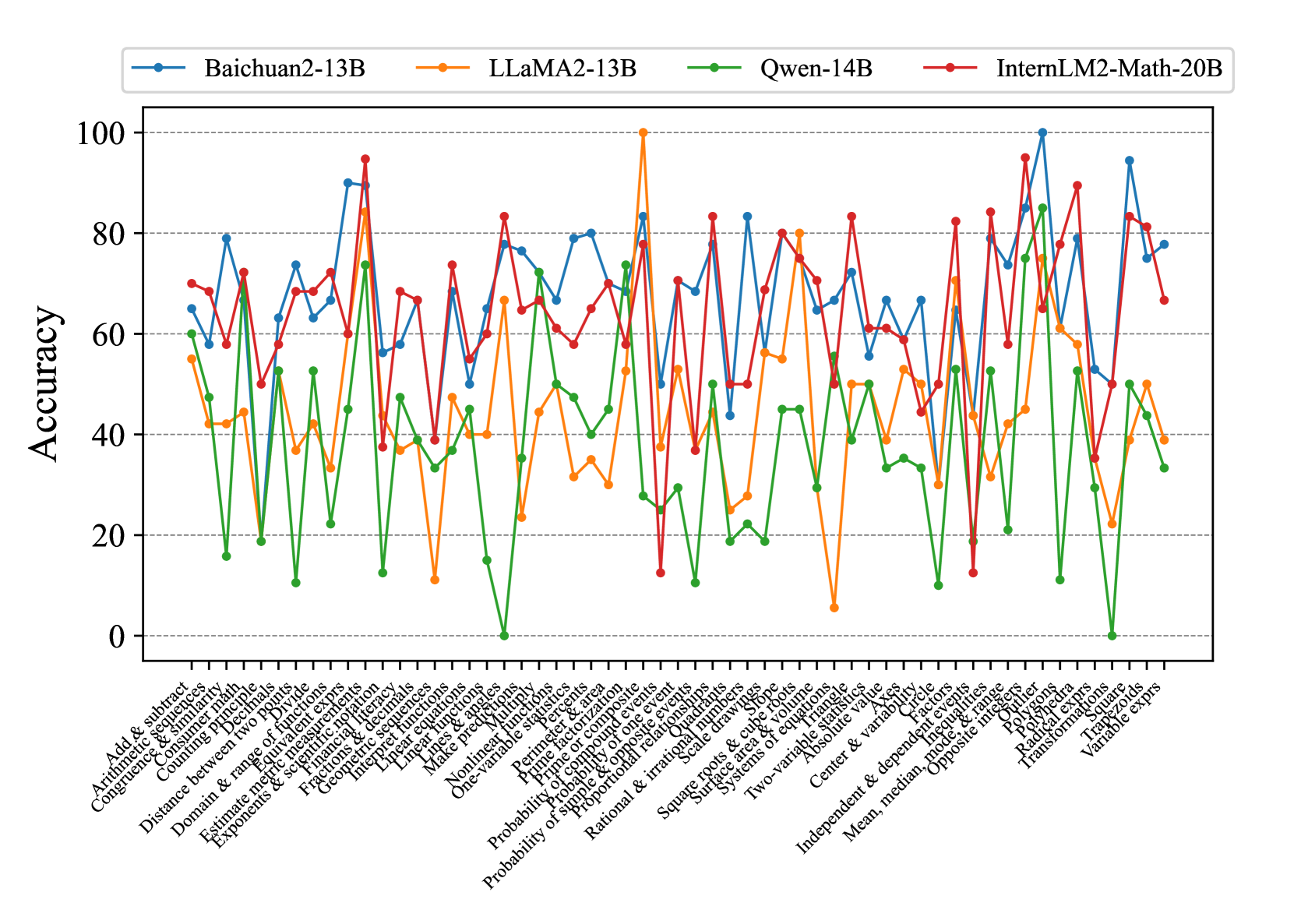
The image is a line chart comparing the accuracy of four different language models (Baichuan2-13B, LLaMA2-13B, Qwen-14B, and InternLM2-Math-20B) on a variety of mathematical problem types. The x-axis represents the problem types, and the y-axis represents the accuracy score.
### Components/Axes
* **Title:** (None visible)
* **X-axis:** Mathematical problem types (listed below in "Content Details")
* **Y-axis:** Accuracy, ranging from 0 to 100, with gridlines at intervals of 20.
* **Legend:** Located at the top of the chart.
* Blue: Baichuan2-13B
* Orange: LLaMA2-13B
* Green: Qwen-14B
* Red: InternLM2-Math-20B
### Content Details
**X-Axis Categories (Problem Types):**
1. Add & subtract
2. Arithmetic sequences
3. Congruence & similarity
4. Consumer math
5. Counting principle
6. Distance between two points
7. Domain & range of functions
8. Equivalent expressions
9. Estimate metric measurements
10. Exponents & scientific notation
11. Financial literacy
12. Fractions & decimals
13. Geometric sequences
14. Interpret functions
15. Linear equations
16. Linear functions
17. Make predictions
18. Multiply
19. Nonlinear functions
20. One-variable statistics
21. Percents
22. Perimeter & area
23. Prime factorization
24. Prime or composite
25. Probability of compound events
26. Probability of simple & opposite events
27. Proportional relationships
28. Quadrants
29. Rational & irrational numbers
30. Scale drawings
31. Square roots & cube roots
32. Surface area & volume
33. Systems of equations
34. Triangle
35. Two-variable statistics
36. Absolute value
37. Axes
38. Center & variability
39. Factors
40. Independent & dependent events
41. Mean, median, mode & range
42. Opposite integers
43. Outlier
44. Polygons
45. Polyhedra
46. Radical exprs
47. Square
48. Transformations
49. Trapezoids
50. Variable exprs
**Data Series Trends and Approximate Values:**
* **Baichuan2-13B (Blue):** The line fluctuates, generally staying between 60 and 80 accuracy, with a peak near 100 around problem 47 (Square).
* Problem 1 (Add & subtract): ~70
* Problem 10 (Exponents & scientific notation): ~72
* Problem 20 (One-variable statistics): ~75
* Problem 30 (Scale drawings): ~80
* Problem 40 (Independent & dependent events): ~60
* Problem 47 (Square): ~98
* Problem 50 (Variable exprs): ~78
* **LLaMA2-13B (Orange):** The line fluctuates significantly, with lows around 20 and highs near 90.
* Problem 1 (Add & subtract): ~60
* Problem 10 (Exponents & scientific notation): ~65
* Problem 20 (One-variable statistics): ~70
* Problem 30 (Scale drawings): ~50
* Problem 40 (Independent & dependent events): ~40
* Problem 47 (Square): ~50
* Problem 50 (Variable exprs): ~68
* **Qwen-14B (Green):** The line generally stays between 20 and 60 accuracy, with some peaks and valleys.
* Problem 1 (Add & subtract): ~58
* Problem 10 (Exponents & scientific notation): ~42
* Problem 20 (One-variable statistics): ~48
* Problem 30 (Scale drawings): ~40
* Problem 40 (Independent & dependent events): ~35
* Problem 47 (Square): ~70
* Problem 50 (Variable exprs): ~40
* **InternLM2-Math-20B (Red):** The line fluctuates significantly, with lows around 20 and highs near 100.
* Problem 1 (Add & subtract): ~70
* Problem 10 (Exponents & scientific notation): ~75
* Problem 20 (One-variable statistics): ~70
* Problem 30 (Scale drawings): ~80
* Problem 40 (Independent & dependent events): ~50
* Problem 47 (Square): ~80
* Problem 50 (Variable exprs): ~68
### Key Observations
* InternLM2-Math-20B and Baichuan2-13B generally perform better than LLaMA2-13B and Qwen-14B across most problem types.
* All models show significant variation in accuracy depending on the problem type.
* There are specific problem types where certain models excel or struggle. For example, Qwen-14B has particularly low accuracy on some problem types.
* Baichuan2-13B has a peak accuracy on "Square" problems.
### Interpretation
The chart illustrates the varying strengths and weaknesses of different language models when applied to mathematical problem-solving. The performance differences highlight the impact of model architecture, training data, and fine-tuning strategies on mathematical reasoning capabilities. The significant fluctuations in accuracy across different problem types suggest that each model has specific areas of expertise and difficulty. The data suggests that no single model consistently outperforms the others across all mathematical domains, indicating the need for specialized models or ensemble approaches for comprehensive mathematical problem-solving. The "Square" problem type being a high point for Baichuan2-13B could indicate a specific emphasis or strength in that area during training.