## Chart Type: Line Graphs Comparing Model Performance
### Overview
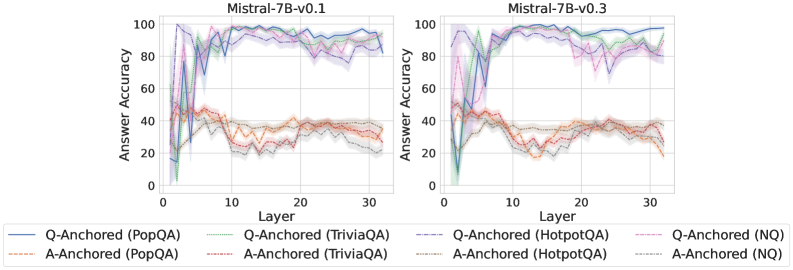
The image presents two line graphs comparing the performance of two versions of the Mistral-7B model (v0.1 and v0.3) on various question-answering datasets. The graphs depict the "Answer Accuracy" as a function of "Layer" for different question-answering tasks, distinguished by whether the question (Q-Anchored) or answer (A-Anchored) is used for anchoring. Each graph shows the performance on PopQA, TriviaQA, HotpotQA, and NQ datasets. The shaded regions around the lines likely represent the standard deviation or confidence intervals.
### Components/Axes
* **Titles:**
* Left Graph: "Mistral-7B-v0.1"
* Right Graph: "Mistral-7B-v0.3"
* **Y-Axis:** "Answer Accuracy" ranging from 0 to 100, with tick marks at 0, 20, 40, 60, 80, and 100.
* **X-Axis:** "Layer" ranging from 0 to 30, with tick marks every 5 layers (0, 10, 20, 30).
* **Legend:** Located at the bottom of the image, mapping line styles and colors to specific datasets and anchoring methods:
* Blue solid line: Q-Anchored (PopQA)
* Tan dashed line: A-Anchored (PopQA)
* Green dotted line: Q-Anchored (TriviaQA)
* Tan dotted line: A-Anchored (TriviaQA)
* Green dashed line: Q-Anchored (HotpotQA)
* Tan solid line: A-Anchored (HotpotQA)
* Purple dashed line: Q-Anchored (NQ)
* Gray dotted line: A-Anchored (NQ)
### Detailed Analysis
**Left Graph: Mistral-7B-v0.1**
* **Q-Anchored (PopQA) - Blue solid line:** Starts around 10% accuracy at layer 0, rapidly increases to approximately 90% by layer 5, and then fluctuates between 85% and 100% for the remaining layers.
* **A-Anchored (PopQA) - Tan dashed line:** Starts around 40% accuracy at layer 0, fluctuates between 30% and 50% until layer 10, and then gradually decreases to around 30% by layer 30.
* **Q-Anchored (TriviaQA) - Green dotted line:** Starts around 10% accuracy at layer 0, rapidly increases to approximately 90% by layer 5, and then fluctuates between 80% and 100% for the remaining layers.
* **A-Anchored (TriviaQA) - Tan dotted line:** Starts around 40% accuracy at layer 0, fluctuates between 30% and 50% until layer 10, and then gradually decreases to around 30% by layer 30.
* **Q-Anchored (HotpotQA) - Green dashed line:** Starts around 10% accuracy at layer 0, rapidly increases to approximately 90% by layer 5, and then fluctuates between 80% and 100% for the remaining layers.
* **A-Anchored (HotpotQA) - Tan solid line:** Starts around 40% accuracy at layer 0, fluctuates between 30% and 50% until layer 10, and then gradually decreases to around 30% by layer 30.
* **Q-Anchored (NQ) - Purple dashed line:** Starts around 10% accuracy at layer 0, rapidly increases to approximately 90% by layer 5, and then fluctuates between 80% and 100% for the remaining layers.
* **A-Anchored (NQ) - Gray dotted line:** Starts around 40% accuracy at layer 0, fluctuates between 30% and 50% until layer 10, and then gradually decreases to around 30% by layer 30.
**Right Graph: Mistral-7B-v0.3**
* **Q-Anchored (PopQA) - Blue solid line:** Starts around 10% accuracy at layer 0, rapidly increases to approximately 90% by layer 5, and then fluctuates between 85% and 100% for the remaining layers.
* **A-Anchored (PopQA) - Tan dashed line:** Starts around 40% accuracy at layer 0, fluctuates between 30% and 50% until layer 10, and then gradually decreases to around 30% by layer 30.
* **Q-Anchored (TriviaQA) - Green dotted line:** Starts around 10% accuracy at layer 0, rapidly increases to approximately 90% by layer 5, and then fluctuates between 80% and 100% for the remaining layers.
* **A-Anchored (TriviaQA) - Tan dotted line:** Starts around 40% accuracy at layer 0, fluctuates between 30% and 50% until layer 10, and then gradually decreases to around 30% by layer 30.
* **Q-Anchored (HotpotQA) - Green dashed line:** Starts around 10% accuracy at layer 0, rapidly increases to approximately 90% by layer 5, and then fluctuates between 80% and 100% for the remaining layers.
* **A-Anchored (HotpotQA) - Tan solid line:** Starts around 40% accuracy at layer 0, fluctuates between 30% and 50% until layer 10, and then gradually decreases to around 30% by layer 30.
* **Q-Anchored (NQ) - Purple dashed line:** Starts around 10% accuracy at layer 0, rapidly increases to approximately 90% by layer 5, and then fluctuates between 80% and 100% for the remaining layers.
* **A-Anchored (NQ) - Gray dotted line:** Starts around 40% accuracy at layer 0, fluctuates between 30% and 50% until layer 10, and then gradually decreases to around 30% by layer 30.
### Key Observations
* **Q-Anchored vs. A-Anchored:** Q-Anchored methods consistently outperform A-Anchored methods across all datasets and both model versions.
* **Rapid Initial Learning:** All Q-Anchored methods show a rapid increase in accuracy within the first 5 layers.
* **Performance Plateau:** After the initial increase, the Q-Anchored methods plateau and fluctuate within a relatively narrow range.
* **Model Version Similarity:** The performance of Mistral-7B-v0.1 and Mistral-7B-v0.3 is very similar across all datasets and anchoring methods.
* **A-Anchored Decline:** The A-Anchored methods show a gradual decline in accuracy after the initial layers.
### Interpretation
The data suggests that anchoring on the question (Q-Anchored) is significantly more effective than anchoring on the answer (A-Anchored) for these question-answering tasks. This could be because the question provides more relevant context for the model to learn from. The rapid initial learning of the Q-Anchored methods indicates that the model quickly identifies and utilizes the information in the question. The plateau in performance suggests that there may be a limit to how much the model can learn from the question alone, or that further training is needed to improve performance. The similarity in performance between the two model versions suggests that the changes between v0.1 and v0.3 did not significantly impact the model's ability to perform these tasks. The decline in A-Anchored performance after the initial layers could be due to the model overfitting to the answer or failing to generalize to new examples.