## Diagram: Knot Theory Transformations
### Overview
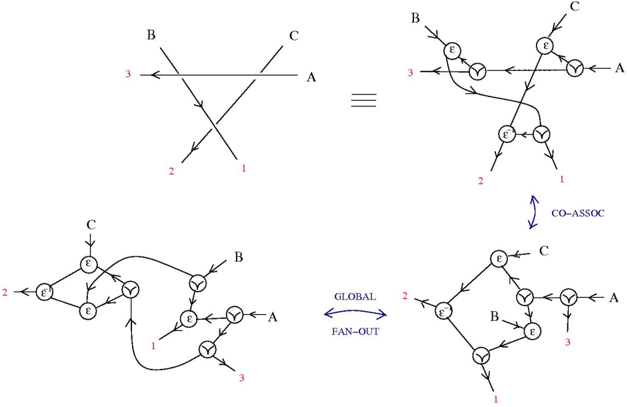
The image presents a series of diagrams illustrating transformations in knot theory. It shows how a basic knot configuration can be represented and manipulated using diagrammatic representations involving vertices, edges, and specific operators. The transformations are labeled with terms like "CO-ASSOC" and "GLOBAL FAN-OUT," indicating different types of algebraic manipulations.
### Components/Axes
* **Diagrams:** Four separate diagrams arranged in a 2x2 grid.
* **Lines/Edges:** Represent strands of the knot, with arrows indicating direction.
* **Vertices:** Represented by circles, some containing the symbol "ε" or "Y".
* **Labels:** Letters A, B, and C, and numbers 1, 2, and 3, labeling the strands.
* **Operators:** "CO-ASSOC" and "GLOBAL FAN-OUT" indicate transformations between diagrams.
* **Equality:** The "≡" symbol indicates equivalence between the initial knot diagram and its first transformation.
### Detailed Analysis
**Top-Left Diagram:**
* A basic knot diagram with three strands labeled A, B, and C.
* Strand B crosses over strand A, and strand C crosses under strand A.
* Strands are also labeled with numbers 1, 2, and 3.
**Top-Right Diagram:**
* Represents the first transformation of the knot diagram.
* The crossing points are replaced with vertices containing "Y" symbols.
* Additional vertices containing "ε" symbols are introduced.
* The strands are still labeled A, B, and C, and numbered 1, 2, and 3.
**Bottom-Left Diagram:**
* Represents a further transformation of the knot diagram.
* The diagram has been rearranged, and the vertices are connected differently.
* The strands are still labeled A, B, and C, and numbered 1, 2, and 3.
**Bottom-Right Diagram:**
* Represents the final transformation of the knot diagram.
* The diagram has been further rearranged, forming a more symmetrical structure.
* The strands are still labeled A, B, and C, and numbered 1, 2, and 3.
**Operators:**
* "CO-ASSOC": A double-headed arrow between the top-right and bottom-right diagrams, indicating a co-associativity transformation.
* "GLOBAL FAN-OUT": A double-headed arrow between the bottom-left and bottom-right diagrams, indicating a global fan-out transformation.
### Key Observations
* The diagrams illustrate how a knot can be represented and manipulated using algebraic transformations.
* The vertices containing "ε" and "Y" symbols likely represent specific operators in the algebraic representation of the knot.
* The "CO-ASSOC" and "GLOBAL FAN-OUT" operators indicate different types of algebraic manipulations.
* The labels A, B, C, 1, 2, and 3 are consistently maintained throughout the transformations, indicating the preservation of strand identity.
### Interpretation
The image demonstrates a series of transformations applied to a knot diagram, likely within the context of knot theory or related mathematical fields. The transformations, labeled "CO-ASSOC" and "GLOBAL FAN-OUT," suggest algebraic manipulations that preserve the fundamental properties of the knot while altering its diagrammatic representation. The use of vertices with "ε" and "Y" symbols hints at a specific algebraic formalism being employed. The overall process illustrates how complex knot structures can be analyzed and simplified through diagrammatic and algebraic techniques.