## Diagram: Geometric Pattern Sequence
### Overview
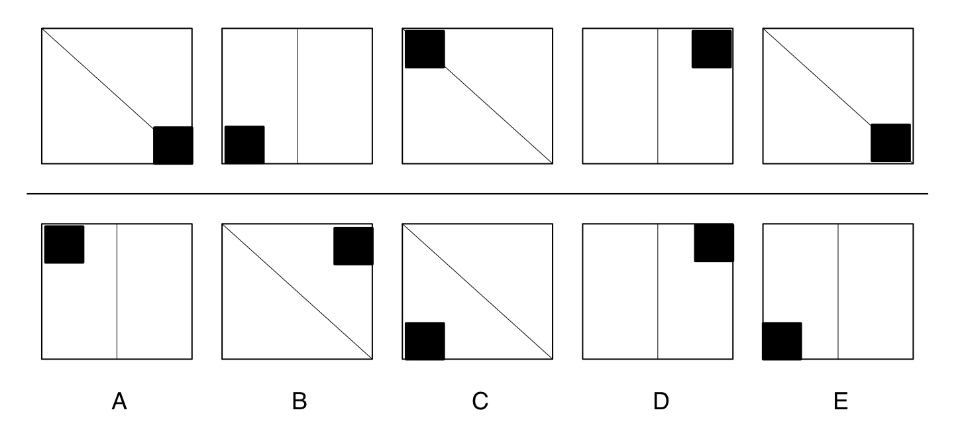
The image displays a diagram consisting of two horizontal rows of squares. Each row contains five squares arranged side-by-side. The top row is unlabeled, while the bottom row has the letters A, B, C, D, and E centered beneath each respective square. Each square contains a combination of a line (either diagonal or vertical) and a solid black square positioned in one of the corners. The diagram appears to be a visual pattern or logic puzzle, likely testing spatial reasoning or sequence identification.
### Components/Axes
* **Structure:** Two rows of five squares each.
* **Labels:** The bottom row squares are labeled with uppercase letters: **A, B, C, D, E**.
* **Internal Elements:**
* **Lines:** Each square contains a single line. Most are diagonal lines running from the top-left corner to the bottom-right corner. Two squares (the second and fourth in the top row, and the fourth in the bottom row) contain a vertical line dividing the square in half.
* **Black Squares:** Each square contains one solid black square, positioned in one of the four corners (top-left, top-right, bottom-left, bottom-right).
### Detailed Analysis
**Top Row (Left to Right):**
1. **Square 1:** Diagonal line (top-left to bottom-right). Black square in the **bottom-right** corner.
2. **Square 2:** Vertical line (center). Black square in the **bottom-left** corner.
3. **Square 3:** Diagonal line (top-left to bottom-right). Black square in the **top-left** corner.
4. **Square 4:** Vertical line (center). Black square in the **top-right** corner.
5. **Square 5:** Diagonal line (top-left to bottom-right). Black square in the **bottom-right** corner.
**Bottom Row (Labeled A-E):**
* **A:** Vertical line (center). Black square in the **top-left** corner.
* **B:** Diagonal line (top-left to bottom-right). Black square in the **top-right** corner.
* **C:** Diagonal line (top-left to bottom-right). Black square in the **bottom-left** corner.
* **D:** Vertical line (center). Black square in the **top-right** corner.
* **E:** Vertical line (center). Black square in the **bottom-left** corner.
### Key Observations
1. **Line Pattern:** The sequence of line types in the top row is: Diagonal, Vertical, Diagonal, Vertical, Diagonal. This creates an alternating pattern.
2. **Black Square Movement (Top Row):** The black square's position changes in a specific sequence: Bottom-Right -> Bottom-Left -> Top-Left -> Top-Right -> Bottom-Right. This represents a clockwise rotation around the corners of the square.
3. **Relationship Between Rows:** The bottom row (A-E) does not appear to be a direct continuation of the top row's sequence. Instead, it presents five distinct configurations. Squares A, D, and E have vertical lines, while B and C have diagonal lines.
4. **Repetition:** The configuration of Top Row Square 1 (Diagonal, Bottom-Right) is identical to that of Top Row Square 5. The configuration of Bottom Row Square D (Vertical, Top-Right) is identical to that of Top Row Square 4.
### Interpretation
This diagram is most likely a **non-verbal reasoning or abstract reasoning test item**. The top row establishes a clear, logical pattern governed by two rules:
* **Rule 1 (Lines):** The line type alternates between diagonal and vertical.
* **Rule 2 (Black Square):** The black square moves one corner clockwise with each step.
The bottom row (A-E) likely presents a set of answer choices. The task would be to identify which of the five squares (A-E) correctly continues the sequence established in the top row. Based on the established patterns:
* The next line type after the fifth square (Diagonal) should be **Vertical**.
* The next black square position after the fifth square (Bottom-Right) should be **Bottom-Left** (moving clockwise).
Therefore, the correct continuation would be a square with a **vertical line** and a **black square in the bottom-left corner**. Examining the options:
* **A:** Vertical, Top-Left (Incorrect position)
* **B:** Diagonal, Top-Right (Incorrect line and position)
* **C:** Diagonal, Bottom-Left (Incorrect line)
* **D:** Vertical, Top-Right (Incorrect position)
* **E:** Vertical, Bottom-Left (**Matches both predicted rules**)
Thus, **Square E** is the logical next element in the sequence. The diagram tests the ability to isolate and apply multiple, concurrent visual rules.