\n
## Diagram: Knowledge Graph Construction from Cloze Questions
### Overview
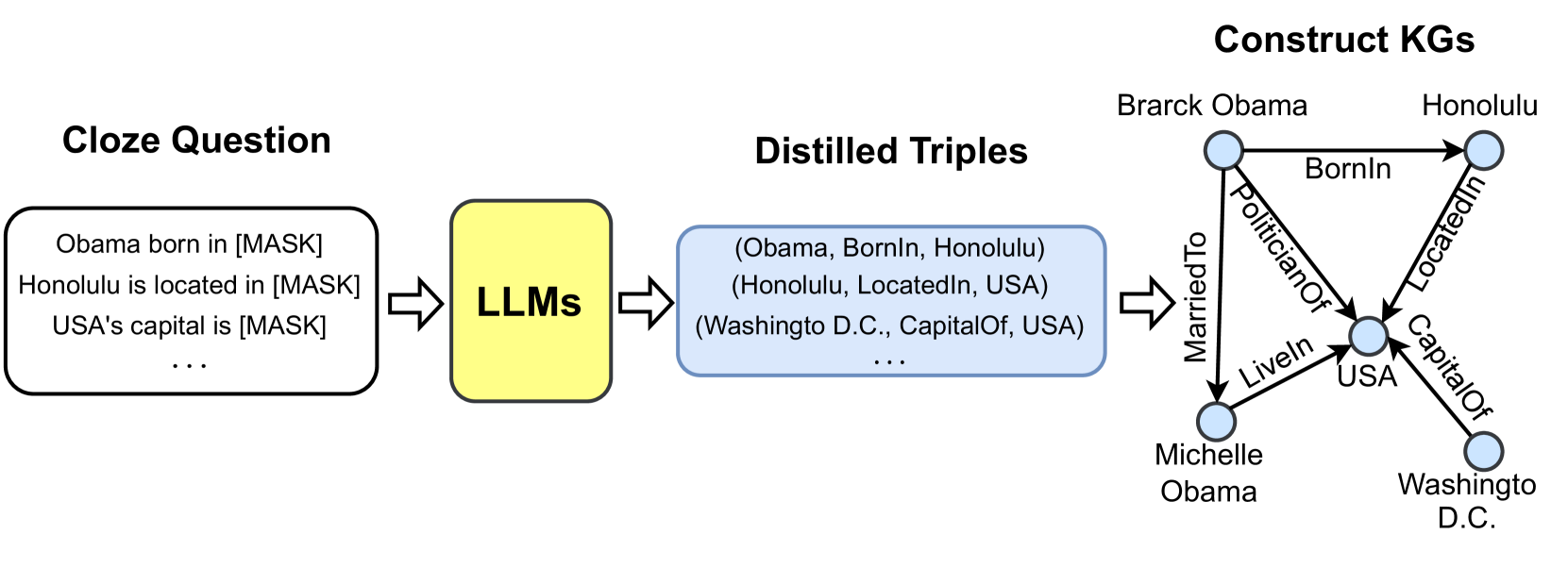
This diagram illustrates a process for constructing Knowledge Graphs (KGs) from Cloze questions using Large Language Models (LLMs). The process involves feeding Cloze questions to LLMs, distilling triples from the LLM output, and then constructing a Knowledge Graph based on these triples.
### Components/Axes
The diagram is divided into three main sections, arranged horizontally from left to right:
1. **Cloze Question:** Presents example Cloze questions with "[MASK]" placeholders.
2. **Distilled Triples:** Shows the output of the LLM as a list of subject-predicate-object triples.
3. **Construct KGs:** Displays a visual representation of the constructed Knowledge Graph.
### Detailed Analysis or Content Details
**Cloze Question Section:**
* Example questions include:
* "Obama born in [MASK]"
* "Honolulu is located in [MASK]"
* "USA's capital is [MASK]"
* "... " (indicating more questions exist)
**Distilled Triples Section:**
* The section lists triples extracted from the LLM's responses to the Cloze questions.
* Triples include:
* (Obama, BornIn, Honolulu)
* (Honolulu, LocatedIn, USA)
* (Washington D.C., CapitalOf, USA)
* "... " (indicating more triples exist)
**Construct KGs Section:**
* The Knowledge Graph is represented as a network of nodes and directed edges.
* **Nodes:** Represent entities such as "Barack Obama", "Honolulu", "Michelle Obama", "USA", and "Washington D.C.".
* **Edges:** Represent relationships between entities, labeled with predicates like "BornIn", "LocatedIn", "CapitalOf", "MarriedTo", "PoliticianOf", and "LiveIn".
* **Specific Relationships:**
* Barack Obama –BornIn→ Honolulu
* Barack Obama –PoliticianOf→ USA
* Barack Obama –MarriedTo→ Michelle Obama
* Honolulu –LocatedIn→ USA
* Washington D.C. –CapitalOf→ USA
* Michelle Obama –LiveIn→ USA
### Key Observations
* The diagram demonstrates a pipeline for converting natural language questions into structured knowledge.
* The LLM acts as a crucial component in extracting relational information from the Cloze questions.
* The Knowledge Graph visually represents the relationships between entities, providing a structured representation of the information.
* The diagram uses a simple example with a limited number of entities and relationships, but the "..." notation suggests the process can be scaled to larger datasets.
### Interpretation
The diagram illustrates a method for knowledge extraction and representation using LLMs. The process begins with Cloze questions, which are designed to elicit specific factual information. The LLM processes these questions and extracts relational triples, which form the basis of the Knowledge Graph. The Knowledge Graph provides a structured and machine-readable representation of the knowledge contained in the original questions. This approach is valuable for tasks such as question answering, reasoning, and knowledge discovery. The use of Cloze questions is a clever way to focus the LLM on specific relationships, potentially improving the accuracy and efficiency of the knowledge extraction process. The diagram suggests a potential solution for automating the construction of Knowledge Graphs from textual data, which is a significant challenge in the field of Artificial Intelligence.