## Diagram: Categorical Symbol Grid
### Overview
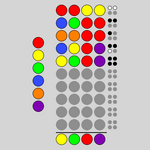
The image displays a structured grid of colored circles (dots) arranged in a pattern against a light gray background. There are no traditional chart axes, titles, legends, or numerical data. The composition appears to be a symbolic or categorical representation, possibly a code, a visual key, or an abstract data visualization where color and position convey meaning. No textual information is present in the image.
### Components/Axes
* **Primary Elements:** Colored circles (dots). Colors observed: Red, Yellow, Blue, Green, Orange, Purple, and Gray.
* **Arrangement:** The circles are organized in a grid-like structure with 7 columns. The number of rows varies by column.
* **Fill Styles:** Circles exhibit different fill styles:
* Solid fill (e.g., top-left red circle).
* Outline only (e.g., some gray circles in the lower section).
* Filled with a pattern of small black dots (e.g., the rightmost column).
* **Spatial Layout:**
* **Top Row (Row 1):** Contains 3 circles in columns 1-3: Red, Yellow, Blue.
* **Main Body (Rows 2-8):** A dense 7x7 grid of circles. The first six columns contain colored circles, while the seventh (rightmost) column contains circles with a black dot pattern.
* **Bottom Section (Rows 9-11):** A block of gray circles, primarily in columns 1-6. The seventh column continues the dot-pattern circles.
* **Footer Row (Row 12):** A final row of 5 colored circles: Yellow, Red, Green, Blue, Purple.
### Detailed Analysis
**Row-by-Row Color & Style Breakdown (Columns 1-7):**
* **Row 1:** Red (solid), Yellow (solid), Blue (solid), [Empty], [Empty], [Empty], [Empty].
* **Row 2:** Red (solid), Yellow (solid), Blue (solid), Green (solid), Orange (solid), Purple (solid), Gray (dot pattern).
* **Row 3:** Red (solid), Yellow (solid), Blue (solid), Green (solid), Orange (solid), Purple (solid), Gray (dot pattern).
* **Row 4:** Red (solid), Yellow (solid), Blue (solid), Green (solid), Orange (solid), Purple (solid), Gray (dot pattern).
* **Row 5:** Red (solid), Yellow (solid), Blue (solid), Green (solid), Orange (solid), Purple (solid), Gray (dot pattern).
* **Row 6:** Red (solid), Yellow (solid), Blue (solid), Green (solid), Orange (solid), Purple (solid), Gray (dot pattern).
* **Row 7:** Red (solid), Yellow (solid), Blue (solid), Green (solid), Orange (solid), Purple (solid), Gray (dot pattern).
* **Row 8:** Red (solid), Yellow (solid), Blue (solid), Green (solid), Orange (solid), Purple (solid), Gray (dot pattern).
* **Row 9:** Gray (solid), Gray (solid), Gray (solid), Gray (solid), Gray (solid), Gray (solid), Gray (dot pattern).
* **Row 10:** Gray (solid), Gray (solid), Gray (solid), Gray (solid), Gray (solid), Gray (solid), Gray (dot pattern).
* **Row 11:** Gray (solid), Gray (solid), Gray (solid), Gray (solid), Gray (solid), Gray (solid), Gray (dot pattern).
* **Row 12:** Yellow (solid), Red (solid), Green (solid), Blue (solid), Purple (solid), [Empty], [Empty].
**Key Pattern Observations:**
1. **Column 7 Consistency:** Every circle in the seventh column, from Row 2 to Row 11, is gray with a black dot pattern.
2. **Color Block:** Columns 1-6 in Rows 2-8 form a consistent block where each column is a single color (Column 1: Red, Column 2: Yellow, Column 3: Blue, Column 4: Green, Column 5: Orange, Column 6: Purple).
3. **Gray Block:** Rows 9-11 in Columns 1-6 are entirely solid gray circles.
4. **Footer Anomaly:** The final row (Row 12) breaks the pattern, presenting a sequence of five distinct colors not aligned with the column colors above.
### Key Observations
* **No Numerical Data:** The image contains no numbers, percentages, scales, or quantitative indicators.
* **No Textual Labels:** There are no titles, axis labels, legends, annotations, or any written text.
* **Structural Symmetry:** The main body (Rows 2-8) shows high symmetry and repetition in its color columns.
* **Stylistic Variation:** The use of solid fills, outlines (in the gray block), and dot patterns adds a layer of visual distinction beyond color alone.
* **Spatial Grouping:** Elements are grouped by color (vertical columns) and by style (the dot-pattern column, the gray block).
### Interpretation
This image is not a data chart in the conventional sense. It is a **symbolic or categorical diagram**. The arrangement suggests it could be:
1. **A Visual Code or Key:** Each color and position might correspond to a specific item, status, or category in a separate system. The dot-pattern column could represent a "null," "check," or "active" state.
2. **An Abstract Representation of Frequency or Composition:** The solid color columns (Red, Yellow, etc.) might represent the presence or count of categories, with the gray block representing an "inactive" or "default" state. The footer row could be a summary or a different data set.
3. **A UI/UX Design Element:** It could be a mockup for a progress indicator, a status board, or a selection matrix where colors represent different states or options.
**Without accompanying text or a legend, the specific meaning is indeterminate.** The value of the image lies in its structured visual grammar—color, pattern, and position—which is designed to be mapped to external information. The clear, repetitive patterns imply an underlying logic or system waiting to be defined.