## Line Graph: Test Accuracy vs. Regularization Parameter (λ)
### Overview
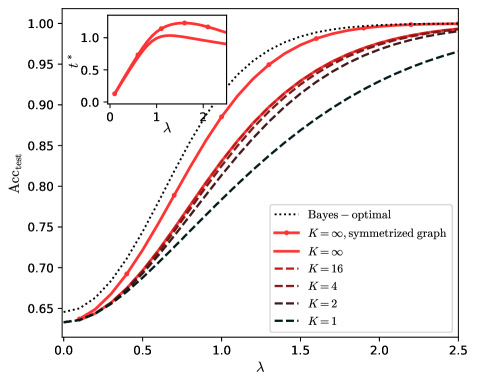
The graph depicts the relationship between the regularization parameter λ and test accuracy (Acc_test) for different model configurations. A secondary inset graph highlights the behavior near λ=0. The primary trend shows test accuracy increasing with λ up to a point before plateauing, with performance varying by model complexity (K).
### Components/Axes
- **X-axis (λ)**: Regularization parameter ranging from 0.0 to 2.5.
- **Y-axis (Acc_test)**: Test accuracy ranging from 0.65 to 1.00.
- **Legend**: Located in the bottom-right corner, with six entries:
- Dotted black: Bayes – optimal
- Solid red: K = ∞, symmetrized graph
- Dashed red: K = ∞
- Dashed brown: K = 16
- Dashed maroon: K = 4
- Dashed black: K = 2
- Solid black: K = 1
### Detailed Analysis
1. **Bayes – optimal (dotted black line)**:
- Remains consistently above all other lines across all λ values.
- Peaks at λ ≈ 1.2 with Acc_test ≈ 0.99, then plateaus.
- Spatial grounding: Topmost line, positioned centrally in the graph.
2. **K = ∞, symmetrized graph (solid red line)**:
- Second-highest performance, closely tracking the Bayes-optimal line.
- Peaks at λ ≈ 1.1 with Acc_test ≈ 0.985, then plateaus.
- Spatial grounding: Directly below the Bayes-optimal line.
3. **K = ∞ (dashed red line)**:
- Third-highest performance, slightly below the solid red line.
- Peaks at λ ≈ 1.0 with Acc_test ≈ 0.98, then plateaus.
- Spatial grounding: Below the solid red line, with dashed pattern.
4. **K = 16 (dashed brown line)**:
- Peaks at λ ≈ 0.8 with Acc_test ≈ 0.95, then declines slightly.
- Spatial grounding: Below K = ∞ lines, with a noticeable dip after λ=1.
5. **K = 4 (dashed maroon line)**:
- Peaks at λ ≈ 0.6 with Acc_test ≈ 0.92, then declines.
- Spatial grounding: Below K = 16, with a steeper decline post-λ=1.
6. **K = 2 (dashed black line)**:
- Peaks at λ ≈ 0.4 with Acc_test ≈ 0.88, then declines.
- Spatial grounding: Below K = 4, with a pronounced downward trend after λ=0.5.
7. **K = 1 (solid black line)**:
- Lowest performance, peaks at λ ≈ 0.2 with Acc_test ≈ 0.85.
- Spatial grounding: Bottommost line, with minimal improvement beyond λ=0.3.
**Inset Graph**:
- Zoomed-in view of the main graph’s lower-left region (λ=0 to 2, Acc_test=0.65 to 1.0).
- Confirms the trend of increasing accuracy with λ up to λ=1, then plateauing.
- Highlights the divergence between high-K and low-K models at small λ values.
### Key Observations
1. **Optimal λ**: All models achieve peak performance near λ=1, with Bayes-optimal and K=∞ configurations performing best.
2. **Model Complexity Trade-off**: Higher K values (e.g., K=∞) achieve higher accuracy but require larger λ to avoid overfitting. Lower K values (e.g., K=1) underperform but are less sensitive to λ.
3. **Performance Saturation**: Beyond λ=1.5, all models plateau, suggesting diminishing returns from increased regularization.
4. **Inset Confirmation**: The zoomed-in view validates the main trend, emphasizing the critical region near λ=0 where performance differences are most pronounced.
### Interpretation
The graph demonstrates that model complexity (K) and regularization (λ) are interdependent factors in achieving optimal test accuracy. The Bayes-optimal configuration (dotted black line) represents the theoretical upper bound, while practical models (K=∞, K=16, etc.) approach this bound with appropriate λ tuning. The inset graph underscores that even small λ values significantly impact performance for low-K models, but higher-K models require larger λ to balance complexity and generalization. The plateau at λ>1.5 suggests that excessive regularization degrades performance, reinforcing the need for careful hyperparameter tuning. The spatial alignment of lines (e.g., K=∞ configurations clustering near the top) visually reinforces the trade-off between model capacity and regularization strength.