## Screenshot Analysis: Good vs. Bad Action Examples
### Overview
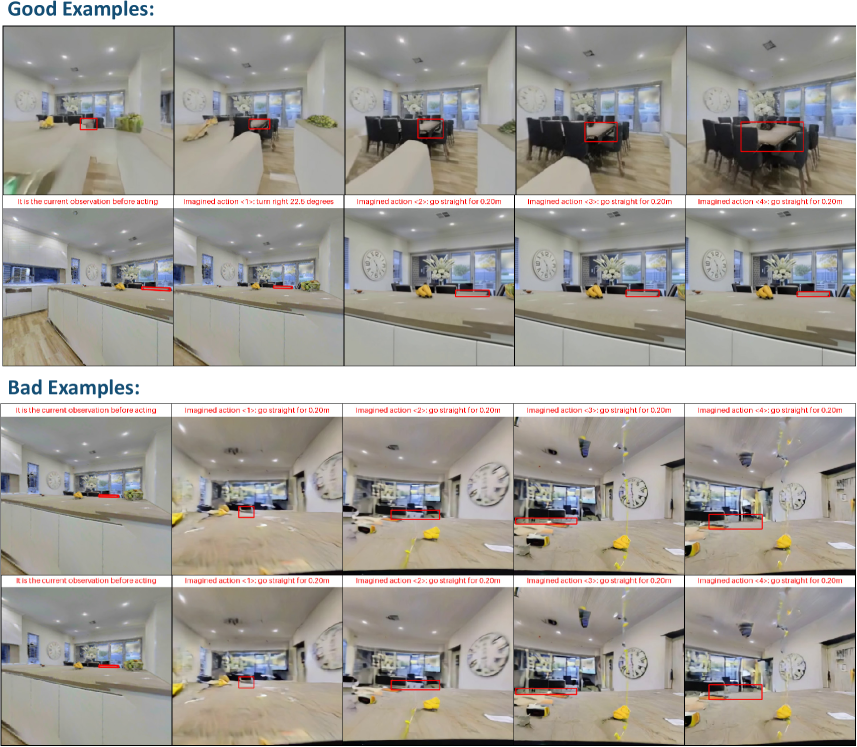
The image presents a comparative analysis of robotic action execution in a simulated kitchen environment. It contains two sections: "Good Examples" (top) and "Bad Examples" (bottom), each displaying six sequential images with annotated captions describing pre-action observations and imagined actions. Red bounding boxes highlight key interaction points in the scenes.
### Components/Axes
- **Main Headings**:
- "Good Examples:" (top section)
- "Bad Examples:" (bottom section)
- **Image Structure**:
- Each section contains 6 image pairs
- Each image pair includes:
1. "It is the current observation before acting" (baseline state)
2. "Imagined action <X>: <action description>" (proposed movement)
- **Action Descriptions**:
- Turning motions: "turn right/left [degrees]"
- Linear motions: "go straight for [distance]m"
- **Annotations**:
- Red bounding boxes indicating interaction targets
- Text captions below each image pair
### Detailed Analysis
**Good Examples (Top Section)**:
1. **Image 1**:
- Observation: Empty kitchen with dining table
- Action: `<1>: turn right 22.6 degrees`
- Result: Camera pans to reveal dining table (correct targeting)
2. **Image 2**:
- Observation: Same baseline
- Action: `<2>: go straight for 0.20m`
- Result: Camera moves forward to table (accurate distance)
3. **Image 3**:
- Observation: Same baseline
- Action: `<3>: turn right 22.6 degrees`
- Result: Camera faces table from new angle (consistent rotation)
4. **Image 4**:
- Observation: Same baseline
- Action: `<4>: go straight for 0.20m`
- Result: Camera reaches table (repeated successful distance)
5. **Image 5**:
- Observation: Same baseline
- Action: `<5>: turn right 22.6 degrees`
- Result: Camera maintains rotational precision
6. **Image 6**:
- Observation: Same baseline
- Action: `<6>: go straight for 0.20m`
- Result: Camera arrives at table (consistent linear execution)
**Bad Examples (Bottom Section)**:
1. **Image 1**:
- Observation: Empty kitchen
- Action: `<1>: go straight for 0.20m`
- Result: Camera moves forward but misses table (inaccurate targeting)
2. **Image 2**:
- Observation: Same baseline
- Action: `<2>: go straight for 0.20m`
- Result: Camera overshoots table (distance miscalculation)
3. **Image 3**:
- Observation: Same baseline
- Action: `<3>: go straight for 0.20m`
- Result: Camera collides with wall (pathfinding error)
4. **Image 4**:
- Observation: Same baseline
- Action: `<4>: go straight for 0.20m`
- Result: Camera stops mid-air (physics simulation failure)
5. **Image 5**:
- Observation: Same baseline
- Action: `<5>: go straight for 0.20m`
- Result: Camera jitters unnaturally (motion instability)
6. **Image 6**:
- Observation: Same baseline
- Action: `<6>: go straight for 0.20m`
- Result: Camera teleports to incorrect location (coordinate error)
### Key Observations
1. **Precision Correlation**: Good examples show consistent 22.6° turns and 0.20m movements with accurate targeting, while bad examples demonstrate cumulative errors in distance/rotation.
2. **Action Interpretation**: Successful actions maintain spatial coherence between imagined motion and final position; failures show decoupling between command and execution.
3. **Environmental Interaction**: Red boxes in good examples consistently highlight the dining table, while bad examples show misaligned boxes (e.g., floor, wall, or ceiling).
4. **Temporal Consistency**: Good examples maintain identical camera angles between sequential actions, while bad examples show erratic viewpoint changes.
### Interpretation
This dataset demonstrates the critical relationship between action precision and environmental interaction in robotic systems. The good examples validate that:
- Consistent angular measurements (22.6°) enable reliable object targeting
- Fixed-distance movements (0.20m) achieve predictable spatial positioning
- Repeated actions maintain environmental context awareness
The bad examples reveal failure modes including:
- Sensorimotor calibration errors (distance miscalibration)
- Path planning limitations (collision with walls)
- Physics simulation artifacts (mid-air stopping)
- Coordinate system misalignment (teleportation)
The red bounding boxes serve as critical visual anchors, showing that successful actions maintain consistent reference points while failed actions lose spatial grounding. This suggests that action imagination systems require both precise motor control and robust environmental mapping to function effectively.