## Diagram: Computational Approach Comparison
### Overview
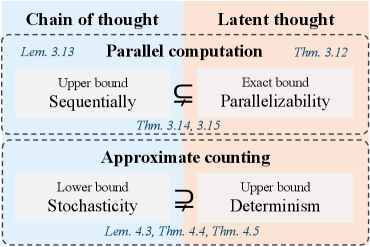
The diagram contrasts two computational paradigms: **"Chain of thought"** (blue) and **"Latent thought"** (orange). It highlights relationships between computational bounds, parallelizability, and counting methods, supported by referenced lemmas and theorems.
### Components/Axes
- **Sections**:
1. **Chain of thought** (blue):
- Subsection: **Parallel computation**
- Labels:
- "Upper bound Sequentially" (left box)
- "Exact bound Parallelizability" (right box)
- Arrows:
- "Thm. 3.12" (top-right)
- "Thm. 3.14, 3.15" (bottom-center)
2. **Latent thought** (orange):
- Subsection: **Approximate counting**
- Labels:
- "Lower bound Stochasticity" (left box)
- "Upper bound Determinism" (right box)
- Arrows:
- "Lem. 4.3" (bottom-left)
- "Thm. 4.4, 4.5" (bottom-center)
- **Color Coding**:
- Blue: Chain of thought (sequential/parallel computation)
- Orange: Latent thought (approximate counting)
### Detailed Analysis
- **Chain of thought**:
- Sequential upper bounds (left box) are linked to exact parallelizability bounds (right box) via **Thm. 3.12, 3.14, 3.15**.
- Emphasizes deterministic parallel computation.
- **Latent thought**:
- Stochastic lower bounds (left box) are connected to deterministic upper bounds (right box) via **Lem. 4.3, Thm. 4.4, 4.5**.
- Focuses on probabilistic counting methods.
### Key Observations
1. **Duality**: The diagram juxtaposes sequential vs. parallel computation (Chain of thought) with stochastic vs. deterministic counting (Latent thought).
2. **Theorem/Lemma References**: Each relationship is anchored to specific mathematical proofs, suggesting formal validation of the claims.
3. **No Numerical Data**: The diagram is conceptual, emphasizing structural relationships over quantitative values.
### Interpretation
The diagram illustrates a theoretical framework for evaluating computational efficiency:
- **Chain of thought** prioritizes parallel computation with exact bounds, implying scalability through deterministic parallelism.
- **Latent thought** leverages stochastic methods for approximate counting, balancing flexibility (stochasticity) with control (determinism).
- The use of theorems/lemmas suggests these paradigms are grounded in formal proofs, likely from a theoretical computer science or optimization context.
- The absence of numerical data implies the focus is on architectural trade-offs rather than empirical performance metrics.