TECHNICAL ASSET FINGERPRINT
1586b0efe7656ab218c11d58
Click to view fullscreen
Press ESC or click to close
FOUND IN PAPERS
EXPERT: healer-alpha-free VERSION 1
RUNTIME: free/openrouter/healer-alpha
INTEL_VERIFIED
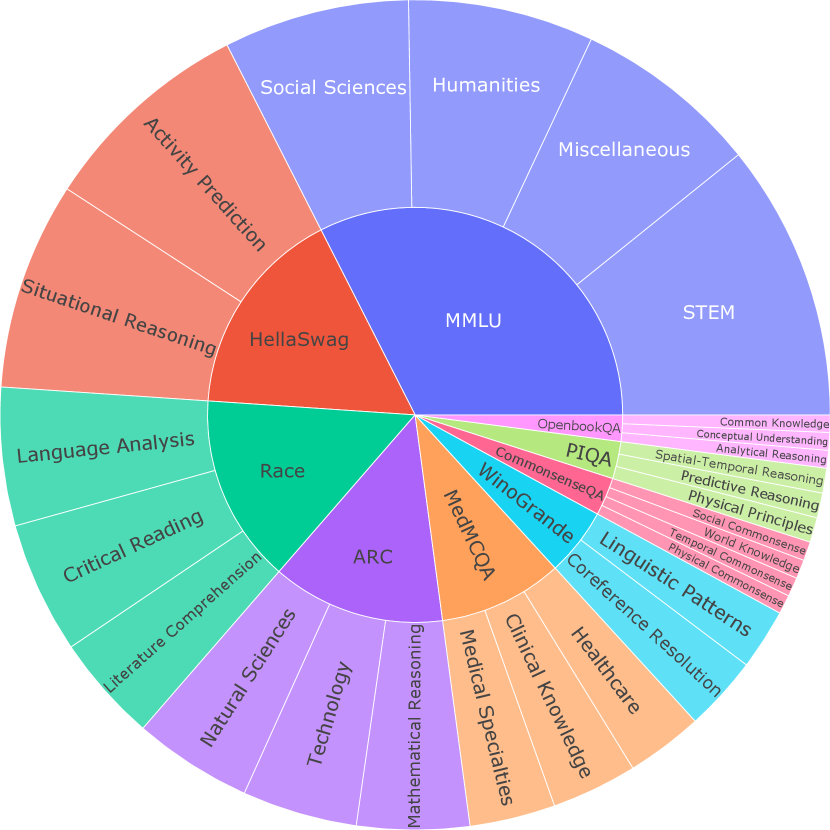
## Nested Pie Chart (Sunburst Chart): AI Evaluation Benchmark Taxonomy
### Overview
The image displays a complex, multi-level pie chart (sunburst chart) that categorizes various artificial intelligence evaluation benchmarks. The chart is organized hierarchically, with broad domains in the outer ring and more specific tasks or sub-domains in the inner ring. Each segment is color-coded, and labels are placed directly on or adjacent to their corresponding slices. The chart visually represents the composition and relative scope of different benchmark categories.
### Components/Axes
* **Chart Type:** Nested Pie Chart / Sunburst Chart.
* **Structure:** Two concentric rings.
* **Outer Ring:** Represents broad, high-level domains or benchmark suites.
* **Inner Ring:** Represents specific tasks, sub-domains, or knowledge areas within the outer ring categories.
* **Legend:** The legend is integrated directly into the chart via color-coded labels placed on or next to each segment. There is no separate legend box.
* **Color Scheme:** A diverse palette is used, with distinct colors for each major category (e.g., blue for STEM, red-orange for HellaSwag, green for Race, purple for ARC, etc.). Sub-categories within a major category share a similar hue but may vary in shade.
### Detailed Analysis
The chart is segmented as follows, moving clockwise from the top. Segment sizes are approximate based on visual angle.
**1. Outer Ring - Major Categories (Clockwise from ~12 o'clock):**
* **STEM** (Blue, largest segment, ~25-30% of chart): Positioned top-right.
* **Miscellaneous** (Lighter Blue): Adjacent to STEM, clockwise.
* **Humanities** (Light Blue): Adjacent to Miscellaneous.
* **Social Sciences** (Light Blue): Adjacent to Humanities.
* **Activity Prediction** (Salmon/Pink): Adjacent to Social Sciences.
* **Situational Reasoning** (Salmon/Pink): Adjacent to Activity Prediction.
* **HellaSwag** (Red-Orange): Adjacent to Situational Reasoning.
* **Language Analysis** (Teal/Green): Adjacent to HellaSwag.
* **Critical Reading** (Teal/Green): Adjacent to Language Analysis.
* **Literature Comprehension** (Teal/Green): Adjacent to Critical Reading.
* **Race** (Green): Adjacent to Literature Comprehension.
* **ARC** (Purple): Adjacent to Race.
* **Natural Sciences** (Purple): Adjacent to ARC.
* **Technology** (Purple): Adjacent to Natural Sciences.
* **Mathematical Reasoning** (Purple): Adjacent to Technology.
* **Medical Specialties** (Orange): Adjacent to Mathematical Reasoning.
* **Clinical Knowledge** (Orange): Adjacent to Medical Specialties.
* **Healthcare** (Orange): Adjacent to Clinical Knowledge.
* **Coreference Resolution** (Cyan): Adjacent to Healthcare.
* **Linguistic Patterns** (Cyan): Adjacent to Coreference Resolution.
* **Physical Commonsense** (Light Green): Adjacent to Linguistic Patterns.
* **Temporal Commonsense** (Light Green): Adjacent to Physical Commonsense.
* **World Knowledge** (Light Green): Adjacent to Temporal Commonsense.
* **Social Commonsense** (Light Green): Adjacent to World Knowledge.
* **Physical Principles** (Light Green): Adjacent to Social Commonsense.
* **Predictive Reasoning** (Light Green): Adjacent to Physical Principles.
* **Spatial-Temporal Reasoning** (Light Green): Adjacent to Predictive Reasoning.
* **Conceptual Understanding** (Light Green): Adjacent to Spatial-Temporal Reasoning.
* **Common Knowledge** (Light Green): Adjacent to Conceptual Understanding.
* **Analytical Reasoning** (Light Green): Adjacent to Common Knowledge.
* **OpenbookQA** (Pink): Adjacent to Analytical Reasoning.
* **PIQA** (Pink): Adjacent to OpenbookQA.
* **CommonsenseQA** (Pink): Adjacent to PIQA.
* **WinoGrande** (Pink): Adjacent to CommonsenseQA.
* **MedMCQA** (Orange): Adjacent to WinoGrande.
**2. Inner Ring - Sub-Categories (Nested within Outer Ring segments):**
* **Within STEM:** No distinct inner ring labels are visible; the STEM segment appears as a single block.
* **Within HellaSwag:** The inner ring is labeled **"MMLU"** (Massive Multitask Language Understanding), which occupies a large portion of the inner circle, suggesting it is a major component or related benchmark.
* **Within ARC:** The inner ring is labeled **"ARC"** (AI2 Reasoning Challenge), indicating the outer and inner segments share the same name.
* **Within Medical Specialties/Clinical Knowledge/Healthcare:** The inner ring contains the label **"MedMCQA"**, indicating this benchmark spans these medical categories.
* **Within Coreference Resolution/Linguistic Patterns:** The inner ring contains the label **"WinoGrande"**, indicating this benchmark spans these language categories.
* **Within Physical Commonsense...Analytical Reasoning:** The inner ring contains the label **"CommonsenseQA"**, indicating this benchmark spans these reasoning categories.
* **Within OpenbookQA/PIQA:** The inner ring contains the label **"PIQA"** (Physical Interaction QA), suggesting a relationship or overlap.
* **Other Inner Ring Labels:** **"CommonsenseQA"** also appears as a standalone segment in the inner ring, adjacent to the PIQA segment.
### Key Observations
1. **Dominance of STEM and MMLU:** The STEM category is the largest single segment in the outer ring. The MMLU benchmark occupies a very large portion of the inner ring, indicating its central importance or broad coverage across multiple domains.
2. **Granularity of Reasoning and Language:** A significant portion of the chart (roughly the bottom-right quadrant) is dedicated to fine-grained categories of reasoning (e.g., Physical, Temporal, Social, Predictive) and language tasks (Coreference Resolution, Linguistic Patterns), many of which are associated with benchmarks like CommonsenseQA and WinoGrande.
3. **Medical Domain Clustering:** Medical-related categories (Medical Specialties, Clinical Knowledge, Healthcare) are grouped together and associated with the MedMCQA benchmark.
4. **Color-Coding Logic:** Colors are used thematically. For example:
* Blues for broad academic/knowledge domains (STEM, Humanities, Social Sciences).
* Greens for language and reading tasks (Language Analysis, Critical Reading, Race).
* Purples for science and technology (ARC, Natural Sciences, Technology).
* Oranges for medical fields.
* Pinks/Salmons for reasoning and prediction tasks.
* Light Greens for a cluster of specific reasoning types.
5. **Hierarchical Relationships:** The nesting shows which specific benchmarks (inner ring) are composed of or evaluated across which broader categories (outer ring). For instance, MedMCQA is evaluated across Medical Specialties, Clinical Knowledge, and Healthcare.
### Interpretation
This chart serves as a **taxonomy or map of the AI evaluation landscape**, specifically for language and reasoning models. It visually answers the question: "What kinds of tasks and knowledge areas are used to test AI systems, and how are they grouped?"
* **What it demonstrates:** The field of AI evaluation is highly specialized. It has moved beyond general language understanding to include highly specific reasoning types (e.g., spatial-temporal, physical principles) and domain-specific knowledge (e.g., medical, STEM). The prominence of benchmarks like MMLU, HellaSwag, ARC, and CommonsenseQA highlights the community's focus on measuring multitask ability, commonsense reasoning, and scientific problem-solving.
* **Relationships between elements:** The hierarchy shows that benchmarks are not monolithic. A single benchmark like MedMCQA is designed to test knowledge across multiple related medical sub-fields. Conversely, a broad domain like "Reasoning" is broken down into many specific, measurable competencies.
* **Notable patterns/anomalies:** The sheer number of fine-grained reasoning categories in the light-green cluster suggests a significant research focus on dissecting and measuring different facets of "common sense" and logical deduction. The large, undivided STEM block might indicate that STEM benchmarks are often treated as a unified category, or that this particular visualization chose not to decompose it further. The central placement and size of MMLU underscore its role as a comprehensive, "Swiss Army knife" benchmark for evaluating broad knowledge and task-solving ability.
DECODING INTELLIGENCE...