## Diagram: Priya's Restaurant Experience Hypothesis Testing
### Overview
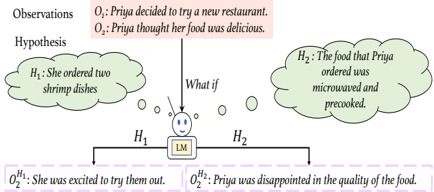
The diagram illustrates a logical reasoning process where observations about Priya's restaurant experience lead to two competing hypotheses (H₁ and H₂), each generating distinct outcomes (O^H₁ and O^H₂). A central "LM" (likely representing a logical model or decision node) connects the hypotheses to their outcomes.
### Components/Axes
- **Observations (Top)**:
- O₁: "Priya decided to try a new restaurant."
- O₂: "Priya thought her food was delicious."
- **Hypotheses (Middle)**:
- H₁: "She ordered two shrimp dishes."
- H₂: "The food that Priya ordered was microwaved and precooked."
- **Outcomes (Bottom)**:
- O^H₁: "She was excited to try them out."
- O^H₂: "Priya was disappointed in the quality of the food."
- **Central Node**:
- "LM" (Logical Model/Decision Node) with a question mark, linking hypotheses to outcomes.
### Detailed Analysis
- **Flow**:
Observations (O₁, O₂) → Hypotheses (H₁, H₂) → Outcomes (O^H₁, O^H₂).
Arrows indicate causal reasoning: hypotheses are derived from observations and lead to specific outcomes.
- **Textual Elements**:
All labels are in English. No non-English text is present.
### Key Observations
1. **Hypothesis Outcomes**:
- H₁ (shrimp dishes) → Positive outcome (excitement).
- H₂ (microwaved/precooked food) → Negative outcome (disappointment).
2. **Ambiguity in Observations**:
- O₂ ("food was delicious") conflicts with H₂'s negative outcome, suggesting H₂ may not align with Priya's actual experience.
3. **Central Node Role**:
- "LM" acts as a decision point, evaluating which hypothesis better explains the observations.
### Interpretation
The diagram models a **Peircean abductive reasoning process**:
- **Observations** (O₁, O₂) are facts to be explained.
- **Hypotheses** (H₁, H₂) are competing explanations.
- **Outcomes** (O^H₁, O^H₂) are predictions derived from each hypothesis.
**Key Insight**:
The conflict between O₂ ("delicious food") and H₂'s negative outcome (disappointment) implies H₂ may be less plausible. This suggests Priya's positive experience (O₂) is better explained by H₁ (enjoying shrimp dishes) rather than H₂ (poor food quality). The "LM" node highlights the need to test hypotheses against real-world outcomes to resolve ambiguity.
**Notable Pattern**:
The diagram emphasizes how subjective experiences (e.g., "delicious food") can be explained by multiple hypotheses, requiring further evidence to validate the most accurate explanation.