## Diagram and Chart: Spiking Neural Network Performance
### Overview
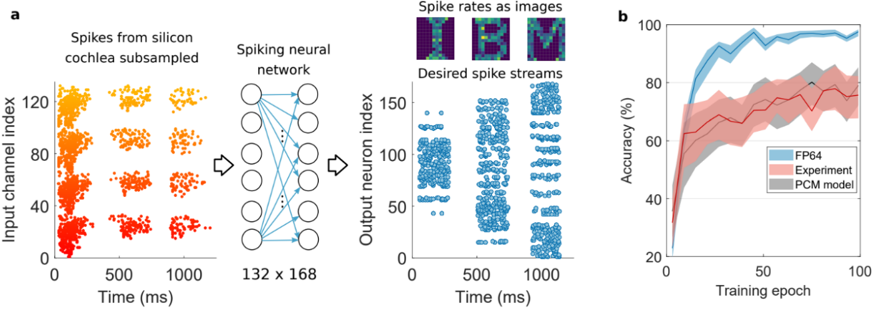
The image presents a diagram of a spiking neural network processing data from a silicon cochlea, along with a chart comparing the accuracy of different models (FP64, Experiment, PCM model) during training.
### Components/Axes
**Part a (Left Side):**
* **Title:** Spikes from silicon cochlea subsampled
* **X-axis:** Time (ms), ranging from 0 to 1000.
* **Y-axis:** Input channel index, ranging from 0 to 120.
* **Data:** A scatter plot showing spike events over time, with the color of the points varying from red (at lower channel indices) to yellow/orange (at higher channel indices). The spikes are clustered in four vertical bands, each containing three sub-bands.
* **Title:** Spiking neural network
* **Description:** A diagram of a neural network with an input layer of 6 nodes, and an output layer of 6 nodes. The dimensions of the network are labeled as "132 x 168".
* **Title:** Desired spike streams
* **X-axis:** Time (ms), ranging from 0 to 1000.
* **Y-axis:** Output neuron index, ranging from 0 to 150.
* **Data:** A scatter plot showing spike events over time. The spikes are clustered in three vertical bands.
* **Title:** Spike rates as images
* **Description:** Three images depicting the letters "I", "B", and "M".
**Part b (Right Side):**
* **Title:** Accuracy vs. Training Epoch
* **X-axis:** Training epoch, ranging from 0 to 100.
* **Y-axis:** Accuracy (%), ranging from 20 to 100.
* **Legend:** Located in the bottom-right corner.
* **FP64:** Blue line with a blue shaded region indicating variance.
* **Experiment:** Red line with a red shaded region indicating variance.
* **PCM model:** Gray line with a gray shaded region indicating variance.
### Detailed Analysis
**Part a (Left Side):**
* **Spikes from silicon cochlea subsampled:** The spike events appear to increase in frequency over time within each of the four main bands. The color gradient suggests that lower channel indices (red) are activated earlier than higher channel indices (yellow/orange).
* **Spiking neural network:** The diagram shows a fully connected network.
* **Desired spike streams:** The spike events are clustered into three distinct vertical bands, corresponding to the three letters "I", "B", and "M".
**Part b (Right Side):**
* **FP64 (Blue):** The accuracy increases rapidly from approximately 20% to nearly 95% within the first 20 training epochs, then plateaus.
* **Experiment (Red):** The accuracy increases from approximately 20% to around 70% within the first 20 training epochs, then fluctuates between 70% and 80% for the remaining epochs.
* **PCM model (Gray):** The accuracy increases from approximately 20% to around 80% within the first 50 training epochs, then plateaus.
### Key Observations
* The FP64 model achieves the highest accuracy and converges faster than the other two models.
* The Experiment and PCM models have similar performance, with the PCM model showing a slightly smoother learning curve.
* The silicon cochlea data is processed by the spiking neural network to produce desired spike streams that represent the letters "I", "B", and "M".
### Interpretation
The data suggests that the FP64 model is the most effective for this particular task, achieving higher accuracy with fewer training epochs. The spiking neural network is successfully processing the input from the silicon cochlea to generate spike streams that correspond to specific letters. The experiment and PCM models show comparable performance, indicating that they may be viable alternatives, although not as efficient as the FP64 model. The diagram illustrates the flow of information from the silicon cochlea, through the spiking neural network, and into the desired output spike streams.