## Process Flow Diagram: Rollout Worker and Replay Buffer Interaction
### Overview
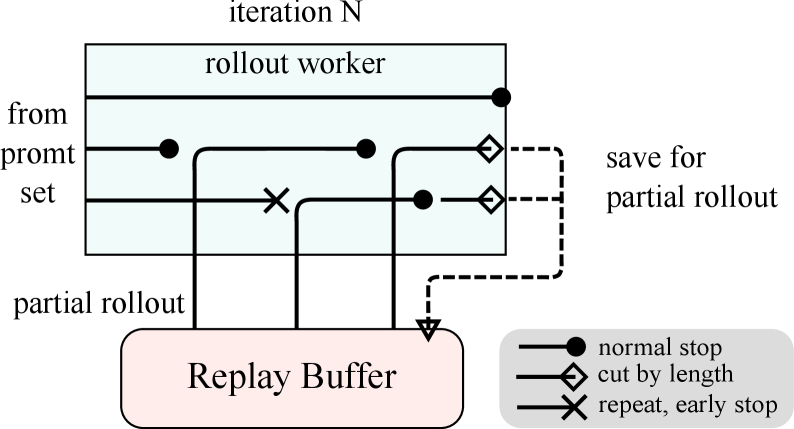
This image is a technical process flow diagram illustrating the data flow and control logic for a "rollout worker" during "iteration N" of a machine learning or reinforcement learning training process. The diagram shows how prompts are processed, under what conditions they stop, and how the resulting data is stored in a "Replay Buffer." It specifically highlights the mechanism for handling "partial rollouts."
### Components/Axes
The diagram is composed of the following labeled components and flow elements:
1. **Main Process Block (Top):** A large rectangle labeled **"rollout worker"**. Above it is the text **"iteration N"**.
2. **Input Source (Left):** The text **"from prompt set"** indicates the origin of the data streams entering the rollout worker.
3. **Output Destination (Bottom):** A rounded rectangle labeled **"Replay Buffer"**.
4. **Flow Lines & Symbols:** Three distinct horizontal lines enter the "rollout worker" from the left. Their paths and termination points within the worker block are defined by specific symbols, which are explained in a legend.
5. **Legend (Bottom-Right):** A key explaining the meaning of the line termination symbols:
* **Solid line ending in a filled circle (●):** "normal stop"
* **Solid line ending in an open diamond (◇):** "cut by length"
* **Solid line with an 'X' mark (✕):** "repeat, early stop"
6. **Secondary Flow Label (Right):** The text **"save for partial rollout"** is connected via dashed lines to the diamond symbols.
7. **Process Label (Left):** The text **"partial rollout"** is positioned near the lines descending to the Replay Buffer.
### Detailed Analysis
The diagram details three distinct data processing paths originating from the "prompt set":
1. **Path 1 (Top Line):**
* **Trajectory:** Enters the "rollout worker" from the left.
* **Termination:** Ends at a **filled circle (●)** on the right edge of the worker block.
* **Legend Meaning:** This represents a **"normal stop"**.
* **Flow:** A solid line descends directly from this termination point into the "Replay Buffer".
2. **Path 2 (Middle Line):**
* **Trajectory:** Enters the worker, travels right, then turns downward.
* **Termination:** Ends at an **open diamond (◇)** on the right edge of the worker block.
* **Legend Meaning:** This represents a process **"cut by length"**.
* **Associated Action:** A dashed line connects this diamond to the label **"save for partial rollout"**.
* **Flow:** A solid line descends from the diamond's position into the "Replay Buffer".
3. **Path 3 (Bottom Line):**
* **Trajectory:** Enters the worker and is immediately marked with an **'X' (✕)**.
* **Legend Meaning:** This indicates a **"repeat, early stop"** condition.
* **Flow:** After the 'X', the line continues, turns downward, and then splits. One branch goes to the "Replay Buffer". Another branch connects to the dashed line system associated with "save for partial rollout".
**Spatial Grounding:** The legend is positioned in the bottom-right corner. The "save for partial rollout" label is on the right side, aligned with the diamond symbols. The "partial rollout" label is on the left, near the vertical lines feeding the buffer. The "Replay Buffer" is centrally located at the bottom.
### Key Observations
* The diagram explicitly models different stopping conditions for a rollout process, which is critical for efficient training in reinforcement learning.
* The **"cut by length" (◇)** and **"repeat, early stop" (✕)** conditions are both linked to the concept of a **"partial rollout"**, suggesting these are non-standard termination points that require special handling.
* The dashed lines create a secondary data flow path specifically for saving information related to partial rollouts, separate from the main data stream to the replay buffer.
* All three processing paths ultimately result in data being sent to the **"Replay Buffer"**, indicating it is the central storage for all generated experience, regardless of how the rollout ended.
### Interpretation
This diagram illustrates a sophisticated data collection mechanism for iterative model training, likely in a reinforcement learning context. The "rollout worker" generates experience by interacting with an environment using a set of prompts.
The key insight is the system's ability to handle incomplete or aborted trajectories ("partial rollouts") gracefully. Instead of discarding this data, it is categorized and saved. A "normal stop" represents a complete, successful episode. A "cut by length" suggests the episode was truncated due to a maximum step limit. A "repeat, early stop" implies the process was halted early, possibly due to a detected failure state or a need to re-sample.
By storing all these outcomes in the Replay Buffer, the training algorithm can learn from both successful completions and various failure or truncation modes. The "save for partial rollout" mechanism may be used for techniques like importance sampling, trajectory stitching, or training value functions to handle incomplete episodes. This design promotes sample efficiency and robust learning by maximizing the utility of every interaction with the environment.