## Diagram: Rollout Worker and Replay Buffer Workflow
### Overview
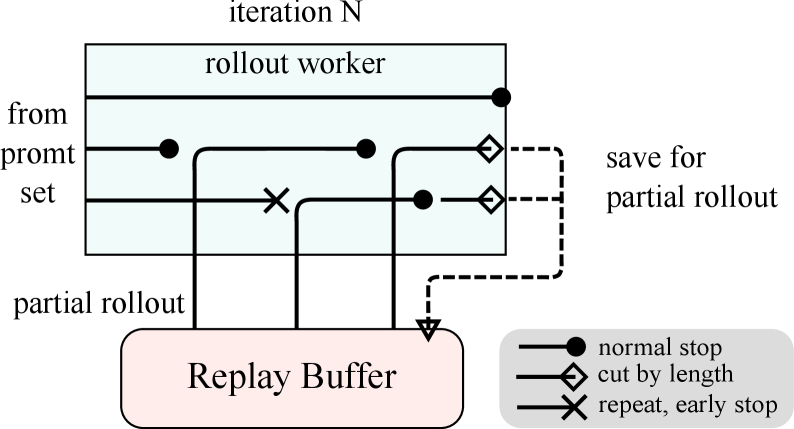
The diagram illustrates a workflow involving a "rollout worker" and a "Replay Buffer," with data flow paths and decision points. Key elements include arrows with symbolic markers (●, ◇, ×) and labels indicating data sources, destinations, and conditions.
### Components/Axes
- **Main Components**:
- **Rollout Worker**: A rectangular box labeled "rollout worker" at the top, representing a processing unit.
- **Replay Buffer**: A pink rectangular box labeled "Replay Buffer" at the bottom, acting as a storage or processing unit.
- **Arrows**: Connect the rollout worker to the replay buffer, with labels and symbolic markers.
- **Legend**:
- **●**: Normal stop
- **◇**: Cut by length
- **×**: Repeat, early stop
- **Labels**:
- "from prompt set" (input to rollout worker)
- "partial rollout" (output from rollout worker)
- "save for partial rollout" (output to replay buffer)
### Detailed Analysis
1. **Rollout Worker**:
- Receives input from the "prompt set."
- Processes data, with three distinct output paths:
- **Normal Stop (●)**: Direct path to the replay buffer.
- **Cut by Length (◇)**: Dashed path to the replay buffer, indicating truncated data.
- **Repeat, Early Stop (×)**: Dashed path looping back to the rollout worker, suggesting reprocessing.
2. **Replay Buffer**:
- Receives data from the rollout worker via three paths:
- Normal stop (●)
- Cut by length (◇)
- Repeat, early stop (×)
- Stores "partial rollout" data for reuse or further processing.
3. **Flow Logic**:
- Data from the prompt set enters the rollout worker.
- Depending on processing outcomes (normal stop, cut, or repeat), data is routed to the replay buffer or reprocessed.
- The replay buffer acts as a central hub for partial rollout data.
### Key Observations
- **Symbol Consistency**: Arrows with ●, ◇, and × match the legend’s definitions.
- **Partial Rollout Handling**: The replay buffer explicitly manages partial rollout data, suggesting iterative or incremental processing.
- **Decision Points**: The rollout worker’s outputs are conditional, with paths diverging based on processing results.
### Interpretation
This diagram represents a cyclical workflow where the rollout worker processes data from a prompt set, with outcomes determining whether data is stored in the replay buffer or reprocessed. The use of symbolic markers (●, ◇, ×) indicates three distinct processing states:
- **Normal Stop (●)**: Successful completion, data saved.
- **Cut by Length (◇)**: Data truncated, saved as partial rollout.
- **Repeat, Early Stop (×)**: Data reprocessed, likely due to errors or incomplete results.
The replay buffer’s role as a central storage unit implies that partial rollouts are critical for iterative improvements or handling incomplete data. The diagram emphasizes conditional processing and data reuse, common in machine learning or simulation workflows where efficiency and resource management are prioritized.
**Note**: No numerical data or trends are present; the diagram focuses on process flow and decision logic.