\n
## Text Document: Prompt Template of Graph-RFT
### Overview
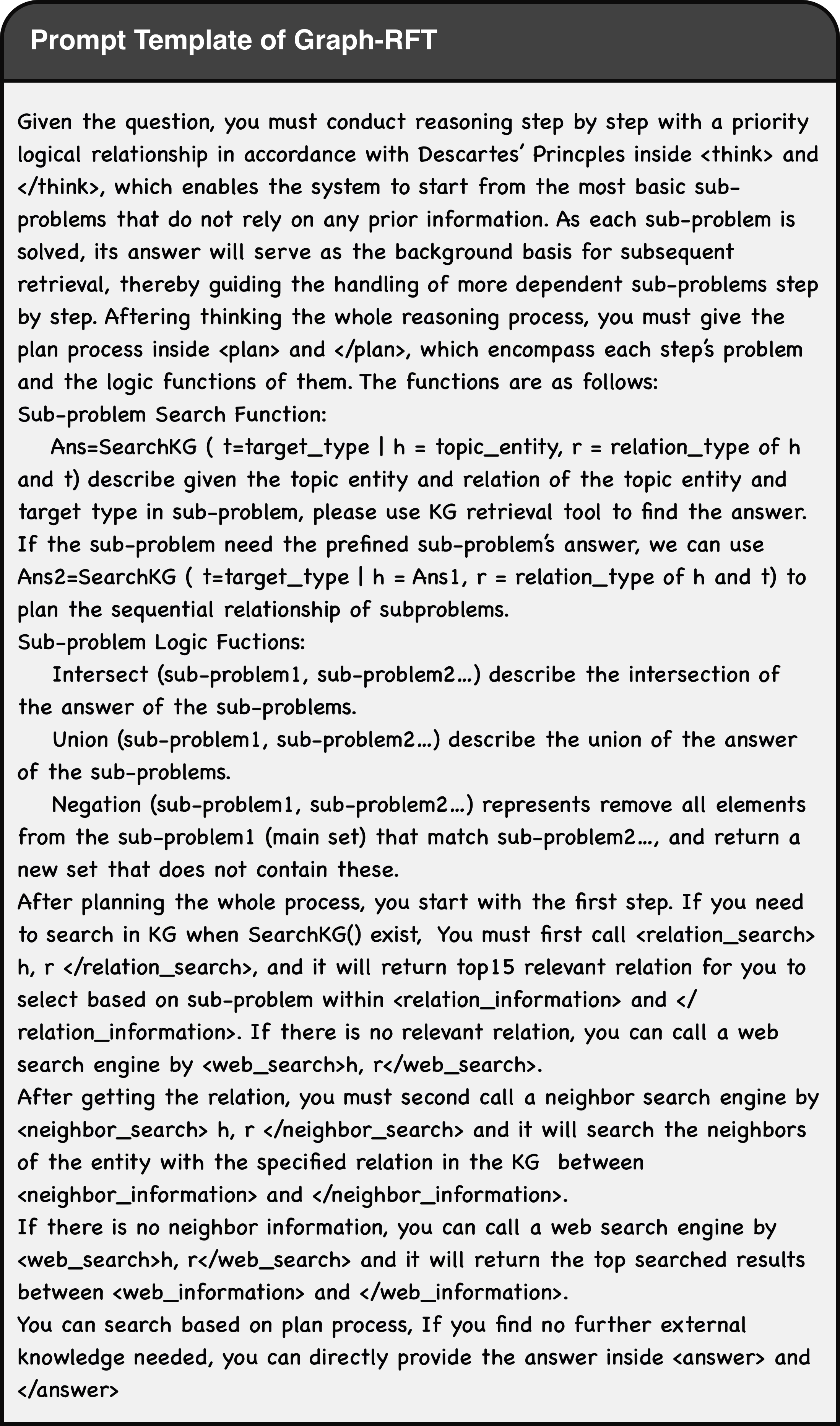
The image presents a text document outlining a prompt template for a system called "Graph-RFT". The document details a reasoning process using a step-by-step approach based on Descartes' Principles, and defines functions for sub-problem search and logic functions. It appears to be a technical specification or guide for implementing this system.
### Components/Axes
The document is structured with headings and bullet points. Key components include:
* **Introduction:** Explains the overall approach to reasoning.
* **Sub-problem Search Function:** Defines the `Ans-searchKG` function.
* **Sub-problem Logic Functions:** Defines `Intersect`, `Union`, and `Negation` functions.
* **Process Flow:** Describes the sequential steps involved in the search and reasoning process.
* **KG Retrieval:** Mentions the use of a Knowledge Graph (KG).
* **Web Search:** Mentions the use of a web search engine.
### Detailed Analysis or Content Details
Here's a transcription of the text, broken down into sections:
**Introduction:**
"Given the question, you must conduct reasoning step by step with a priority logical relationship in accordance with Descartes’ Principles inside <think> and <think>, which enables the system to start from the most basic sub-problems that do not rely on any prior information. As each sub-problem is solved, its answer will serve as the background basis for subsequent retrieval, thereby guiding the handling of more dependent sub-problems step by step. After thinking the whole reasoning process, you must give the plan process inside <plan> and </plan>, which encompass each step’s problem and the logic functions of them. The functions are as follows:"
**Sub-problem Search Function:**
"Ans-searchKG (t=target_type | h = topic_entity, r = relation_type of h and t) describe given the topic entity and relation of the topic entity and target type in sub-problem, please use KG retrieval tool to find the answer. If the sub-problem need the predefined sub-problem’s answer, we can use Ans2-searchKG (t=target_type | h = Ans1, r = relation_type of h and t) to plan the sequential relationship of subproblems."
**Sub-problem Logic Functions:**
"Intersect (sub-problem1, sub-problem2…) describe the intersection of the answer of the sub-problems.
Union (sub-problem1, sub-problem2…) describe the union of the answer of the sub-problems.
Negation (sub-problem1, sub-problem2…) represents remove all elements from the sub-problem1 (main set) that match sub-problem2…, and return a new set that does not contain these)."
**Process Flow:**
"After planning the whole process, you start with the first step. If you need to search in KG when SearchKG(I) exist, You must first call <relation_search> h, r, </relation_search>, and it will return top15 relevant relation for you to select based on sub-problem within <relation_informations> and </relation_informations>. If there is no relevant relation, you can call a web search engine by <web_search>, r,/web_search.
After getting the relation, you must second call a neighbor search engine by <neighbor_search> h, r, </neighbor_search> and it will search the neighbors of the entity with the specified relation in the KG between <neighbor_information> and </neighbor_information>.
If there is no neighbor information, you can call a web search engine by <web_search>, r,/web_search, and it will return the top searched results between <web_information> and </web_information>.
You can search based on plan process, if you find no further external knowledge needed, you can directly pass the answer inside <answer> and </answer>."
### Key Observations
The document focuses on a structured approach to problem-solving using a combination of Knowledge Graph retrieval and web searches. The use of specific tags like `<think>`, `<plan>`, `<relation_search>`, `<web_search>`, `<answer>` suggests a system designed for automated reasoning and response generation. The emphasis on breaking down problems into smaller sub-problems and building upon previous solutions is a key characteristic of the approach.
### Interpretation
This document describes a sophisticated system for automated reasoning. The "Graph-RFT" system appears to leverage the strengths of both structured knowledge (Knowledge Graph) and unstructured information (web searches) to answer complex questions. The step-by-step process, guided by Descartes' Principles, aims to ensure a logical and transparent reasoning path. The use of specific tags suggests that this system is intended to be implemented as a software application or a component within a larger AI system. The functions defined (Intersect, Union, Negation) indicate the system's ability to perform logical operations on the results obtained from different sources. The overall design suggests a focus on explainability and traceability in the reasoning process.