## Line Graph: Test Accuracy (Acc_test) vs. Regularization Parameter (λ)
### Overview
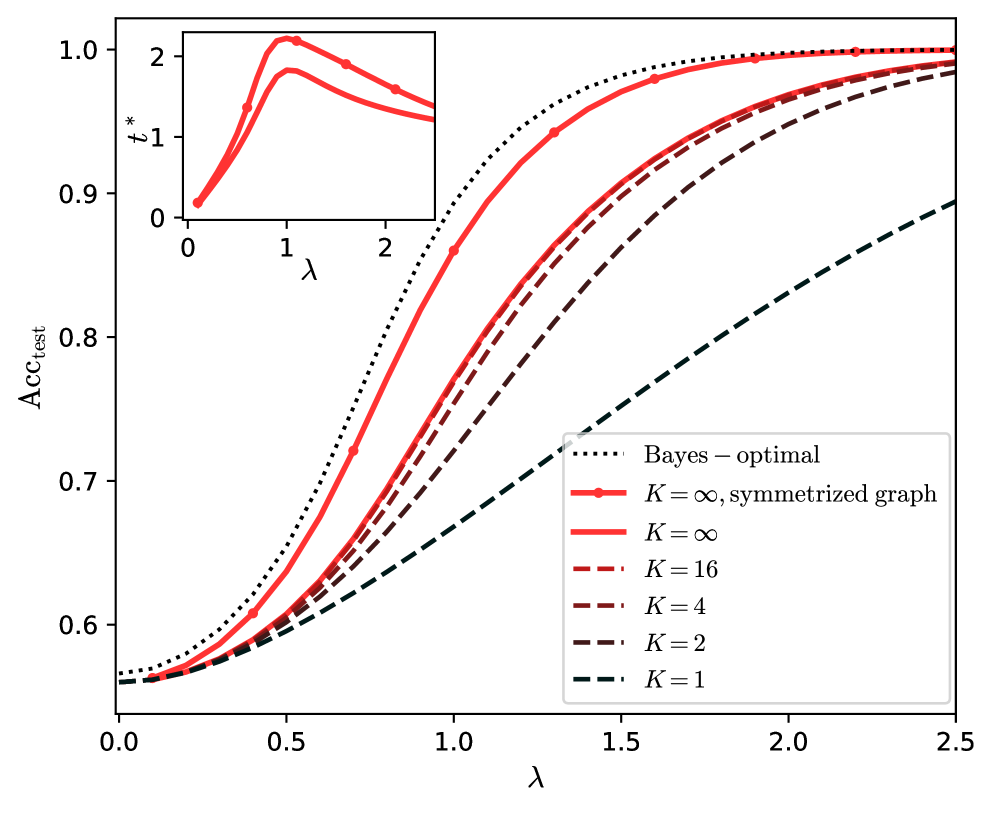
The graph illustrates the relationship between the regularization parameter λ and test accuracy (Acc_test) for different model configurations. Multiple lines represent varying values of K (model complexity) and a Bayes-optimal baseline. An inset graph highlights behavior at lower λ values (0–2).
### Components/Axes
- **X-axis (λ)**: Regularization parameter, ranging from 0 to 2.5.
- **Y-axis (Acc_test)**: Test accuracy, ranging from 0.5 to 1.0.
- **Legend**:
- **Dotted black**: Bayes-optimal (upper bound).
- **Solid red**: K = ∞, symmetrized graph.
- **Dashed red**: K = 16.
- **Dotted red**: K = 4.
- **Dashed brown**: K = 2.
- **Dotted green**: K = 1.
### Detailed Analysis
1. **Bayes-optimal (dotted black)**:
- Remains flat at Acc_test ≈ 1.0 across all λ.
- Serves as the theoretical maximum accuracy.
2. **K = ∞, symmetrized graph (solid red)**:
- Stays nearly parallel to the Bayes-optimal line, with Acc_test ≈ 0.98–1.0.
- Minimal deviation suggests near-optimal performance.
3. **K = 16 (dashed red)**:
- Acc_test increases from ~0.55 (λ=0) to ~0.95 (λ=2.5).
- Slightly lags behind K = ∞ but converges at higher λ.
4. **K = 4 (dotted red)**:
- Acc_test rises from ~0.52 (λ=0) to ~0.88 (λ=2.5).
- Shows a steeper initial increase but plateaus earlier.
5. **K = 2 (dashed brown)**:
- Acc_test climbs from ~0.50 (λ=0) to ~0.82 (λ=2.5).
- Slower growth compared to higher K values.
6. **K = 1 (dotted green)**:
- Acc_test increases from ~0.48 (λ=0) to ~0.75 (λ=2.5).
- Lowest performance, indicating underfitting.
7. **Inset Graph (λ=0–2)**:
- Zooms into the lower λ range, showing a peak at λ ≈ 1 for K = ∞ and K = 16.
- Lines for K = 4, 2, and 1 intersect near λ = 1, suggesting a critical transition point.
### Key Observations
- **Trend Verification**:
- All lines exhibit upward trends as λ increases, confirming that regularization improves performance.
- Higher K values (e.g., K = ∞, 16) achieve higher Acc_test, aligning with expectations for model complexity.
- The inset reveals a local maximum at λ ≈ 1 for K = ∞ and K = 16, followed by a slight decline before stabilization.
- **Legend Consistency**:
- Colors and line styles match the legend exactly (e.g., solid red for K = ∞, dashed red for K = 16).
### Interpretation
The graph demonstrates that:
1. **Model Complexity (K)**: Higher K values (e.g., K = ∞) achieve near-optimal accuracy, while lower K values (e.g., K = 1) underperform due to underfitting.
2. **Regularization Impact**: Increasing λ improves test accuracy across all K values, but the rate of improvement depends on K. Higher K models benefit more from regularization.
3. **Optimal λ**: The inset suggests λ ≈ 1 may be optimal for K = ∞ and K = 16, though performance stabilizes at higher λ. For lower K values, the optimal λ is less distinct but still critical for balancing bias-variance trade-offs.
4. **Bayes-optimal Baseline**: The flat dotted black line underscores the theoretical limit, emphasizing that practical models (even with K = ∞) cannot exceed this bound.
This analysis highlights the interplay between model complexity, regularization, and performance, providing insights for tuning λ and K in machine learning pipelines.