## Dashboard Analysis: Adoption, Quality, and Performance Trends
### Overview
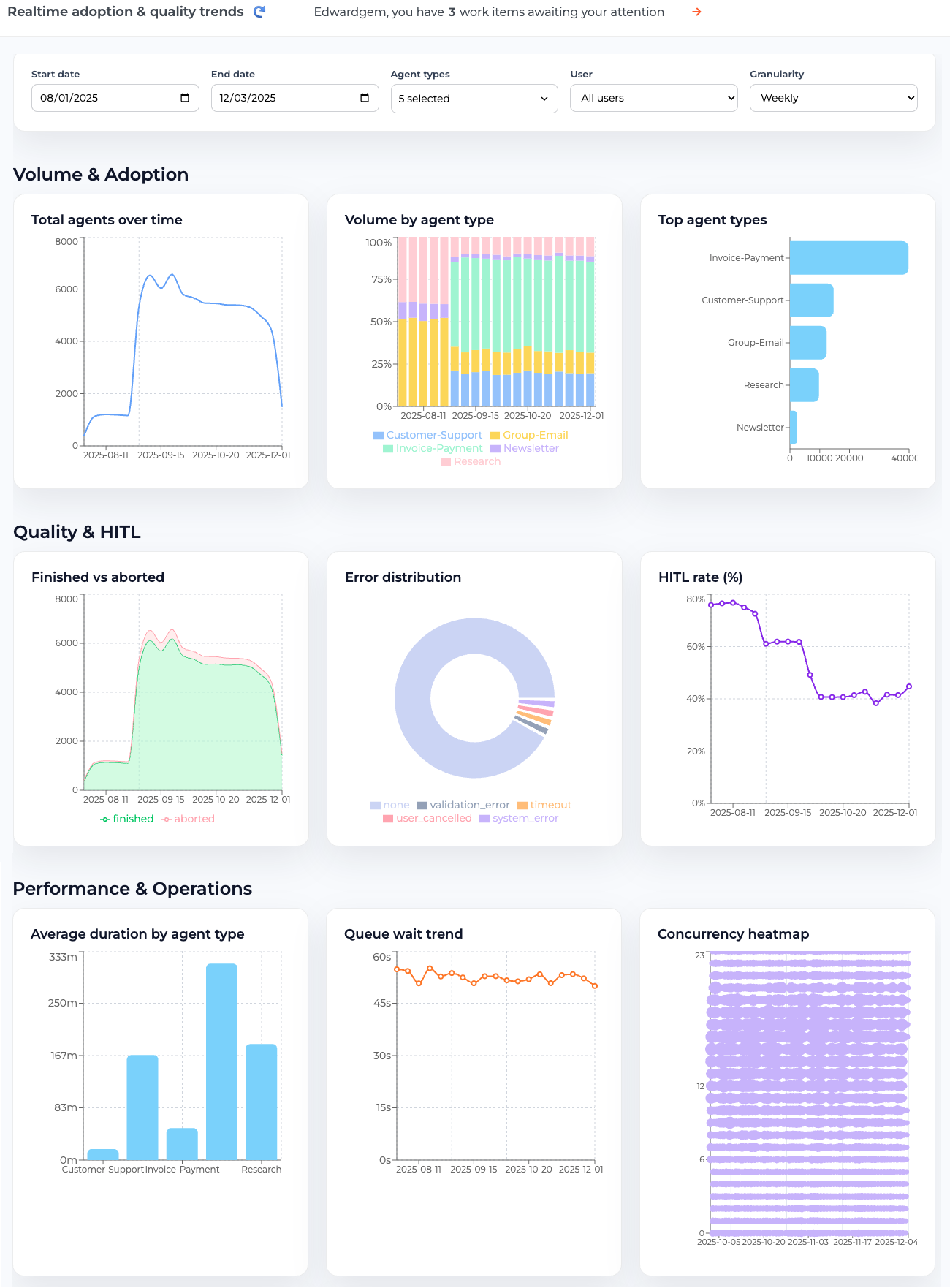
The image presents a dashboard displaying various charts and graphs related to agent adoption, quality, and performance trends over time. The dashboard includes visualizations of total agents, agent types, error distributions, HITL rates, average duration, queue wait times, and concurrency. The data spans from approximately August 2025 to December 2025.
### Components/Axes
**Header:**
* **Title:** Realtime adoption & quality trends
* **Notification:** "Edwardgem, you have 3 work items awaiting your attention"
* **Start Date:** 08/01/2025
* **End Date:** 12/03/2025
* **Agent Types:** 5 selected
* **User:** All users
* **Granularity:** Weekly
**Volume & Adoption Section:**
1. **Total agents over time:**
* **Y-axis:** Total agents, ranging from 0 to 8000.
* **X-axis:** Time, with labels at 2025-08-11, 2025-09-15, 2025-10-20, and 2025-12-01.
2. **Volume by agent type:**
* **Y-axis:** Percentage, ranging from 0% to 100%.
* **X-axis:** Time, with labels at 2025-08-11, 2025-09-15, 2025-10-20, and 2025-12-01.
* **Legend (bottom-left):**
* Customer-Support (light blue)
* Invoice-Payment (green)
* Research (pink)
* Group-Email (dark blue)
* Newsletter (yellow)
3. **Top agent types:**
* **X-axis:** Count, ranging from 0 to 40000.
* **Y-axis:** Agent types (Invoice-Payment, Customer-Support, Group-Email, Research, Newsletter).
**Quality & HITL Section:**
1. **Finished vs aborted:**
* **Y-axis:** Count, ranging from 0 to 8000.
* **X-axis:** Time, with labels at 2025-08-11, 2025-09-15, 2025-10-20, and 2025-12-01.
* **Legend (bottom):**
* Finished (green)
* Aborted (pink)
2. **Error distribution:**
* **Chart Type:** Donut chart.
* **Categories:** none (light blue), validation_error (dark blue), timeout (yellow), user_cancelled (pink), system_error (grey).
3. **HITL rate (%):**
* **Y-axis:** Percentage, ranging from 0% to 80%.
* **X-axis:** Time, with labels at 2025-08-11, 2025-09-15, 2025-10-20, and 2025-12-01.
**Performance & Operations Section:**
1. **Average duration by agent type:**
* **Y-axis:** Duration in minutes (m), ranging from 0m to 333m.
* **X-axis:** Agent types (Customer-Support, Invoice-Payment, Research).
2. **Queue wait trend:**
* **Y-axis:** Time in seconds (s), ranging from 0s to 60s.
* **X-axis:** Time, with labels at 2025-08-11, 2025-09-15, 2025-10-20, and 2025-12-01.
3. **Concurrency heatmap:**
* **Y-axis:** Count, ranging from 0 to 23.
* **X-axis:** Time, with labels at 2025-10-05, 2025-10-20, 2025-11-03, 2025-11-17, and 2025-12-04.
### Detailed Analysis
**Total agents over time:**
* The number of agents starts around 1200.
* There is a sharp increase to approximately 6800 around 2025-09-15.
* The number of agents peaks around 7000.
* The number of agents then decreases to approximately 5000 by 2025-12-01.
**Volume by agent type:**
* The stacked bar chart shows the distribution of agent types over time.
* Customer-Support (light blue) and Invoice-Payment (green) are the dominant agent types.
* The proportions of each agent type appear relatively stable over time.
**Top agent types:**
* Invoice-Payment has the highest count, approximately 38000.
* Customer-Support has a count of approximately 18000.
* Group-Email has a count of approximately 12000.
* Research has a count of approximately 8000.
* Newsletter has a count of approximately 2000.
**Finished vs aborted:**
* The number of finished tasks (green) and aborted tasks (pink) are tracked over time.
* Both finished and aborted tasks increase sharply around 2025-09-15.
* The number of finished tasks is consistently higher than the number of aborted tasks.
* Both decrease to approximately 5000 and 4000 respectively by 2025-12-01.
**Error distribution:**
* The donut chart shows the distribution of error types.
* "None" errors are the most frequent.
* Validation errors, timeouts, user-cancelled errors, and system errors are present in smaller proportions.
**HITL rate (%):**
* The HITL rate starts at approximately 78%.
* It decreases to approximately 62% around 2025-09-15.
* It further decreases to approximately 40% around 2025-10-20.
* It remains relatively stable around 40% until 2025-12-01.
* There is a slight increase to approximately 44% by 2025-12-01.
**Average duration by agent type:**
* Invoice-Payment has the highest average duration, approximately 280m.
* Customer-Support has an average duration of approximately 170m.
* Research has an average duration of approximately 200m.
**Queue wait trend:**
* The queue wait time fluctuates between approximately 48s and 52s.
* There is no clear trend of increasing or decreasing wait times.
**Concurrency heatmap:**
* The concurrency heatmap shows the distribution of concurrent tasks over time.
* The concurrency count is mostly between 10 and 23.
* There are some periods with lower concurrency counts.
### Key Observations
* There is a significant increase in total agents and finished/aborted tasks around 2025-09-15.
* Invoice-Payment is the top agent type in terms of count and average duration.
* The HITL rate decreases significantly between 2025-08-11 and 2025-10-20.
* Queue wait times remain relatively stable over time.
### Interpretation
The dashboard provides insights into the adoption, quality, and performance of agents over time. The increase in total agents and tasks around 2025-09-15 suggests a period of increased activity or a change in the system. The high volume and duration of Invoice-Payment agents indicate their importance in the overall workflow. The decreasing HITL rate may indicate improvements in automation or agent efficiency. The stable queue wait times suggest that the system is handling the workload effectively. The error distribution highlights areas where improvements can be made to reduce errors and improve the overall quality of the system. The concurrency heatmap provides insights into the utilization of resources and can be used to optimize system performance.