## Diagram: State Transition Model with Epistemic and Temporal Actions
### Overview
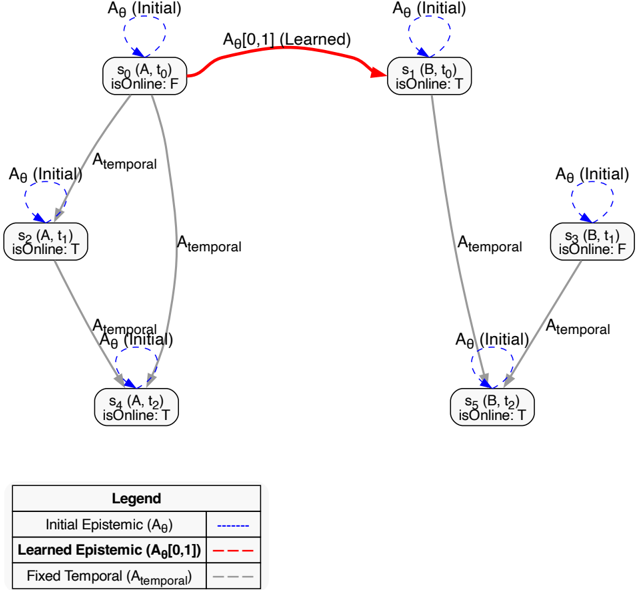
The image is a directed graph representing a state machine with six distinct states ($s_0$ through $s_5$). The diagram illustrates how an agent or system transitions between these states based on three types of actions: Initial Epistemic, Learned Epistemic, and Fixed Temporal. Each state node contains a label indicating a variable pair (e.g., $(A, t_0)$) and a boolean status ("isOnline").
### Components/Axes
* **Nodes:** Six rectangular nodes labeled $s_0$ through $s_5$.
* **Legend (Bottom-Left):** Defines the three edge types used in the diagram.
* **Initial Epistemic ($A_\theta$):** Represented by blue dashed lines.
* **Learned Epistemic ($A_\theta[0,1]$):** Represented by red dashed lines (Note: The diagram uses solid red lines).
* **Fixed Temporal ($A_{temporal}$):** Represented by grey dashed lines (Note: The diagram uses solid grey lines).
### Detailed Analysis
#### Node Definitions
Each node contains a state identifier, a variable pair, and an "isOnline" status:
| Node | Variable Pair | isOnline Status |
| :--- | :--- | :--- |
| $s_0$ | $(A, t_0)$ | F (False) |
| $s_1$ | $(B, t_0)$ | T (True) |
| $s_2$ | $(A, t_1)$ | T (True) |
| $s_3$ | $(B, t_1)$ | F (False) |
| $s_4$ | $(A, t_2)$ | T (True) |
| $s_5$ | $(B, t_2)$ | T (True) |
#### Edge/Transition Analysis
* **Initial Epistemic ($A_\theta$):** Every node ($s_0$ through $s_5$) features a self-looping blue dashed arrow labeled "$A_\theta$ (Initial)". This indicates a persistent internal state maintenance or epistemic action available at every state.
* **Learned Epistemic ($A_\theta[0,1]$):** A single red solid arrow connects $s_0$ to $s_1$. This represents a specific "learned" transition that is only available from $s_0$.
* **Fixed Temporal ($A_{temporal}$):** Grey solid arrows represent the progression of time or fixed temporal transitions:
* $s_0 \rightarrow s_2$
* $s_0 \rightarrow s_4$
* $s_1 \rightarrow s_5$
* $s_3 \rightarrow s_5$
*Note on Discrepancy:* While the legend specifies dashed lines for "Learned Epistemic" and "Fixed Temporal" actions, the actual diagram uses solid lines for these connections.
### Key Observations
* **State Bifurcation:** The states are grouped by variable $A$ ($s_0, s_2, s_4$) and variable $B$ ($s_1, s_3, s_5$).
* **Temporal Progression:** The temporal transitions generally move from $t_0$ to $t_1$ and $t_2$.
* **Connectivity:** $s_0$ is the most connected node, acting as a source for both temporal transitions and the unique learned transition. $s_5$ acts as a sink for temporal transitions from both $s_1$ and $s_3$.
* **Online Status:** The "isOnline" status is False only for $s_0$ and $s_3$. All other states ($s_1, s_2, s_4, s_5$) are "isOnline: T".
### Interpretation
This diagram appears to model a reinforcement learning or automated planning environment.
1. **Learning Mechanism:** The "Learned Epistemic" transition ($A_\theta[0,1]$) from $s_0$ to $s_1$ suggests that the system starts in an offline state ($s_0$) and, through a learned action, can transition to an online state ($s_1$).
2. **Temporal Constraints:** The "Fixed Temporal" actions ($A_{temporal}$) represent the natural progression of the system over time ($t_0 \rightarrow t_1 \rightarrow t_2$). The fact that $s_0$ can transition to both $s_2$ and $s_4$ suggests that the system can skip temporal steps or that multiple temporal paths exist from the initial state.
3. **Epistemic Stability:** The ubiquitous $A_\theta$ (Initial) self-loops suggest that the agent can perform "epistemic" actions (likely gathering information or updating beliefs) without changing the underlying state variables ($A/B$ or $t_0/t_1/t_2$).
4. **System Logic:** The system demonstrates that while the agent can be "offline" ($s_0, s_3$), it has pathways to reach an "online" state ($s_1, s_2, s_4, s_5$) either through learning ($s_0 \rightarrow s_1$) or through temporal progression ($s_0 \rightarrow s_2$).