## Diagram: Bidirectional System Interaction Model
### Overview
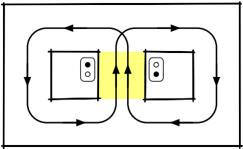
The image depicts a technical diagram illustrating bidirectional interactions between two interconnected systems or components. Arrows form closed loops around each component, with a highlighted yellow area indicating a critical interface or interaction zone between them.
### Components/Axes
- **Left Rectangle**: Contains two symbols:
- A filled black circle (●)
- An outlined white circle (○)
- **Right Rectangle**: Contains two outlined white circles (○)
- **Arrows**:
- Bidirectional arrows connect the two rectangles, forming continuous loops.
- Arrows are black with arrowheads, indicating directional flow.
- **Highlighted Area**: A yellow-shaded region between the rectangles, emphasizing the interaction zone.
### Detailed Analysis
- **Left Component Symbols**:
- Filled circle (●): Likely represents a primary state or active element.
- Outlined circle (○): May denote a secondary state or passive element.
- **Right Component Symbols**:
- Two outlined circles (○, ○): Suggests dual passive or secondary states.
- **Flow Dynamics**:
- Bidirectional arrows imply mutual exchange or synchronization between components.
- Closed loops suggest cyclical processes or feedback mechanisms.
### Key Observations
1. The highlighted yellow area between the rectangles is the only visually distinct element, suggesting its functional importance.
2. The left component has one active (●) and one passive (○) element, while the right component has two passive elements (○, ○).
3. No numerical data, labels, or legends are present in the diagram.
### Interpretation
This diagram likely represents a system architecture where two components interact bidirectionally. The left component may have a primary-active state (●) and a secondary state (○), while the right component operates in dual passive states. The highlighted yellow interface implies a critical point for data exchange, control signals, or synchronization. The absence of labels necessitates further context to confirm the exact nature of the components (e.g., hardware modules, software processes, or biological systems). The bidirectional loops suggest a closed-loop system with feedback, common in control systems, communication protocols, or coupled mechanical/electrical systems.