## Stacked Bar Chart with Line Overlay: Accuracy vs. Maximum Depth
### Overview
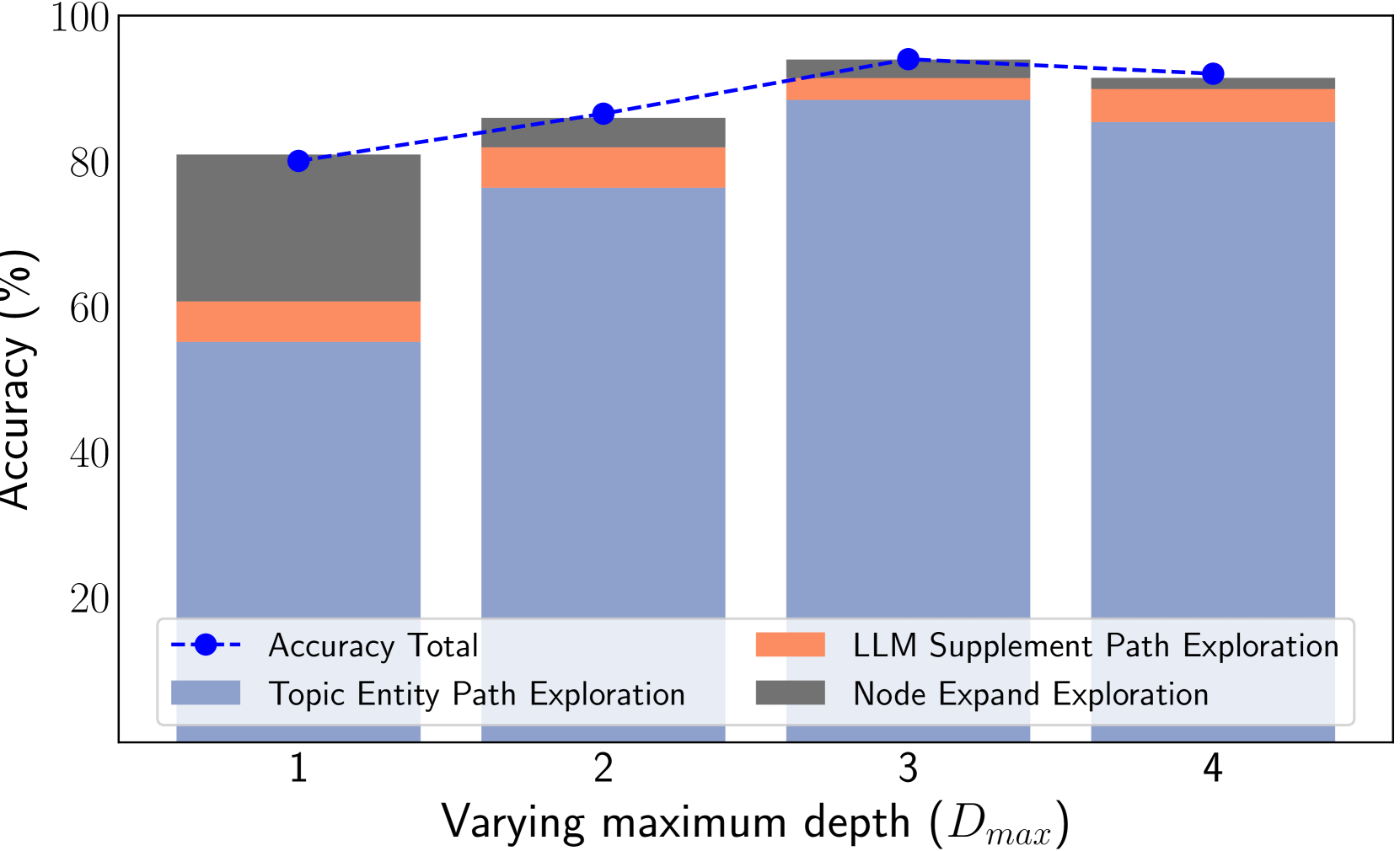
This image displays a stacked bar chart with an overlaid line graph. It illustrates how the total accuracy and the contribution of three different exploration methods change as a parameter called "Varying maximum depth (D_max)" increases from 1 to 4. The chart suggests an analysis of a system's performance, likely in a knowledge graph or information retrieval context, where different path exploration strategies contribute to an overall accuracy score.
### Components/Axes
* **Chart Type:** Stacked bar chart with a line graph overlay.
* **X-Axis:** Labeled "Varying maximum depth (D_max)". It has four discrete, evenly spaced categories marked with the integers: **1, 2, 3, 4**.
* **Y-Axis:** Labeled "Accuracy (%)". The scale runs from 0 to 100, with major tick marks and numerical labels at intervals of 20 (0, 20, 40, 60, 80, 100).
* **Legend:** Positioned at the bottom center of the chart area. It contains four entries:
1. **Accuracy Total:** Represented by a blue dashed line with circular markers (`--●--`).
2. **Topic Entity Path Exploration:** Represented by a light blue/periwinkle solid bar segment.
3. **LLM Supplement Path Exploration:** Represented by an orange solid bar segment.
4. **Node Expand Exploration:** Represented by a dark gray solid bar segment.
### Detailed Analysis
The data is presented for each of the four depth categories (D_max = 1 to 4). For each category, a single bar is composed of three stacked segments. The total height of the bar corresponds to the sum of the three components. A blue dashed line connects data points that align with the top of each bar, representing the "Accuracy Total."
**Trend Verification:**
* The **Accuracy Total (blue line)** shows an upward trend from D_max=1 to D_max=3, peaking at D_max=3, followed by a slight decrease at D_max=4.
* The **Topic Entity Path Exploration (light blue)** segment shows a strong, consistent upward trend as depth increases.
* The **LLM Supplement Path Exploration (orange)** segment appears relatively stable in height from D_max=2 to D_max=4, after being smaller at D_max=1.
* The **Node Expand Exploration (dark gray)** segment decreases significantly in height from D_max=1 to D_max=2 and remains a very small component for depths 3 and 4.
**Data Point Extraction (Approximate Values):**
* **D_max = 1:**
* Topic Entity Path Exploration: ~55%
* LLM Supplement Path Exploration: ~5% (bar from ~55% to ~60%)
* Node Expand Exploration: ~20% (bar from ~60% to ~80%)
* **Total Bar Height / Accuracy Total:** ~80%
* **D_max = 2:**
* Topic Entity Path Exploration: ~76%
* LLM Supplement Path Exploration: ~6% (bar from ~76% to ~82%)
* Node Expand Exploration: ~4% (bar from ~82% to ~86%)
* **Total Bar Height / Accuracy Total:** ~86%
* **D_max = 3:**
* Topic Entity Path Exploration: ~88%
* LLM Supplement Path Exploration: ~4% (bar from ~88% to ~92%)
* Node Expand Exploration: ~2% (bar from ~92% to ~94%)
* **Total Bar Height / Accuracy Total:** ~94%
* **D_max = 4:**
* Topic Entity Path Exploration: ~85%
* LLM Supplement Path Exploration: ~5% (bar from ~85% to ~90%)
* Node Expand Exploration: ~2% (bar from ~90% to ~92%)
* **Total Bar Height / Accuracy Total:** ~92%
### Key Observations
1. **Dominant Component:** The "Topic Entity Path Exploration" method is the primary contributor to accuracy at all depths, and its contribution grows substantially with increased depth.
2. **Diminishing Returns:** The "Node Expand Exploration" method is a major contributor only at the shallowest depth (D_max=1). Its contribution becomes negligible at deeper levels.
3. **Peak Performance:** The highest total accuracy (~94%) is achieved at a maximum depth of 3. Increasing the depth further to 4 results in a slight performance drop (~92%).
4. **Stable Supplement:** The "LLM Supplement Path Exploration" provides a small but consistent boost to accuracy across all depths, with its most notable contribution at D_max=1.
### Interpretation
The data demonstrates a clear relationship between the allowed search depth (D_max) and the system's accuracy, mediated by the exploration strategy employed.
* **Strategy Efficacy:** The "Topic Entity Path Exploration" is the most effective strategy, and its value increases with depth, suggesting that deeper, more focused searches along topic-entity paths yield better results. Conversely, the "Node Expand Exploration" strategy, which likely involves broader, less targeted expansion, is only useful when the search is very shallow (D_max=1). This implies it may introduce noise or irrelevant paths that hinder performance at greater depths.
* **Optimal Depth:** The system exhibits an optimal operating point at D_max=3. The drop in accuracy at D_max=4 could indicate the onset of over-searching, where the system begins to retrieve less relevant information or encounters computational/complexity limits that degrade performance.
* **Role of LLM Supplement:** The consistent, small contribution from "LLM Supplement Path Exploration" suggests it acts as a reliable auxiliary method, possibly filling gaps left by the primary topic-entity path method, but it is not the main driver of performance gains.
* **System Design Implication:** For this system, configuring a maximum depth of 3 and prioritizing the "Topic Entity Path Exploration" algorithm would maximize accuracy. The "Node Expand Exploration" method could potentially be disabled or heavily constrained for depths greater than 1 to save resources without harming performance.