## Diagram: Hybrid Dynamical System Framework
### Overview
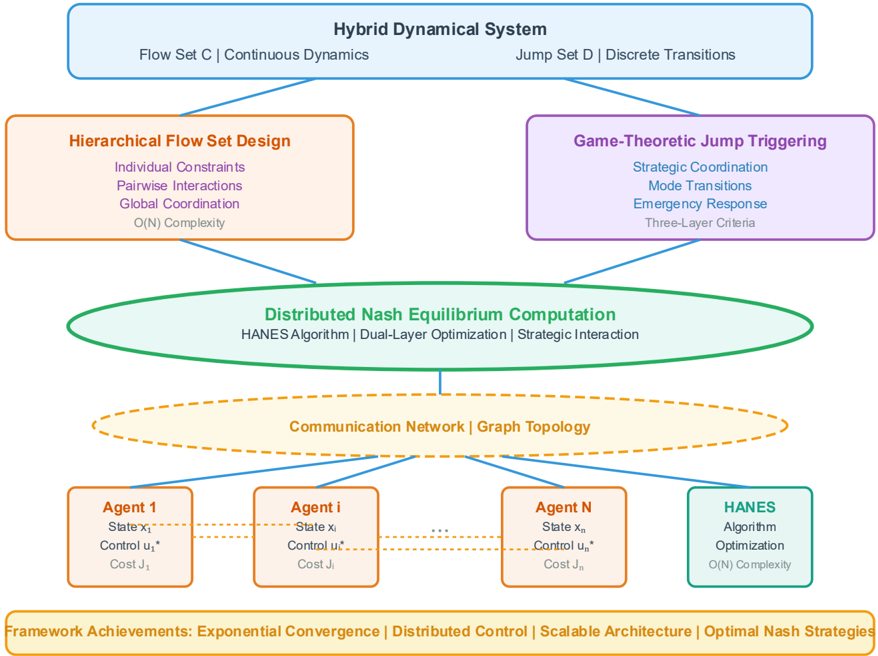
The image depicts a diagram illustrating a framework for a Hybrid Dynamical System. The system is broken down into four main components: Hierarchical Flow Set Design, Game-Theoretic Jump Triggering, Distributed Nash Equilibrium Computation, and a Communication Network. These components are interconnected and supported by a "Framework Achievements" section at the bottom. The diagram uses color-coding to differentiate the components and their associated characteristics.
### Components/Axes
The diagram is structured around the central concept of a "Hybrid Dynamical System" at the top, branching into four main areas.
* **Top Header:** "Hybrid Dynamical System" with sub-categories "Flow Set C | Continuous Dynamics" and "Jump Set D | Discrete Transitions".
* **Left Branch (Light Blue):** "Hierarchical Flow Set Design" with sub-categories: "Individual Constraints", "Pairwise Interactions", "Global Coordination", and "O(N) Complexity".
* **Right Branch (Purple):** "Game-Theoretic Jump Triggering" with sub-categories: "Strategic Coordination", "Mode Transitions", "Emergency Response", and "Three-Layer Criteria".
* **Center (Green):** "Distributed Nash Equilibrium Computation" with sub-categories: "HANESAlgorithm | Dual-Layer Optimization | Strategic Interaction".
* **Bottom (Orange):** "Communication Network | Graph Topology" with three "Agent" blocks (Agent 1, Agent i, Agent N) and a "HANES Algorithm" block.
* **Agent Blocks:** Each agent block contains "State xᵢ", "Control uᵢ*", and "Cost Jᵢ".
* **HANES Algorithm Block:** Contains "Algorithm", "Optimization", and "O(N) Complexity".
* **Footer (Yellow):** "Framework Achievements: Exponential Convergence | Distributed Control | Scalable Architecture | Optimal Nash Strategies".
### Detailed Analysis or Content Details
The diagram illustrates a system where continuous dynamics (Flow Set C) and discrete transitions (Jump Set D) are managed through hierarchical flow set design and game-theoretic jump triggering. These are coordinated via distributed Nash equilibrium computation, facilitated by a communication network.
* **Hierarchical Flow Set Design:** Focuses on managing individual constraints, pairwise interactions, and global coordination, with a computational complexity of O(N).
* **Game-Theoretic Jump Triggering:** Emphasizes strategic coordination, mode transitions, emergency response, and utilizes a three-layer criteria for triggering jumps.
* **Distributed Nash Equilibrium Computation:** Leverages the HANES algorithm, dual-layer optimization, and strategic interaction to achieve equilibrium.
* **Communication Network:** Connects multiple agents (Agent 1, Agent i, Agent N) allowing for information exchange. Each agent has a state (xᵢ), control input (uᵢ*), and associated cost (Jᵢ). The HANES algorithm is also integrated into the network.
* **Agent Details:**
* Agent 1: State x₁, Control u₁*, Cost J₁.
* Agent i: State xᵢ, Control uᵢ*, Cost Jᵢ.
* Agent N: State xₙ, Control uₙ*, Cost Jₙ.
* **HANES Algorithm:** The HANES algorithm is used for optimization and has a computational complexity of O(N).
* **Framework Achievements:** The framework boasts exponential convergence, distributed control, scalable architecture, and optimal Nash strategies.
### Key Observations
The diagram highlights the interplay between continuous and discrete dynamics within a distributed system. The use of the HANES algorithm suggests a focus on optimization and game theory. The O(N) complexity indicates a potential scalability challenge as the number of agents (N) increases. The diagram emphasizes a layered approach, with hierarchical flow design, game-theoretic triggering, and distributed computation working in concert.
### Interpretation
This diagram represents a sophisticated control framework for hybrid systems, likely applicable to multi-agent systems or complex robotic coordination. The framework aims to achieve optimal performance by leveraging game theory and distributed computation. The emphasis on scalability (O(N) complexity) suggests that the framework is designed to handle a large number of agents, but also acknowledges the potential computational limitations. The integration of continuous and discrete dynamics allows the system to respond to both gradual changes and abrupt events. The "Emergency Response" component within the Game-Theoretic Jump Triggering suggests a focus on robustness and safety. The HANES algorithm appears to be a core component, providing the optimization engine for the distributed Nash equilibrium computation. The diagram is a high-level overview, and further details would be needed to understand the specific implementation and performance characteristics of the framework.