## Diagram: Paradigm-Dependent Multi-Agent Systems Architecture
### Overview
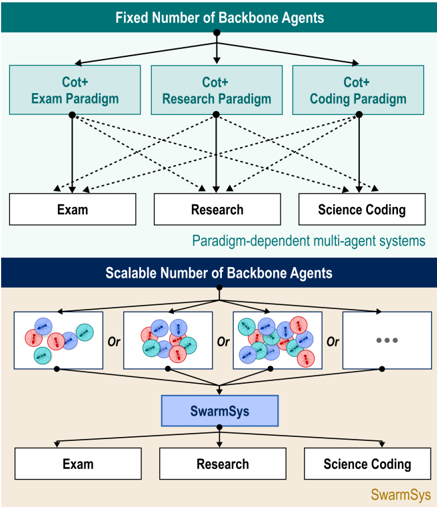
The image presents a comparative architecture of two multi-agent systems: one with a fixed number of backbone agents and another with a scalable number. It illustrates how different paradigms (exam, research, science coding) interact with backbone agents under each system type.
### Components/Axes
**Top Section (Fixed Number of Backbone Agents):**
- **Header:** "Fixed Number of Backbone Agents" (dark teal banner)
- **Three Paradigm Boxes:**
1. "Cot+ Exam Paradigm" (left)
2. "Cot+ Research Paradigm" (center)
3. "Cot+ Coding Paradigm" (right)
- **Three Task Boxes:**
- "Exam" (bottom-left)
- "Research" (bottom-center)
- "Science Coding" (bottom-right)
- **Connections:** Dotted bidirectional arrows between paradigms and tasks
- **Footer Text:** "Paradigm-dependent multi-agent systems" (bottom-center)
**Bottom Section (Scalable Number of Backbone Agents):**
- **Header:** "Scalable Number of Backbone Agents" (dark blue banner)
- **Agent Clusters:**
- Multiple overlapping circles in red, blue, and green (representing agents)
- Connected via "or" operators between clusters
- **Central Box:** "SwarmSys" (light blue box)
- **Three Task Boxes:** Same as top section ("Exam," "Research," "Science Coding")
- **Connections:** Solid arrows from SwarmSys to tasks
- **Footer Text:** "SwarmSys" (bottom-right, orange text)
### Detailed Analysis
**Fixed System Architecture:**
1. Three distinct paradigms (exam, research, coding) each have dedicated connections to their respective tasks
2. Bidirectional dotted arrows suggest mutual influence between paradigms and tasks
3. Paradigms appear specialized but interconnected through shared task dependencies
**Scalable System Architecture:**
1. "SwarmSys" acts as a central coordinator for all tasks
2. Multiple agent clusters (red/blue/green) represent flexible agent populations
3. "or" operators between clusters imply combinatorial agent selection possibilities
4. Solid arrows indicate top-down task assignment from SwarmSys
**Color Coding:**
- Red/blue/green circles likely represent different agent types or capabilities
- Orange text ("SwarmSys") distinguishes the scalable system's core component
### Key Observations
1. Fixed system emphasizes paradigm-specific agent-task relationships
2. Scalable system introduces a centralized coordination layer (SwarmSys)
3. Bidirectional vs. unidirectional connections suggest different interaction models
4. "or" operators in scalable system imply non-deterministic agent selection
5. Both systems share the same three core tasks but implement them differently
### Interpretation
This diagram illustrates two approaches to multi-agent system design:
1. **Fixed Paradigm System:** Suitable for well-defined tasks with stable requirements. The paradigm-dependent connections suggest specialized agents for specific domains (exams, research, coding), potentially optimizing performance through focused expertise.
2. **Scalable Swarm System:** Designed for dynamic environments requiring flexible resource allocation. The SwarmSys central coordinator manages variable agent populations (represented by colored circles), with "or" operators suggesting adaptive task assignment based on current agent availability and capabilities.
The bidirectional arrows in the fixed system imply knowledge sharing between paradigms, while the scalable system's solid arrows suggest more rigid task delegation. The color-coded agents in the scalable system may represent different skill sets or processing capabilities that SwarmSys can dynamically combine.
The diagram highlights a fundamental tradeoff: fixed systems offer specialized efficiency at the cost of flexibility, while scalable systems provide adaptability through distributed intelligence but may sacrifice some optimization potential. This architectural comparison is particularly relevant for domains requiring both domain-specific expertise and dynamic resource management.