## Infographic: Movie Industry Analysis Framework
### Overview
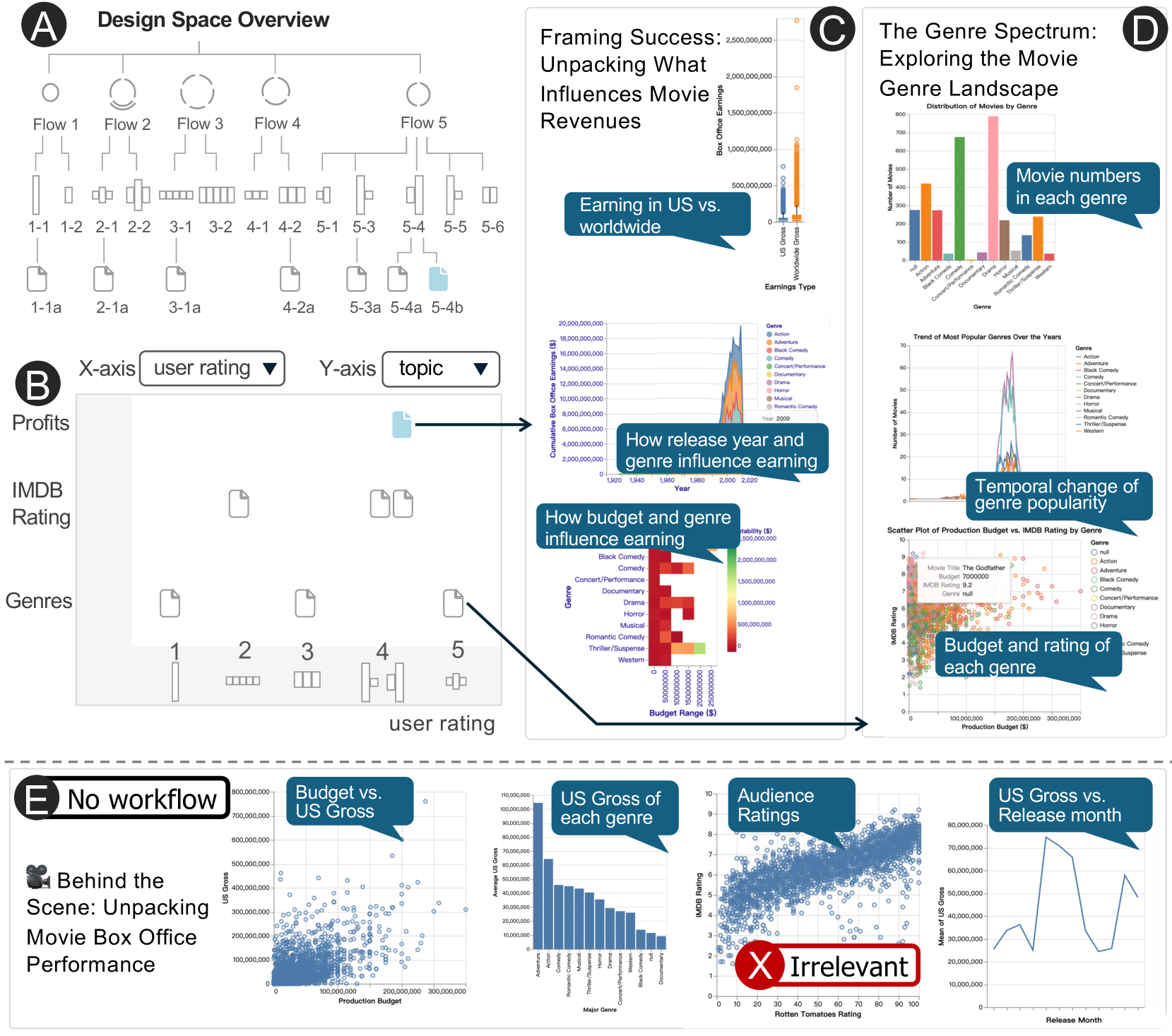
The image presents a multi-section technical document analyzing movie industry dynamics through data visualization. It combines flowcharts, scatter plots, bar charts, and line graphs to explore relationships between production budgets, earnings, genres, and audience reception. Sections A-E represent distinct analytical frameworks.
### Components/Axes
**Section A: Design Space Overview**
- Flowchart with 5 main flows (Flow 1-5) and sub-flows (1-1a, 2-1a, 3-1a, 4-2a, 5-3a, 5-4b)
- Components: Circles (flows), rectangles (sub-flows), connecting lines
- Labels: "Flow 1" to "Flow 5" with hierarchical sub-flow numbering
**Section B: Genre-User Rating Matrix**
- X-axis: User Rating (dropdown)
- Y-axis: Topic (dropdown)
- Elements: Profits, IMDb Rating, Genres (represented by document icons)
- Positioning: Matrix layout with 5 genre categories (1-5)
**Section C: Framing Success**
1. **Bar Chart**: US vs. Worldwide Earnings
- X-axis: Earnings Type (US Gross, Worldwide Gross)
- Y-axis: Earnings ($)
- Data: US Gross ~$1.2B, Worldwide Gross ~$3.5B
2. **Line Graph**: Release Year vs. Genre Influence
- X-axis: Year (2009-2020)
- Y-axis: Cumulative Earnings ($)
- Trend: Peak in 2015 ($20B), decline to $15B by 2020
3. **Heatmap**: Budget vs. Genre Influence
- Color scale: Red (high budget) to Blue (low budget)
- Notable: Action/Adventure shows highest budget density
4. **Scatter Plot**: Budget vs. IMDb Rating
- X-axis: Production Budget ($)
- Y-axis: IMDb Rating (0-10)
- Red X labeled "Irrelevant" at ($300M, 4.5)
**Section D: Genre Spectrum**
1. **Bar Chart**: Genre Distribution
- Genres: Action (450), Comedy (300), Drama (600), Horror (200), Romance (150)
- Y-axis: Number of Movies (0-800)
2. **Line Graph**: Genre Popularity Over Time
- X-axis: Year (2000-2020)
- Y-axis: Movie Count (0-80)
- Trend: Peak ~2010 (70 movies), decline to 40 by 2020
3. **Scatter Plot**: Budget vs. IMDb Rating
- Color gradient: Red (high budget) to Blue (low budget)
- Notable: High-budget films cluster at lower ratings
**Section E: No Workflow Analysis**
1. **Scatter Plot**: Budget vs. US Gross
- X-axis: Production Budget ($)
- Y-axis: US Gross ($)
- Data points: Blue dots showing weak correlation
2. **Bar Chart**: US Gross by Genre
- Genres: Action ($1.2B), Comedy ($800M), Drama ($950M), Horror ($600M)
3. **Scatter Plot**: Audience Ratings vs. Rotten Tomatoes
- X-axis: Rotten Tomatoes (0-100)
- Y-axis: Audience Rating (0-10)
- Blue dots show positive correlation
4. **Line Graph**: US Gross vs. Release Month
- X-axis: Month (Jan-Dec)
- Y-axis: US Gross ($)
- Trend: Peaks in March ($75M) and July ($90M)
### Key Observations
1. **Budget-Quality Disconnect**: High-budget films (red in heatmap) show lower IMDb ratings (red X at $300M budget, 4.5 rating)
2. **Genre Dominance**: Action/Adventure dominates both budget and earnings metrics
3. **Temporal Shifts**: Genre popularity peaked in 2010, with significant decline by 2020
4. **Release Timing**: March and July show highest US gross earnings
5. **Audience-Professional Alignment**: Positive correlation between audience ratings and Rotten Tomatoes scores
### Interpretation
The data reveals complex industry dynamics:
1. **Budget vs. Quality**: High production budgets don't guarantee critical success, evidenced by the "Irrelevant" outlier
2. **Genre Economics**: Action/Adventure dominates financially but shows declining popularity over time
3. **Release Strategy**: Summer months (March-July) correlate with highest earnings, suggesting strategic release planning
4. **Audience Consensus**: Strong alignment between professional (Rotten Tomatoes) and audience ratings indicates reliable critical consensus
5. **Market Saturation**: Despite high budgets, the scatter plots show no clear correlation between spending and returns, suggesting market unpredictability
The framework demonstrates how multiple factors (budget, genre, timing) interact to influence movie success, with notable exceptions challenging traditional assumptions about production investment and returns.