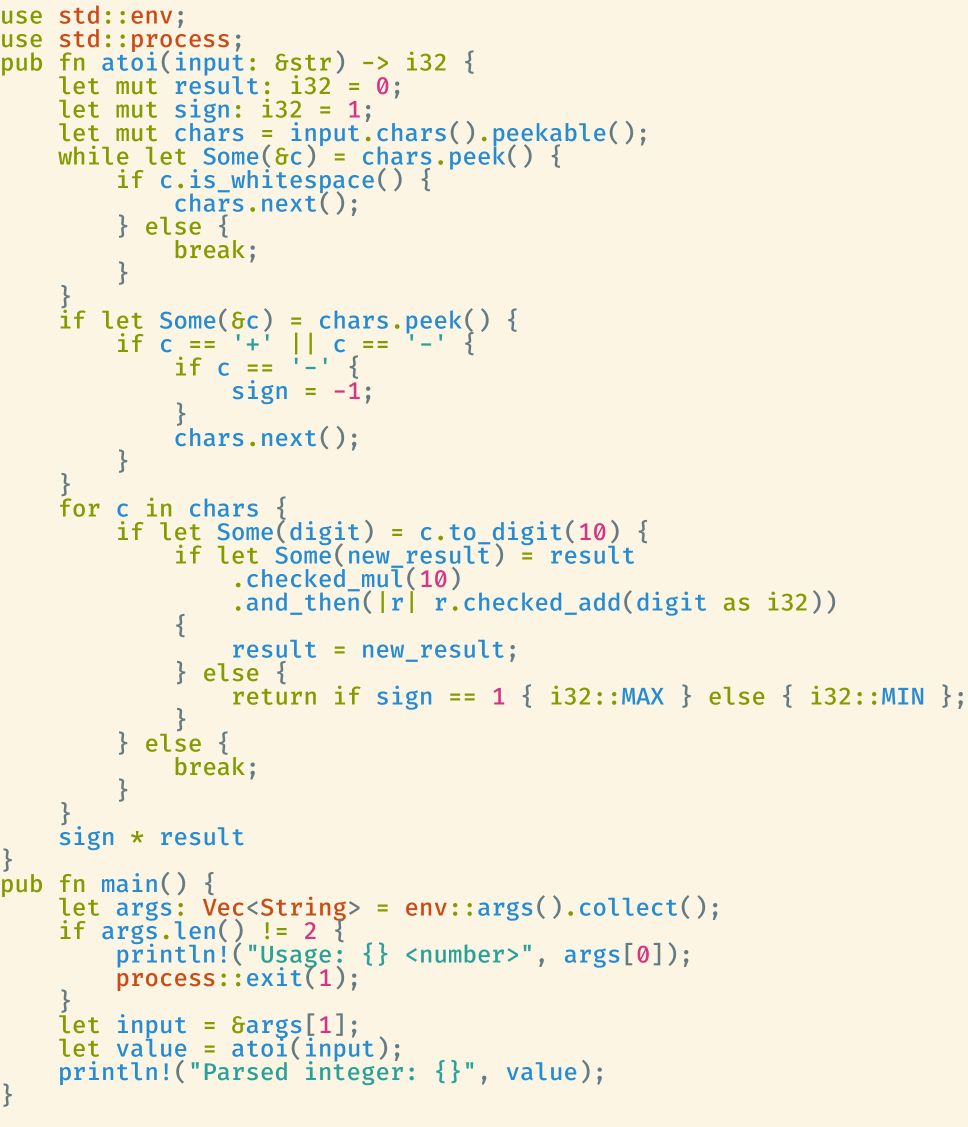
## Rust Code: Integer Parsing and Command-Line Argument Handling
### Overview
This code implements a command-line utility that parses an integer from user input, handling edge cases like overflow, invalid characters, and sign detection. It uses Rust's standard libraries for environment interaction and error handling.
### Components/Axes
- **Standard Libraries**:
- `std::env` for command-line argument access
- `std::process` for process exit functionality
- **Key Functions**:
- `atoi(input: &str) -> i32`: Custom string-to-integer conversion
- `main()`: Entry point handling argument validation and parsing
### Detailed Analysis
1. **Argument Validation**:
- Checks if exactly 2 arguments exist (`args.len() != 2`)
- Prints usage message `"Usage: <number>"` on invalid input count
- Exits with code 1 on argument count mismatch
2. **Integer Parsing Logic**:
- **Sign Detection**:
- Scans for leading `+` or `-` to set `sign` (1 or -1)
- Skips whitespace before sign detection
- **Digit Processing**:
- Converts characters to digits using `to_digit(10)`
- Uses `checked_add` for safe arithmetic to prevent overflow
- Returns `i32::MAX`/`i32::MIN` on overflow detection
- **Error Handling**:
- Returns `None` for non-digit characters
- Breaks loop on invalid input during parsing
3. **Output**:
- Prints parsed integer with `"Parsed integer: {value}"`
- Uses `println!` macro for formatted output
### Key Observations
- **Overflow Protection**: Explicit checks using `checked_add` and bounds (`i32::MAX`/`i32::MIN`)
- **Whitespace Handling**: Skips leading whitespace before sign detection
- **Command-Line Interface**: Strict argument count validation (requires exactly one input)
- **Rust Safety Features**: Leverages `checked_*` methods for memory-safe operations
### Interpretation
This code demonstrates Rust's emphasis on safety and explicit error handling. The custom `atoi` implementation:
1. **Prevents Buffer Overflow**: By validating input length and character validity
2. **Handles Edge Cases**:
- Leading/trailing whitespace
- Positive/negative signs
- 32-bit integer overflow
3. **Integrates with CLI**: Follows Unix-style argument parsing conventions
The code's structure reflects Rust's ownership model through:
- Immutable references (`&str`)
- Explicit error propagation via `Option` types
- Safe arithmetic operations
Notable design choices include:
- Returning `i32::MAX`/`i32::MIN` for overflow instead of panicking
- Using `checked_add` to avoid undefined behavior
- Clear separation of sign handling and digit accumulation