## Heatmap: Node Degree Distribution
### Overview
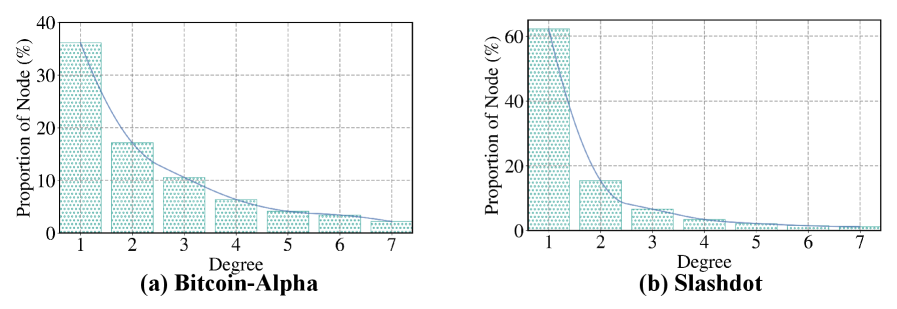
The image displays two heatmaps, (a) Bitcoin-Alpha and (b) Slashdot, which represent the distribution of node degrees in their respective networks. The x-axis shows the degree of nodes, ranging from 1 to 7, while the y-axis represents the proportion of nodes with that degree, measured in percentages.
### Components/Axes
- **Bitcoin-Alpha (a)**:
- **X-Axis**: Degree of nodes (1 to 7)
- **Y-Axis**: Proportion of nodes with that degree (%)
- **Legend**: Not visible in the image
- **Data Points**: Represented by dots, with varying sizes indicating the proportion of nodes with each degree.
- **Slashdot (b)**:
- **X-Axis**: Degree of nodes (1 to 7)
- **Y-Axis**: Proportion of nodes with that degree (%)
- **Legend**: Not visible in the image
- **Data Points**: Represented by dots, with varying sizes indicating the proportion of nodes with each degree.
### Detailed Analysis or ### Content Details
- **Bitcoin-Alpha (a)**:
- The highest proportion of nodes is observed at degree 1, with approximately 35% of nodes having a degree of 1.
- The proportion decreases sharply as the degree increases, with the highest proportion at degree 7, around 10%.
- The distribution is relatively flat, with no significant peaks or valleys.
- **Slashdot (b)**:
- The highest proportion of nodes is observed at degree 1, with approximately 45% of nodes having a degree of 1.
- The proportion decreases sharply as the degree increases, with the highest proportion at degree 7, around 5%.
- The distribution is relatively flat, with no significant peaks or valleys.
### Key Observations
- Both networks show a high proportion of nodes with a degree of 1, indicating a centralized structure.
- The Slashdot network has a slightly higher proportion of nodes with a degree of 1 compared to Bitcoin-Alpha.
- The distribution is relatively flat, with no significant peaks or valleys, suggesting a balanced network structure.
### Interpretation
The data suggests that both Bitcoin-Alpha and Slashdot networks have a centralized structure, with a high proportion of nodes having a degree of 1. This could indicate that these networks are dominated by a few highly connected nodes, which could be critical for the network's functionality and security. The relatively flat distribution suggests that the networks are balanced, with no single node dominating the network. However, the Slashdot network has a slightly higher proportion of nodes with a degree of 1, which could indicate a different level of centralization or a different network structure.