TECHNICAL ASSET FINGERPRINT
1dee2b6323179bc930a92893
Click to view fullscreen
Press ESC or click to close
FOUND IN PAPERS
EXPERT: healer-alpha-free VERSION 1
RUNTIME: free/openrouter/healer-alpha
INTEL_VERIFIED
## Diagram: Iterative Code Generation Process with Knowledge Retrieval
### Overview
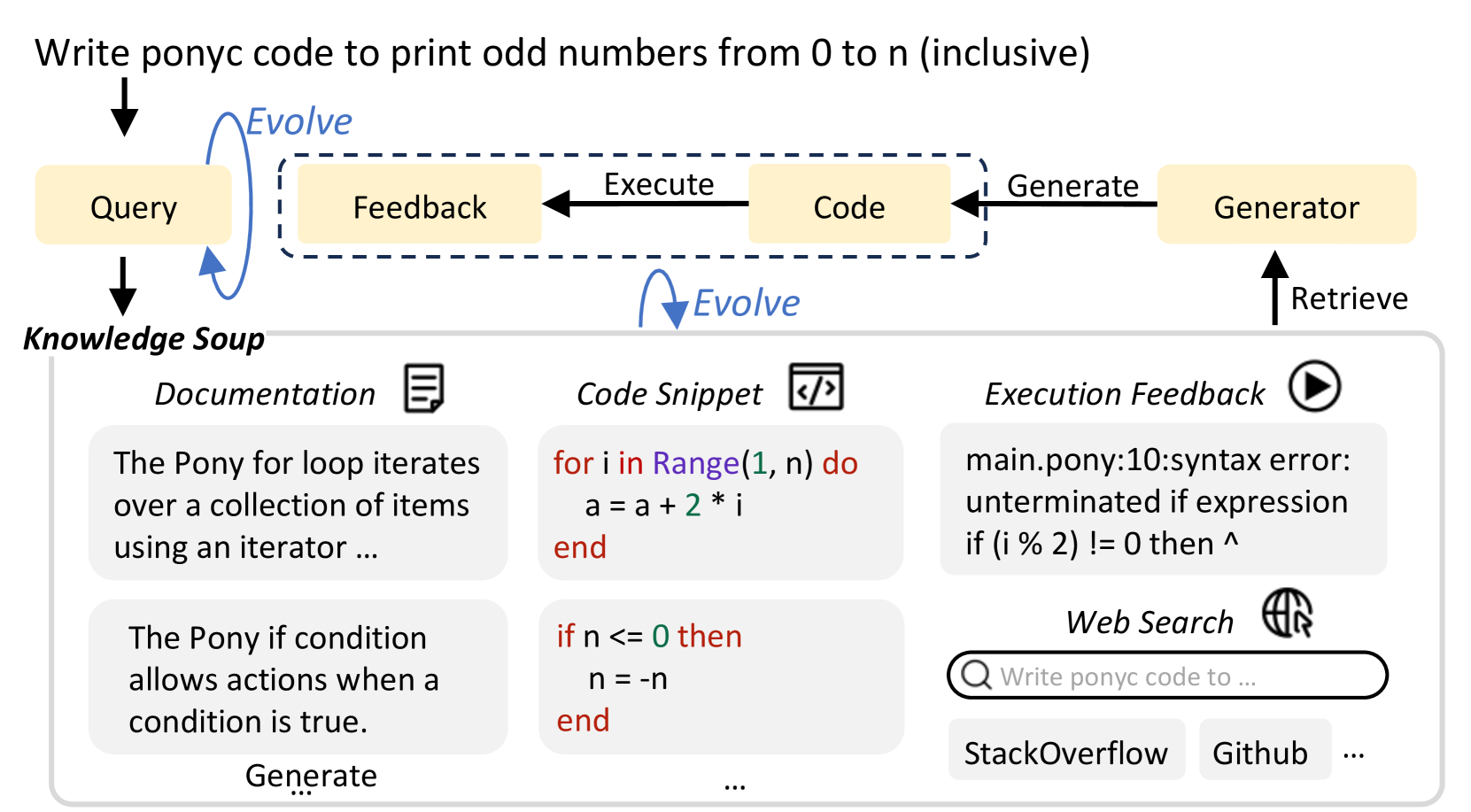
The image is a technical diagram illustrating an iterative, feedback-driven system for generating code (specifically Ponyc code) to solve a given programming query. The system incorporates a "Knowledge Soup" of external resources to inform and evolve the generated code. The overall process is cyclical, involving query input, code generation, execution, feedback, and retrieval of knowledge to improve subsequent iterations.
### Components/Axes
The diagram is divided into two primary sections:
1. **Top Flowchart (Process Loop):**
* **Title:** "Write ponyc code to print odd numbers from 0 to n (inclusive)"
* **Main Process Boxes (from left to right):**
* `Query` (light yellow box, top-left)
* `Feedback` (light yellow box, center-left)
* `Code` (light yellow box, center-right)
* `Generator` (light yellow box, top-right)
* **Arrows & Labels:**
* A downward arrow from the title points to the `Query` box.
* A curved, double-headed blue arrow labeled `Evolve` connects the `Query` and `Feedback` boxes.
* A dashed rectangle encloses the `Feedback` and `Code` boxes.
* A horizontal arrow labeled `Execute` points from `Code` to `Feedback`.
* A horizontal arrow labeled `Generate` points from `Generator` to `Code`.
* A vertical arrow labeled `Retrieve` points upward from the "Knowledge Soup" section to the `Generator` box.
* A curved, double-headed blue arrow labeled `Evolve` connects the dashed rectangle (Feedback/Code) to the "Knowledge Soup" below.
2. **Bottom Section ("Knowledge Soup"):**
* **Title:** `Knowledge Soup` (bold, top-left of the section)
* **Three Columns:**
* **Left Column: `Documentation`** (with a document icon 📄)
* Text Block 1: "The Pony for loop iterates over a collection of items using an iterator ..."
* Text Block 2: "The Pony if condition allows actions when a condition is true."
* Label at bottom: `Generate` (with an ellipsis `...`)
* **Center Column: `Code Snippet`** (with a code icon `</>`)
* Snippet 1:
```
for i in Range(1, n) do
a = a + 2 * i
end
```
* Snippet 2:
```
if n <= 0 then
n = -n
end
```
* Label at bottom: `...` (ellipsis)
* **Right Column: `Execution Feedback`** (with a play icon ▶️)
* Error Message: "main.pony:10:syntax error: unterminated if expression if (i % 2) != 0 then ^"
* **Sub-section: `Web Search`** (with a globe icon 🌐)
* Search Bar: Contains placeholder text "Write ponyc code to ..."
* Source Buttons: `StackOverflow`, `Github`, `...` (ellipsis)
### Detailed Analysis
The diagram details a closed-loop system for automated code generation and refinement.
* **Process Initiation:** The process begins with a natural language `Query` ("Write ponyc code to print odd numbers from 0 to n (inclusive)").
* **Core Generation Loop:** The `Generator` component produces `Code` based on the query and retrieved knowledge. This code is then `Execute`d, and the results (success or error) become `Feedback`. This feedback loop is enclosed in a dashed box, indicating a tight coupling. The `Evolve` arrow suggests that both the query understanding and the code/feedback pair are iteratively refined.
* **Knowledge Integration:** The `Generator` does not work in isolation. It actively `Retrieve`s information from the `Knowledge Soup`. This soup is a multi-modal repository containing:
* **Documentation:** Natural language explanations of Ponyc syntax (for loops, if conditions).
* **Code Snippets:** Concrete examples of Ponyc code structures.
* **Execution Feedback:** Specific error messages from previous code execution attempts (e.g., a syntax error on line 10 of `main.pony`).
* **Web Search:** A mechanism to fetch additional knowledge from external sources like StackOverflow and Github.
* **Evolution:** The system is designed to `Evolve`. The blue `Evolve` arrows indicate that knowledge from the soup informs the generator, and the outcomes of the code/feedback cycle can, in turn, update the knowledge soup itself (e.g., by adding a new learned code pattern or a resolved error case).
### Key Observations
1. **Iterative Refinement:** The system is fundamentally iterative, not a one-shot generator. It relies on execution feedback to improve.
2. **Multi-Source Knowledge:** The "Knowledge Soup" explicitly combines static documentation, executable code examples, runtime errors, and dynamic web search, creating a rich context for the generator.
3. **Error-Driven Learning:** The inclusion of a specific syntax error ("unterminated if expression") in the feedback column highlights that the system uses concrete failure cases to guide correction.
4. **Ambiguity in "Evolve":** The term `Evolve` is used in two contexts: 1) between Query and Feedback, and 2) between the core loop and the Knowledge Soup. This implies evolution happens at both the problem-understanding and solution-generation levels.
### Interpretation
This diagram represents a sophisticated **self-correcting code generation agent**. It moves beyond simple prompt-response models by incorporating a persistent, updatable memory (the Knowledge Soup) and a validation step (code execution).
* **What it demonstrates:** The system aims to solve the "hallucination" problem in code generation by grounding its output in verifiable execution results and curated knowledge. The flow shows a machine learning or AI agent that learns from its mistakes (feedback) and external resources to progressively generate correct code.
* **Relationships:** The `Generator` is the central actor, but it is entirely dependent on the `Knowledge Soup` for its capabilities and the `Feedback` loop for its validation. The `Query` is the driver, but it too can be evolved based on the process.
* **Notable Implications:** The presence of `Web Search` indicates the system's knowledge is not static; it can expand its context window dynamically. The specific Ponyc language example suggests this framework is language-agnostic and could be applied to any programming language where documentation, code, and execution feedback are available. The ultimate goal is to transform a high-level, possibly ambiguous query into correct, executable code through a process of retrieval, generation, execution, and evolution.
DECODING INTELLIGENCE...