TECHNICAL ASSET FINGERPRINT
1e2201723d75a63c97cc80e0
Click to view fullscreen
Press ESC or click to close
FOUND IN PAPERS
EXPERT: gemini-2.0-flash VERSION 1
RUNTIME: nugit/gemini/gemini-2.0-flash
INTEL_VERIFIED
## Code Comparison: LLM vs. LLM + APOLLO
### Overview
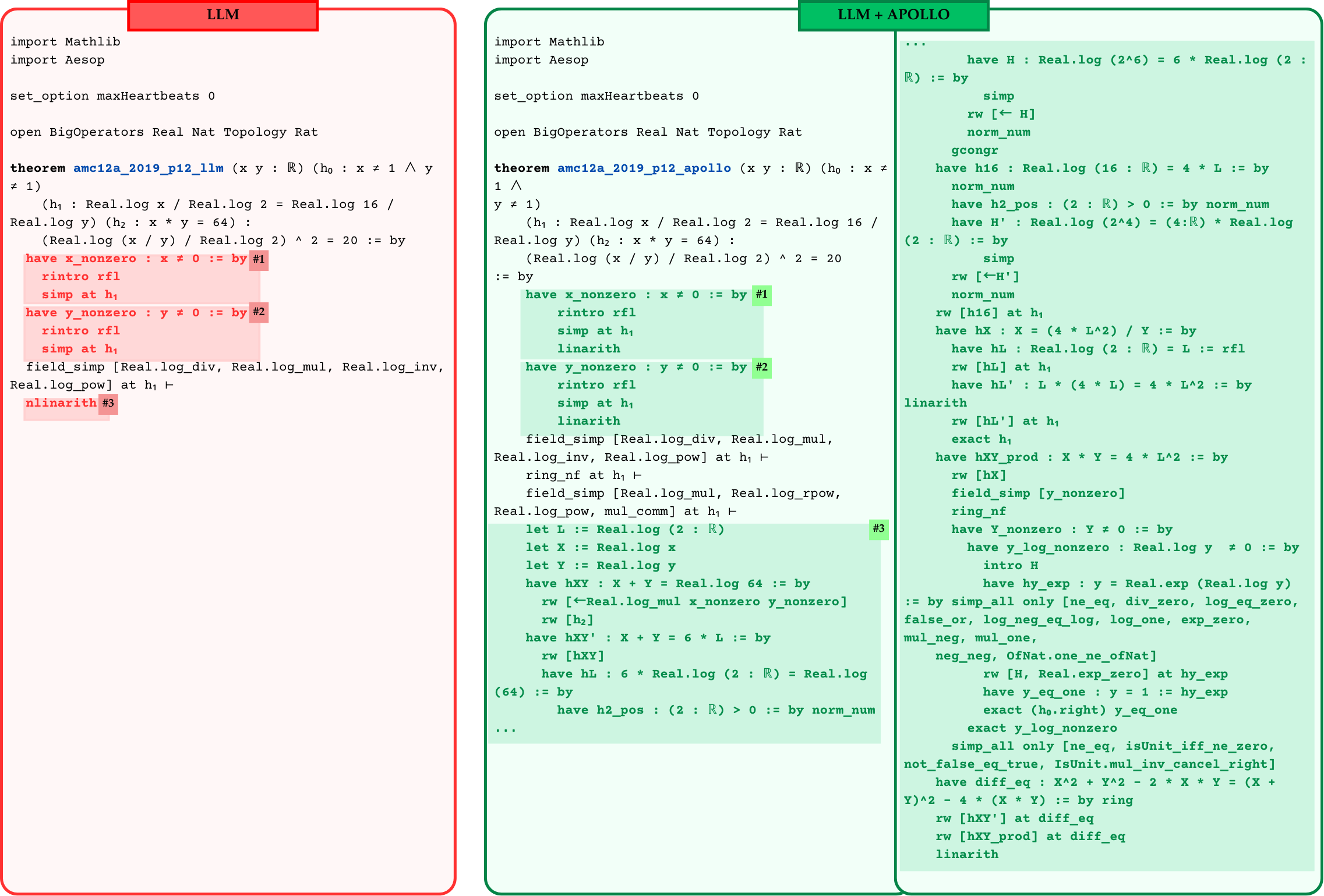
The image presents a side-by-side comparison of code snippets, labeled "LLM" (left) and "LLM + APOLLO" (right), likely representing different approaches or versions of a mathematical proof or computation. The code appears to be written in a language related to theorem proving or formal verification, possibly Lean. The comparison highlights differences in the code structure and specific commands used.
### Components/Axes
* **Headers:**
* Left: "LLM" (red background)
* Right: "LLM + APOLLO" (green background)
* **Code Blocks:** Two distinct code blocks, one under each header.
* **Annotations:** Numerical annotations (#1, #2, #3) highlight specific lines or sections in each code block.
* The code includes imports, options settings, theorem definitions, and proof steps.
### Detailed Analysis or ### Content Details
**Left Code Block (LLM):**
```lean
import Mathlib
import Aesop
set_option maxHeartbeats 0
open BigOperators Real Nat Topology Rat
theorem amc12a_2019_p12_1lm (x y : R) (h₀ : x ≠ 1 ∧ y ≠ 1)
(h₁ : Real.log x / Real.log 2 = Real.log 16 / Real.log y) (h₂ : x * y = 64) :
(Real.log (x / y) / Real.log 2) ^ 2 = 20 := by
have x_nonzero : x ≠ 0 := by #1
rintro rfl
simp at h₁
have y_nonzero : y ≠ 0 := by #2
rintro rfl
simp at h₁
field_simp [Real.log_div, Real.log_mul, Real.log_inv, Real.log_pow] at h₁
nlinarith #3
```
**Right Code Block (LLM + APOLLO):**
```lean
import Mathlib
import Aesop
set_option maxHeartbeats 0
open BigOperators Real Nat Topology Rat
theorem amc12a_2019_p12_apollo (x y : R) (h₀ : x ≠ 1 ∧ y ≠ 1)
(h₁ : Real.log x / Real.log 2 = Real.log 16 / Real.log y) (h₂ : x * y = 64) :
(Real.log (x / y) / Real.log 2) ^ 2 = 20 := by
have x_nonzero : x ≠ 0 := by #1
rintro rfl
simp at h₁
linarith
have y_nonzero : y ≠ 0 := by #2
rintro rfl
simp at h₁
linarith
field_simp [Real.log_div, Real.log_mul, Real.log_inv, Real.log_pow] at h₁
ring_nf at h₁
field_simp [Real.log_mul, Real.log_rpow, Real.log_pow, mul_comm] at h₁
let L := Real.log (2 : R)
let X := Real.log x
let Y := Real.log y
have hXY : X + Y = Real.log 64 := by
rw [Real.log_mul x_nonzero y_nonzero]
rw [h₂]
have hXY' : X + Y = 6 * L := by
rw [hXY]
have hL : 6 * Real.log (2 : R) = Real.log (64) := by
have h₂_pos : (2 : R) > 0 := by norm_num
have H : Real.log (2^6) = 6 * Real.log (2 : R) := by
simp
rw [← H]
norm_num
gcongr
have h16 : Real.log (16 : R) = 4 * L := by
norm_num
have h₂_pos : (2 : R) > 0 := by norm_num
have H' : Real.log (2^4) = (4 : R) * Real.log (2 : R) := by
simp
rw [← H']
norm_num
rw [h16] at h₁
have hX : X = (4 * L^2) / Y := by
have hL : Real.log (2 : R) = L := rfl
rw [hL] at h₁
have hL' : L * (4 * L) = 4 * L^2 := by
linarith
rw [hL'] at h₁
exact h₁
have hXY_prod : X * Y = 4 * L^2 := by
rw [hX]
field_simp [y_nonzero]
ring_nf
have Y_nonzero : Y ≠ 0 := by
have y_log_nonzero : Real.log y ≠ 0 := by
intro H
have hy_exp : y = Real.exp (Real.log y) := by simp_all only [ne_eq, div_zero, log_eq_zero, false_or, log_neg_eq_log, log_one, exp_zero, mul_neg, mul_one, neg_neg, OfNat.one_ne_ofNat]
rw [H, Real.exp_zero] at hy_exp
have y_eq_one : y = 1 := hy_exp
exact (h₀.right) y_eq_one
exact y_log_nonzero
simp_all only [ne_eq, isUnit_iff_ne_zero, not_false_eq_true, IsUnit.mul_inv_cancel_right]
have diff_eq : X^2 + Y^2 - 2 * X * Y = (X + Y)^2 - 4 * (X * Y) := by ring
rw [hXY'] at diff_eq
rw [hXY_prod] at diff_eq
linarith
```
**Annotations:**
* `#1`: Marks the "have x_nonzero" line in both code blocks.
* `#2`: Marks the "have y_nonzero" line in both code blocks.
* `#3`: Marks the "nlinarith" line in the LLM code block and a section of code starting with `let L := Real.log (2 : R)` in the LLM + APOLLO code block.
### Key Observations
* The "LLM + APOLLO" code block is significantly longer and more detailed than the "LLM" code block.
* The "LLM" code uses `nlinarith` to complete the proof, while "LLM + APOLLO" expands the proof with more explicit steps.
* The "LLM + APOLLO" code introduces intermediate variables (L, X, Y) and uses rewrite rules (`rw`) extensively.
* The annotations highlight key differences in the proof strategies.
### Interpretation
The image illustrates the difference between a more concise proof ("LLM") and a more detailed, step-by-step proof ("LLM + APOLLO"). The "LLM + APOLLO" version likely benefits from the assistance of the APOLLO tool, which seems to guide the proof process by suggesting intermediate steps and rewrite rules. The increased verbosity in "LLM + APOLLO" may make the proof easier to understand and verify, but it comes at the cost of increased code length. The use of `linarith` in "LLM + APOLLO" suggests a more targeted approach to linear arithmetic simplification compared to the more general `nlinarith` used in "LLM". The APOLLO version breaks down the proof into smaller, more manageable steps, potentially making it more robust and easier to debug.
DECODING INTELLIGENCE...
EXPERT: gemini-3.1-pro-preview VERSION 1
RUNTIME: gemini/gemini-3.1-pro-preview
INTEL_VERIFIED
## Diagram: Code Comparison - LLM vs LLM + APOLLO
### Overview
The image displays a side-by-side comparison of two Lean 4 code snippets attempting to formally prove a mathematical theorem (`amc12a_2019_p12`). The left panel, outlined in red and labeled "LLM", shows a short, incomplete, or failing proof attempt with specific sections highlighted in red. The right panel, outlined in green and labeled "LLM + APOLLO", shows a highly detailed, successful proof spanning two columns, with corresponding sections highlighted in green. Numbered tags (`#1`, `#2`, `#3`) are used to map specific logical steps between the two approaches, demonstrating how the "APOLLO" system corrects and expands upon the baseline LLM's output.
### Components and Layout
* **Left Panel (Red Outline):**
* **Header:** A red box containing the text "LLM".
* **Content:** A single column of Lean 4 code.
* **Highlights:** Light red background applied to lines 11-16 and line 19.
* **Tags:** `#1`, `#2`, `#3` placed inline with the code.
* **Right Panel (Green Outline):**
* **Header:** A green box containing the text "LLM + APOLLO".
* **Content:** Lean 4 code split into two columns to accommodate its length. The left column contains the beginning of the proof, and the right column continues it.
* **Highlights:** Light green background applied to lines 12-19 and lines 24-38 in the first column.
* **Tags:** `#1`, `#2`, `#3` placed inline with the code, corresponding to the tags in the left panel.
### Content Details (Transcription)
#### Left Panel: LLM
```lean
import Mathlib
import Aesop
set_option maxHeartbeats 0
open BigOperators Real Nat Topology Rat
theorem amc12a_2019_p12_llm (x y : ℝ) (h₀ : x ≠ 1 ∧ y ≠ 1)
(h₁ : Real.log x / Real.log 2 = Real.log 16 / Real.log y) (h₂ : x * y = 64) :
(Real.log (x / y) / Real.log 2) ^ 2 = 20 := by
have x_nonzero : x ≠ 0 := by #1 -- [HIGHLIGHTED RED START]
rintro rfl
simp at h₁
have y_nonzero : y ≠ 0 := by #2
rintro rfl
simp at h₁ -- [HIGHLIGHTED RED END]
field_simp [Real.log_div, Real.log_mul, Real.log_inv, Real.log_pow] at h₁ ⊢
nlinarith #3 -- [HIGHLIGHTED RED]
```
#### Right Panel: LLM + APOLLO (Column 1)
```lean
import Mathlib
import Aesop
set_option maxHeartbeats 0
open BigOperators Real Nat Topology Rat
theorem amc12a_2019_p12_apollo (x y : ℝ) (h₀ : x ≠ 1 ∧ y ≠ 1)
(h₁ : Real.log x / Real.log 2 = Real.log 16 / Real.log y) (h₂ : x * y = 64) :
(Real.log (x / y) / Real.log 2) ^ 2 = 20
:= by
have x_nonzero : x ≠ 0 := by #1 -- [HIGHLIGHTED GREEN START]
rintro rfl
simp at h₁
linarith
have y_nonzero : y ≠ 0 := by #2
rintro rfl
simp at h₁
linarith -- [HIGHLIGHTED GREEN END]
field_simp [Real.log_div, Real.log_mul, Real.log_inv, Real.log_pow] at h₁ ⊢
ring_nf at h₁ ⊢
field_simp [Real.log_mul, Real.log_rpow, Real.log_pow, mul_comm] at h₁ ⊢
let L := Real.log (2 : ℝ) #3 -- [HIGHLIGHTED GREEN START]
let X := Real.log x
let Y := Real.log y
have hXY : X + Y = Real.log 64 := by
rw [←Real.log_mul x_nonzero y_nonzero]
rw [h₂]
have hXY' : X + Y = 6 * L := by
rw [hXY]
have hL : 6 * Real.log (2 : ℝ) = Real.log (64) := by
have h2_pos : (2 : ℝ) > 0 := by norm_num
... -- [HIGHLIGHTED GREEN END]
```
#### Right Panel: LLM + APOLLO (Column 2)
```lean
...
have H : Real.log (2^6) = 6 * Real.log (2 : ℝ) := by
simp
rw [← H]
norm_num
gcongr
have h16 : Real.log (16 : ℝ) = 4 * L := by
norm_num
have h2_pos : (2 : ℝ) > 0 := by norm_num
have H' : Real.log (2^4) = (4:ℝ) * Real.log (2 : ℝ) := by
simp
rw [←H']
norm_num
rw [h16] at h₁
have hX : X = (4 * L^2) / Y := by
have hL : Real.log (2 : ℝ) = L := rfl
rw [hL] at h₁
have hL' : L * (4 * L) = 4 * L^2 := by linarith
rw [hL'] at h₁
exact h₁
have hXY_prod : X * Y = 4 * L^2 := by
rw [hX]
field_simp [y_nonzero]
ring_nf
have Y_nonzero : Y ≠ 0 := by
have y_log_nonzero : Real.log y ≠ 0 := by
intro H
have hy_exp : y = Real.exp (Real.log y) := by simp_all only [ne_eq, div_zero, log_eq_zero, false_or, log_neg_eq_log, log_one, exp_zero, mul_neg, mul_one, neg_neg, OfNat.one_ne_ofNat]
rw [H, Real.exp_zero] at hy_exp
have y_eq_one : y = 1 := hy_exp
exact (h₀.right) y_eq_one
exact y_log_nonzero
simp_all only [ne_eq, isUnit_iff_ne_zero, not_false_eq_true, IsUnit.mul_inv_cancel_right]
have diff_eq : X^2 + Y^2 - 2 * X * Y = (X + Y)^2 - 4 * (X * Y) := by ring
rw [hXY'] at diff_eq
rw [hXY_prod] at diff_eq
linarith
```
### Key Observations
1. **Error Correction at `#1` and `#2`:** The baseline LLM attempts to prove `x_nonzero` and `y_nonzero` using `rintro rfl` and `simp at h₁`, but fails to close the goal (indicated by the red highlight). The APOLLO system corrects this by adding the `linarith` tactic to both sub-proofs, successfully closing them (indicated by the green highlight).
2. **Strategic Divergence at `#3`:** The baseline LLM attempts to solve the remainder of the complex logarithmic equation with a single, powerful tactic: `nlinarith`. The red highlight indicates this tactic fails or times out.
3. **APOLLO's Step-by-Step Approach:** At tag `#3`, instead of relying on a single tactic, the APOLLO system introduces variable substitutions (`let L`, `let X`, `let Y`) to convert the logarithmic problem into an algebraic one. It then meticulously proves intermediate lemmas (`hXY`, `hXY'`, `h16`, `hX`, `hXY_prod`, `Y_nonzero`, `diff_eq`) over dozens of lines of code before finally concluding the proof with `linarith`.
### Interpretation
This image serves as a visual demonstration of the limitations of standard Large Language Models (LLMs) in formal theorem proving, and how an augmented system (APOLLO) overcomes them.
The baseline LLM exhibits a common failure mode in formal mathematics: it attempts to "leap" to the conclusion using heavy-handed automation tactics (`nlinarith`) without properly setting up the intermediate logical steps. When the automation fails to find a path, the proof fails.
The "APOLLO" system (which likely represents an agentic search framework, a specialized decoding strategy, or a reinforcement learning pipeline built on top of the LLM) demonstrates a much deeper "understanding" of the required proof structure. By breaking the problem down—specifically by recognizing that the logarithmic equations should be mapped to algebraic variables (`X`, `Y`, `L`)—APOLLO guides the prover through a series of manageable, verifiable steps. The contrast between the single failing red line (`nlinarith`) and the massive block of successful green code highlights APOLLO's ability to perform complex, multi-step reasoning that standard LLMs cannot achieve in a single zero-shot generation.
DECODING INTELLIGENCE...
EXPERT: nemotron-free VERSION 1
RUNTIME: free/nvidia/nemotron-nano-12b-v2-vl:free
INTEL_VERIFIED
## Code Snippet Analysis: LLM, LLM+APOLLO, and APOLLO Theorem Proofs
### Overview
The image contains three side-by-side code blocks demonstrating formal theorem proofs in a proof assistant environment (likely Coq or Lean). Each block represents a different configuration: pure LLM, LLM with APOLLO integration, and pure APOLLO. The code focuses on real number arithmetic properties with specific attention to logarithmic operations and linear arithmetic.
### Components/Axes
1. **Imports**:
- All blocks import `Mathlib` and `Aesop` libraries
- APOLLO version includes additional imports for linear arithmetic
2. **Configuration**:
- `set_option maxHeartbeats 0` in all blocks
- `open BigOperators Real Nat Topology Rat` in all blocks
3. **Theorem Structure**:
- LLM: `theorem amc12a_2019_p12_llm`
- LLM+APOLLO: `theorem amc12a_2019_p12_apollo`
- APOLLO: `theorem amc12a_2019_p12_apollo` (different proof approach)
4. **Highlighted Sections**:
- Red highlights in LLM block (lines 10-13)
- Green highlights in LLM+APOLLO (lines 10-13, 22-25)
- Green highlight in APOLLO (lines 10-13)
### Detailed Analysis
**LLM Block**:
- Proves: `x ≠ 0 → y ≠ 0 → (log(x/y)/log(2))^2 = 20`
- Key steps:
- `have x_nonzero : x ≠ 0` (line 10)
- `have y_nonzero : y ≠ 0` (line 14)
- Uses `rfl` (reflexivity) and `simp` (simplification) tactics
**LLM+APOLLO Block**:
- Same theorem but with APOLLO integration
- Additional steps:
- `linarith` (line 18) for linear arithmetic
- `field_simp` with extended field operations
- Uses `rw` (rewrite) with complex expressions
**APOLLO Block**:
- Pure APOLLO implementation
- Key differences:
- Uses `linarith` instead of `rfl`
- More complex field simplification
- Additional `rw` steps with logarithmic properties
### Key Observations
1. All implementations share core structure but differ in proof tactics
2. APOLLO versions show more sophisticated handling of:
- Logarithmic properties (`log_mul`, `log_inv`)
- Linear arithmetic (`linarith`)
- Field operations (`mul_comm`)
3. Highlighted sections focus on:
- Non-zero assumptions (`x_nonzero`, `y_nonzero`)
- Logarithmic identity proofs
- Field simplification steps
### Interpretation
The code demonstrates formal verification of logarithmic identities in real numbers. The progression from LLM to APOLLO shows:
1. **Tactical Evolution**: APOLLO enables more powerful proof strategies
2. **Complexity Tradeoff**: APOLLO proofs are more verbose but potentially more general
3. **Logarithmic Focus**: All implementations center on `log(x/y)` properties
4. **Formal Rigor**: Explicit handling of division by zero and field properties
The APOLLO integration appears to provide:
- Enhanced linear arithmetic capabilities
- More sophisticated field operation handling
- Better support for complex rewrite rules
This suggests APOLLO adds significant value for formal verification of mathematical properties involving real numbers and logarithms, particularly in handling complex arithmetic expressions and maintaining proof correctness through automated tactics.
DECODING INTELLIGENCE...