## Line Chart: Accuracy vs. Thinking Compute
### Overview
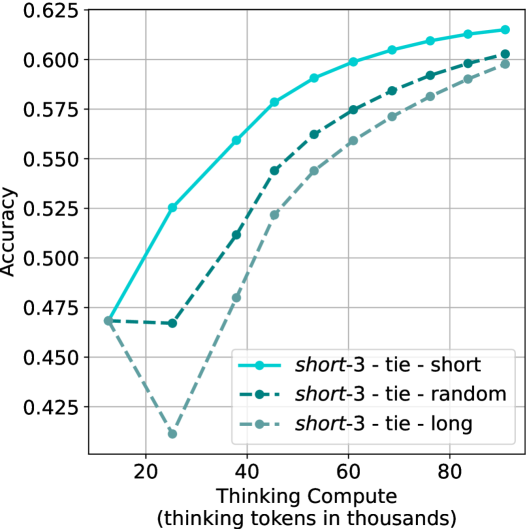
The image is a line chart comparing the accuracy of three different configurations ("short-3 - tie - short", "short-3 - tie - random", and "short-3 - tie - long") against the "Thinking Compute" (measured in thousands of thinking tokens). The chart shows how accuracy changes as the thinking compute increases.
### Components/Axes
* **X-axis:** "Thinking Compute (thinking tokens in thousands)". The scale ranges from approximately 10 to 90, with tick marks at 20, 40, 60, and 80.
* **Y-axis:** "Accuracy". The scale ranges from 0.425 to 0.625, with tick marks at 0.425, 0.450, 0.475, 0.500, 0.525, 0.550, 0.575, 0.600, and 0.625.
* **Legend:** Located in the bottom-right corner.
* **Teal (solid line):** "short-3 - tie - short"
* **Dark Teal (dashed line):** "short-3 - tie - random"
* **Light Teal (dashed line):** "short-3 - tie - long"
### Detailed Analysis
**1. short-3 - tie - short (Teal Solid Line):**
* Trend: Generally increasing accuracy as thinking compute increases.
* Data Points:
* At 10 thinking compute, accuracy is approximately 0.47.
* At 20 thinking compute, accuracy is approximately 0.47.
* At 40 thinking compute, accuracy is approximately 0.56.
* At 60 thinking compute, accuracy is approximately 0.59.
* At 80 thinking compute, accuracy is approximately 0.61.
* At 90 thinking compute, accuracy is approximately 0.62.
**2. short-3 - tie - random (Dark Teal Dashed Line):**
* Trend: Generally increasing accuracy as thinking compute increases.
* Data Points:
* At 10 thinking compute, accuracy is approximately 0.47.
* At 20 thinking compute, accuracy is approximately 0.47.
* At 40 thinking compute, accuracy is approximately 0.51.
* At 60 thinking compute, accuracy is approximately 0.56.
* At 80 thinking compute, accuracy is approximately 0.58.
* At 90 thinking compute, accuracy is approximately 0.60.
**3. short-3 - tie - long (Light Teal Dashed Line):**
* Trend: Initially decreasing, then generally increasing accuracy as thinking compute increases.
* Data Points:
* At 10 thinking compute, accuracy is approximately 0.47.
* At 20 thinking compute, accuracy is approximately 0.42.
* At 40 thinking compute, accuracy is approximately 0.48.
* At 60 thinking compute, accuracy is approximately 0.54.
* At 80 thinking compute, accuracy is approximately 0.57.
* At 90 thinking compute, accuracy is approximately 0.59.
### Key Observations
* "short-3 - tie - short" consistently outperforms the other two configurations across the range of thinking compute values.
* "short-3 - tie - long" shows an initial dip in accuracy before increasing, suggesting a different learning curve compared to the other two.
* All three configurations show diminishing returns in accuracy as thinking compute increases beyond 60,000 tokens.
### Interpretation
The chart demonstrates the relationship between "Thinking Compute" and accuracy for three different configurations. The "short-3 - tie - short" configuration appears to be the most effective, achieving the highest accuracy with a given amount of thinking compute. The initial dip in accuracy for "short-3 - tie - long" might indicate a need for a certain threshold of thinking compute before it can effectively learn. The diminishing returns observed for all configurations suggest that increasing thinking compute beyond a certain point may not significantly improve accuracy, indicating a potential optimization point for resource allocation.