TECHNICAL ASSET FINGERPRINT
1e92595b7d1bb37ddc808e9b
Click to view fullscreen
Press ESC or click to close
FOUND IN PAPERS
EXPERT: healer-alpha-free VERSION 1
RUNTIME: free/openrouter/healer-alpha
INTEL_VERIFIED
## Diagram: Visual Pattern Recognition Test and Spatial Arrangement Concepts
### Overview
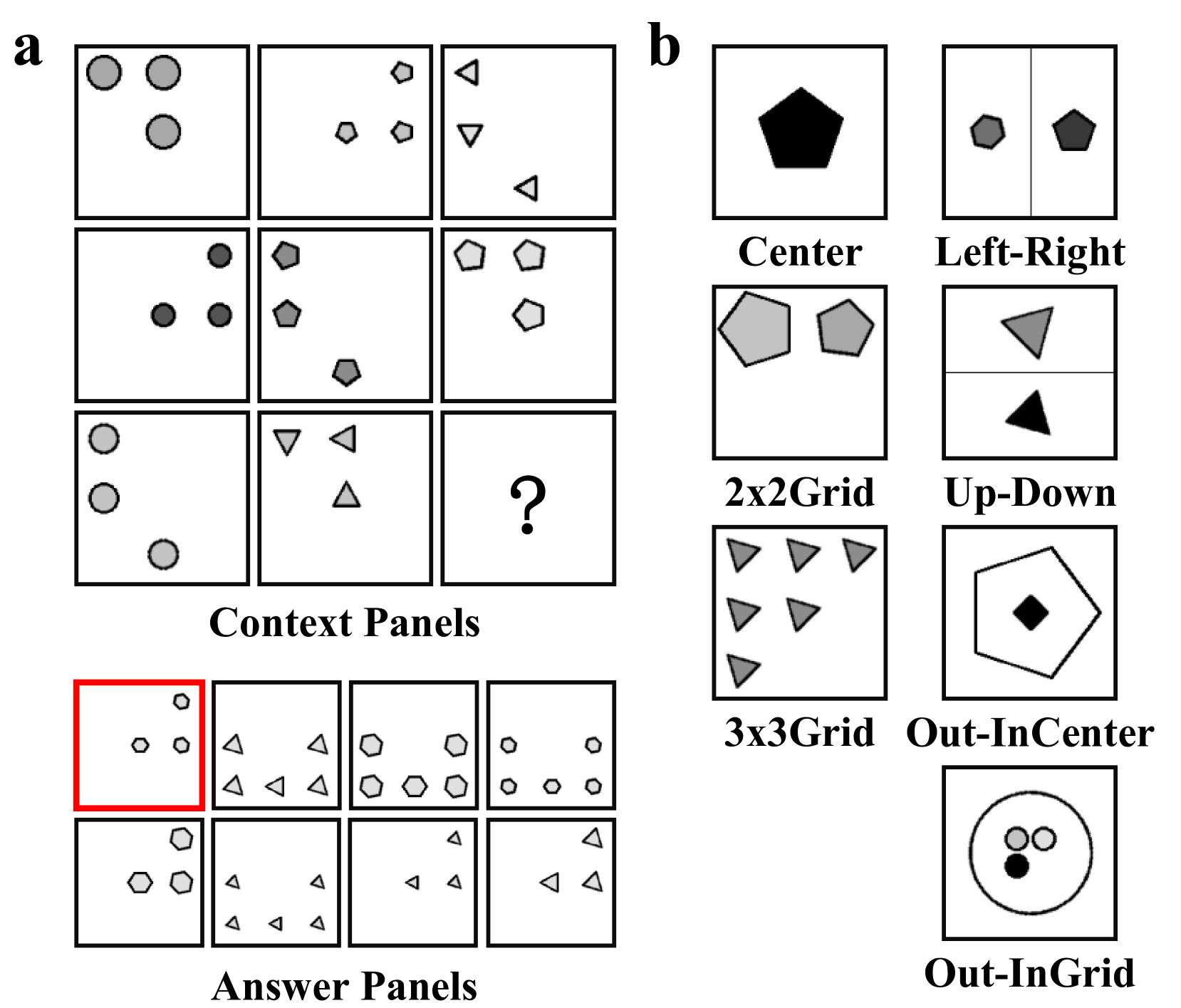
The image is a composite diagram divided into two primary sections, labeled **a** and **b**. Section **a** presents a visual matrix reasoning puzzle (similar to Raven's Progressive Matrices) with a set of "Context Panels" and a set of "Answer Panels." Section **b** illustrates and labels seven distinct spatial arrangement concepts using geometric shapes. The overall purpose appears to be demonstrating or testing pattern recognition and spatial reasoning abilities.
### Components/Axes
**Section a: Pattern Puzzle**
* **Context Panels:** A 3x3 grid of square panels. The bottom-right panel contains a question mark (`?`).
* **Answer Panels:** A 2x4 grid of eight square panels below the context grid. One panel (top-left) is highlighted with a red border.
* **Labels:** The text "Context Panels" is centered below the 3x3 grid. The text "Answer Panels" is centered below the 2x4 grid.
**Section b: Spatial Arrangement Concepts**
* **Layout:** Seven individual square panels, each containing a diagram and a text label below it.
* **Labels (in order, top to bottom, left to right):**
1. `Center`
2. `Left-Right`
3. `2x2Grid`
4. `Up-Down`
5. `3x3Grid`
6. `Out-InCenter`
7. `Out-InGrid`
### Detailed Analysis
**Section a: Context Panels (3x3 Grid)**
Each panel contains exactly three geometric shapes. The shapes vary in type (circle, pentagon, triangle) and fill shade (light gray, medium gray, dark gray/black).
* **Row 1:**
* Panel 1 (Top-Left): Three medium-gray circles.
* Panel 2 (Top-Center): Three medium-gray pentagons.
* Panel 3 (Top-Right): Three medium-gray triangles.
* **Row 2:**
* Panel 1 (Middle-Left): Three dark-gray/black circles.
* Panel 2 (Middle-Center): Three dark-gray/black pentagons.
* Panel 3 (Middle-Right): Three light-gray pentagons.
* **Row 3:**
* Panel 1 (Bottom-Left): Three light-gray circles.
* Panel 2 (Bottom-Center): Three light-gray triangles.
* Panel 3 (Bottom-Right): Contains a large question mark (`?`).
**Section a: Answer Panels (2x4 Grid)**
Each of the eight panels contains three shapes, primarily triangles and pentagons in light gray or white with black outlines.
* **Panel with Red Border (Top-Left of Answer Grid):** Contains three small, light-gray pentagons arranged in a triangular formation (one top, two bottom).
* **Other Panels:** Contain various arrangements of three triangles or three pentagons. For example, the panel to the right of the red-bordered one has three triangles pointing in different directions.
**Section b: Spatial Arrangement Diagrams**
Each diagram uses shapes (pentagons, triangles, circles, diamonds) to illustrate a spatial concept.
1. **Center:** A single, large, black pentagon centered in the panel.
2. **Left-Right:** Two pentagons (one medium-gray, one dark-gray) placed side-by-side, separated by a vertical line.
3. **2x2Grid:** Two light-gray pentagons placed in the top-left and top-right positions of an implied 2x2 grid.
4. **Up-Down:** Two triangles (one medium-gray pointing down, one black pointing up) stacked vertically, separated by a horizontal line.
5. **3x3Grid:** Six medium-gray triangles arranged in the top two rows of an implied 3x3 grid (positions: top-left, top-center, top-right, middle-left, middle-center).
6. **Out-InCenter:** A large, white pentagon (outline) containing a small, black diamond at its center.
7. **Out-InGrid:** A large circle (outline) containing three smaller circles inside: two white (top) and one black (bottom-left).
### Key Observations
1. **Pattern in Context Panels:** There is a clear pattern across rows and columns in Section **a**.
* **Shape Type:** Each row contains one set of circles, one set of pentagons, and one set of triangles, but not in the same order.
* **Shade:** The shade of the shapes is consistent within each row for the first two rows (Row 1: medium gray, Row 2: dark gray for first two panels). Row 3 introduces light gray.
* **Logical Gap:** The missing panel (Row 3, Column 3) should logically contain three light-gray triangles to complete the pattern of shape types (circles, pentagons, triangles) and shade (light gray) for the third row.
2. **Answer Panel Correlation:** The red-bordered answer panel contains three light-gray pentagons. This does **not** match the predicted "three light-gray triangles." This suggests either the puzzle has a more complex rule, or the red border indicates an incorrect selection for demonstration purposes.
3. **Section b as a Key:** The diagrams in Section **b** explicitly define spatial terms (`Center`, `Left-Right`, `2x2Grid`, etc.). These terms likely describe the *arrangement* of the three shapes within each context panel, which is a separate variable from shape type and shade. For example, the shapes in the context panels are not centered; they are scattered, which might correspond to an unlisted "scattered" or "random" arrangement.
### Interpretation
This image is a technical illustration from a cognitive assessment or research paper on visual reasoning. It serves two purposes:
1. **Demonstration of a Test Item (Section a):** It presents a classic matrix reasoning problem where the solver must deduce the rule governing the distribution of shape types and shades across the grid to identify the missing piece. The presence of the red-bordered answer panel suggests this image might be from an answer key or a study analyzing common errors, as the highlighted answer contradicts the most straightforward pattern (shape type completion).
2. **Definition of Spatial Vocabulary (Section b):** It provides a visual lexicon for describing how objects are arranged within a frame. This is crucial for precisely documenting the rules of the puzzle or for scoring responses in a standardized way. The concepts range from simple (`Center`) to more complex relational (`Out-InGrid`).
The disconnect between the obvious pattern in the context panels and the highlighted answer is the most significant finding. It implies that the correct solution may depend on a more nuanced rule involving the spatial arrangements defined in Section **b**, rather than just the shape/shade matrix. For instance, the rule might involve a specific sequence of arrangements (e.g., "scattered," "clustered," "linear") that the solver must also deduce. The image, therefore, doesn't just show a puzzle; it shows the puzzle *and* the conceptual tools needed to solve or analyze it at a deeper level.
DECODING INTELLIGENCE...