## Line Chart: NDCG@10/% vs. Dimensions for Different Algorithms
### Overview
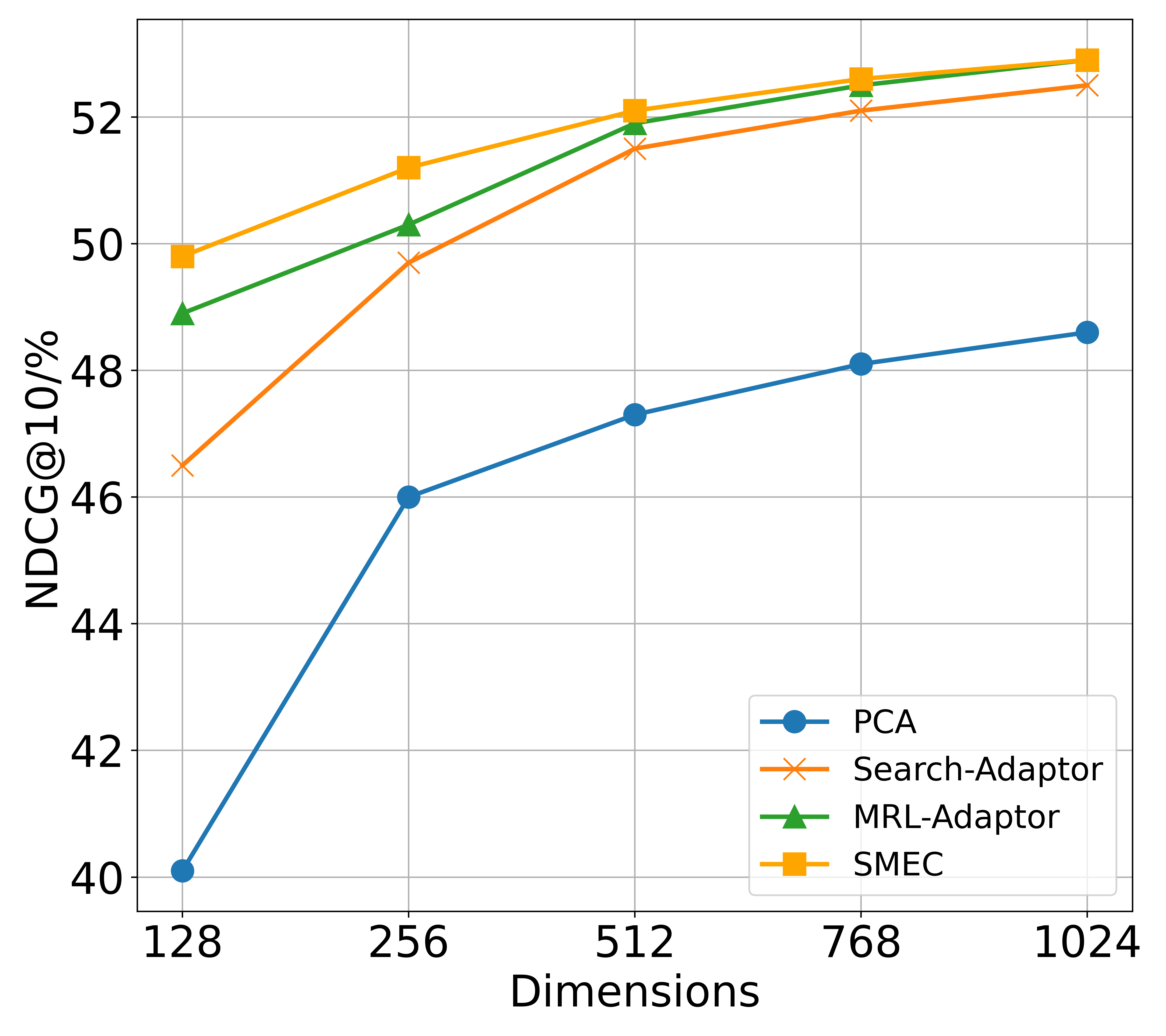
The image is a line chart comparing the performance of four different algorithms (PCA, Search-Adaptor, MRL-Adaptor, and SMEC) based on their NDCG@10/% score across varying dimensions. The x-axis represents the number of dimensions, and the y-axis represents the NDCG@10/% score.
### Components/Axes
* **Title:** There is no explicit title on the chart.
* **X-axis:**
* Label: "Dimensions"
* Scale: 128, 256, 512, 768, 1024
* **Y-axis:**
* Label: "NDCG@10/%"
* Scale: 40, 42, 44, 46, 48, 50, 52
* **Legend:** Located in the bottom-right corner.
* PCA (Blue line with circle markers)
* Search-Adaptor (Orange line with cross markers)
* MRL-Adaptor (Green line with triangle markers)
* SMEC (Yellow/Orange line with square markers)
### Detailed Analysis
* **PCA (Blue):** The line starts at approximately 40 at 128 dimensions, increases to approximately 46 at 256 dimensions, reaches approximately 47.3 at 512 dimensions, then increases to approximately 48.1 at 768 dimensions, and ends at approximately 48.6 at 1024 dimensions. The trend is upward, with the most significant increase between 128 and 256 dimensions.
* **Search-Adaptor (Orange):** The line starts at approximately 46.5 at 128 dimensions, increases to approximately 49.8 at 256 dimensions, reaches approximately 51.5 at 512 dimensions, then increases to approximately 52.3 at 768 dimensions, and ends at approximately 52.6 at 1024 dimensions. The trend is upward, with a decreasing rate of increase as dimensions increase.
* **MRL-Adaptor (Green):** The line starts at approximately 49 at 128 dimensions, increases to approximately 50.3 at 256 dimensions, reaches approximately 51.8 at 512 dimensions, then increases to approximately 52.4 at 768 dimensions, and ends at approximately 52.6 at 1024 dimensions. The trend is upward, with a decreasing rate of increase as dimensions increase.
* **SMEC (Yellow/Orange):** The line starts at approximately 49.8 at 128 dimensions, increases to approximately 51.3 at 256 dimensions, reaches approximately 52 at 512 dimensions, then increases to approximately 52.5 at 768 dimensions, and ends at approximately 52.7 at 1024 dimensions. The trend is upward, with a decreasing rate of increase as dimensions increase.
### Key Observations
* SMEC and MRL-Adaptor consistently outperform PCA and Search-Adaptor across all dimensions.
* The performance of all algorithms generally improves as the number of dimensions increases, but the rate of improvement decreases at higher dimensions.
* PCA has the lowest NDCG@10/% score across all dimensions.
* The performance difference between MRL-Adaptor and SMEC is minimal, especially at higher dimensions.
### Interpretation
The chart suggests that increasing the number of dimensions generally improves the performance of these algorithms, as measured by NDCG@10/%. However, there are diminishing returns, as the rate of improvement decreases at higher dimensions. The choice of algorithm significantly impacts performance, with SMEC and MRL-Adaptor consistently outperforming PCA and Search-Adaptor. PCA shows the most significant performance gain from 128 to 256 dimensions, indicating that increasing dimensions is particularly beneficial for this algorithm in the lower range. The close performance of MRL-Adaptor and SMEC suggests they may have similar underlying mechanisms or be optimized for similar data characteristics.