## Line Chart: Per-Period Regret vs. Time Period
### Overview
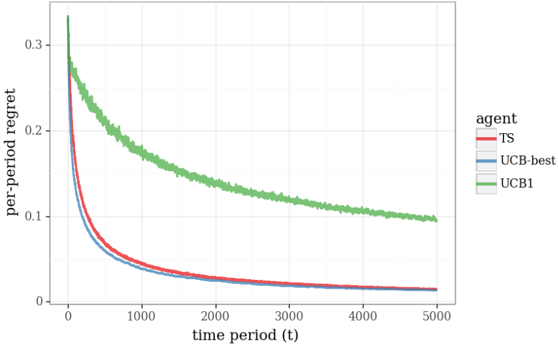
The image presents a line chart illustrating the per-period regret of three different agents (TS, UCB-best, and UCB1) over a time period of 5000 units. The chart aims to compare the performance of these agents in terms of cumulative regret.
### Components/Axes
* **X-axis:** "time period (t)", ranging from approximately 0 to 5000.
* **Y-axis:** "per-period regret", ranging from approximately 0 to 0.35.
* **Legend:** Located in the top-right corner, identifying the three agents:
* TS (represented by a red line)
* UCB-best (represented by a blue line)
* UCB1 (represented by a green line)
* **Gridlines:** Present to aid in reading values.
### Detailed Analysis
* **TS (Red Line):** The red line representing TS exhibits a steep downward trend initially, rapidly decreasing from approximately 0.32 at t=0 to approximately 0.01 at t=5000. The curve appears to be logarithmic or exponential decay.
* At t=100, per-period regret is approximately 0.25.
* At t=500, per-period regret is approximately 0.12.
* At t=1000, per-period regret is approximately 0.08.
* At t=2000, per-period regret is approximately 0.03.
* At t=4000, per-period regret is approximately 0.015.
* **UCB-best (Blue Line):** The blue line representing UCB-best starts at approximately 0.34 at t=0 and decreases more slowly than TS. It reaches approximately 0.11 at t=5000. The curve is also decreasing, but at a slower rate.
* At t=100, per-period regret is approximately 0.30.
* At t=500, per-period regret is approximately 0.22.
* At t=1000, per-period regret is approximately 0.18.
* At t=2000, per-period regret is approximately 0.14.
* At t=4000, per-period regret is approximately 0.12.
* **UCB1 (Green Line):** The green line representing UCB1 starts at approximately 0.35 at t=0 and decreases at a rate between TS and UCB-best. It reaches approximately 0.10 at t=5000.
* At t=100, per-period regret is approximately 0.33.
* At t=500, per-period regret is approximately 0.25.
* At t=1000, per-period regret is approximately 0.20.
* At t=2000, per-period regret is approximately 0.15.
* At t=4000, per-period regret is approximately 0.11.
### Key Observations
* TS consistently exhibits the lowest per-period regret throughout the entire time period.
* UCB-best has the highest per-period regret.
* All three agents demonstrate a decreasing trend in per-period regret as time progresses, indicating learning and improvement.
* The rate of decrease in regret is most rapid for TS, followed by UCB1, and then UCB-best.
### Interpretation
The chart suggests that the TS agent is the most effective in minimizing per-period regret compared to UCB-best and UCB1. This implies that TS learns and adapts more quickly to the environment, leading to better decision-making and reduced cumulative regret. The slower decrease in regret for UCB-best and UCB1 suggests that these agents may require more time to explore and exploit the environment effectively. The differences in performance could be attributed to the underlying algorithms and exploration-exploitation strategies employed by each agent. The logarithmic decay pattern observed in all three lines indicates diminishing returns to learning over time. The initial high regret values suggest a period of significant exploration, while the decreasing regret values indicate a transition towards exploitation of learned knowledge. The chart provides valuable insights into the relative performance of different reinforcement learning algorithms in a dynamic environment.