## Research Article Structure: Financial Technology Asset Allocation Models
### Overview
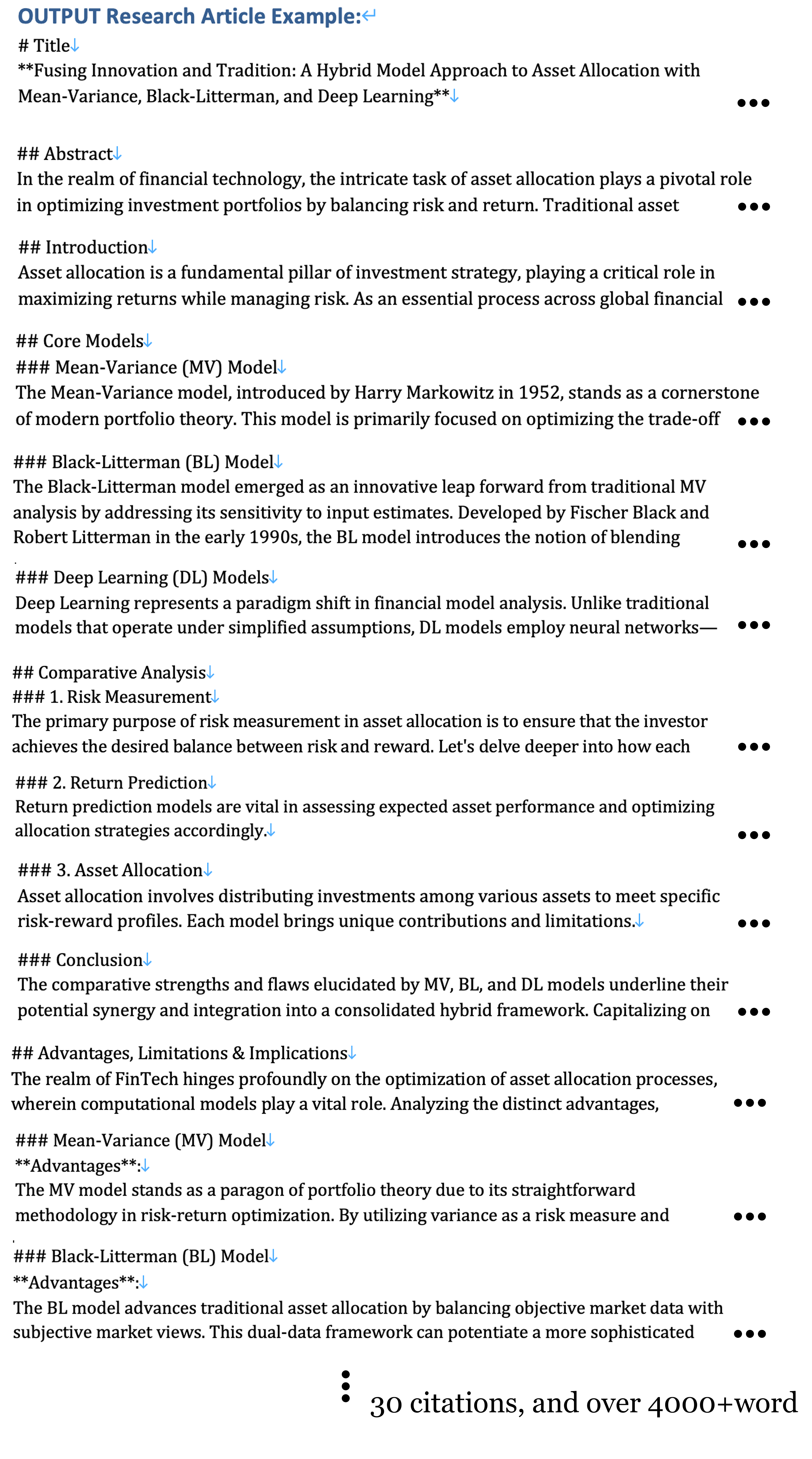
The image depicts a structured outline of a research article titled *"Fusing Innovation and Tradition: A Hybrid Model Approach to Asset Allocation with Mean-Variance, Black-Litterman, and Deep Learning."* It presents a comparative analysis of three asset allocation models, their advantages, limitations, and potential integration into a hybrid framework.
### Components/Axes
- **Headings**:
- `# Title`
- `## Abstract`
- `## Introduction`
- `### Core Models`
- `#### Mean-Variance (MV) Model`
- `#### Black-Litterman (BL) Model`
- `#### Deep Learning (DL) Models`
- `## Comparative Analysis`
- `#### 1. Risk Measurement`
- `#### 2. Return Prediction`
- `#### 3. Asset Allocation`
- `### Conclusion`
- `## Advantages, Limitations & Implications`
### Detailed Analysis
- **Title**:
- Full title: *"Fusing Innovation and Tradition: A Hybrid Model Approach to Asset Allocation with Mean-Variance, Black-Litterman, and Deep Learning."*
- Emphasizes integration of traditional (MV, BL) and modern (DL) models.
- **Abstract**:
- Highlights the role of asset allocation in balancing risk and return in financial technology.
- Mentions traditional models (MV, BL) and introduces DL as a paradigm shift.
- **Introduction**:
- Defines asset allocation as a cornerstone of investment strategy.
- Positions the study within global financial markets.
- **Core Models**:
- **Mean-Variance (MV) Model**:
- Introduced by Harry Markowitz (1952).
- Focuses on optimizing risk-return trade-offs using variance as a risk measure.
- **Black-Litterman (BL) Model**:
- Developed by Fischer Black and Robert Litterman (1990s).
- Combines objective market data with subjective investor views.
- **Deep Learning (DL) Models**:
- Uses neural networks to operate under simplified assumptions.
- Represents a shift from traditional models.
- **Comparative Analysis**:
- **Risk Measurement**: Ensures balance between risk and reward.
- **Return Prediction**: Assesses asset performance to optimize strategies.
- **Asset Allocation**: Distributes investments across assets based on risk-reward profiles.
- **Conclusion**:
- Summarizes strengths/flaws of MV, BL, and DL models.
- Proposes a hybrid framework for synergistic integration.
- **Advantages, Limitations & Implications**:
- **MV Model**:
- *Advantages*: Straightforward methodology, foundational in portfolio theory.
- **BL Model**:
- *Advantages*: Balances objective data with subjective insights.
- **DL Models**:
- *Implications*: Potential for advanced optimization but requires computational resources.
### Key Observations
- The article emphasizes the evolution of asset allocation models from traditional (MV, BL) to modern (DL) approaches.
- The hybrid framework aims to address limitations of individual models by combining their strengths.
- No numerical data or visualizations are present; the focus is on theoretical and methodological analysis.
### Interpretation
This research article template outlines a structured approach to evaluating asset allocation models in financial technology. By comparing MV, BL, and DL models, it highlights their unique contributions and limitations. The proposed hybrid framework suggests that integrating these models could optimize investment strategies by leveraging both historical data (MV/BL) and predictive capabilities (DL). The absence of empirical data implies the article may serve as a conceptual framework for future studies or a review of existing methodologies.
**Note**: The image contains no charts, diagrams, or numerical data. All information is derived from textual content and headings.