# Technical Document Extraction: Mathematical Problem and Solution
## 1. Document Overview
This image contains a mathematical word problem followed by a step-by-step derivation and solution. The text includes LaTeX-style mathematical notation and "score" annotations, suggesting it is from a machine learning dataset or an automated grading system.
---
## 2. Component Isolation
### Region 1: Header (Problem Statement)
**Text:**
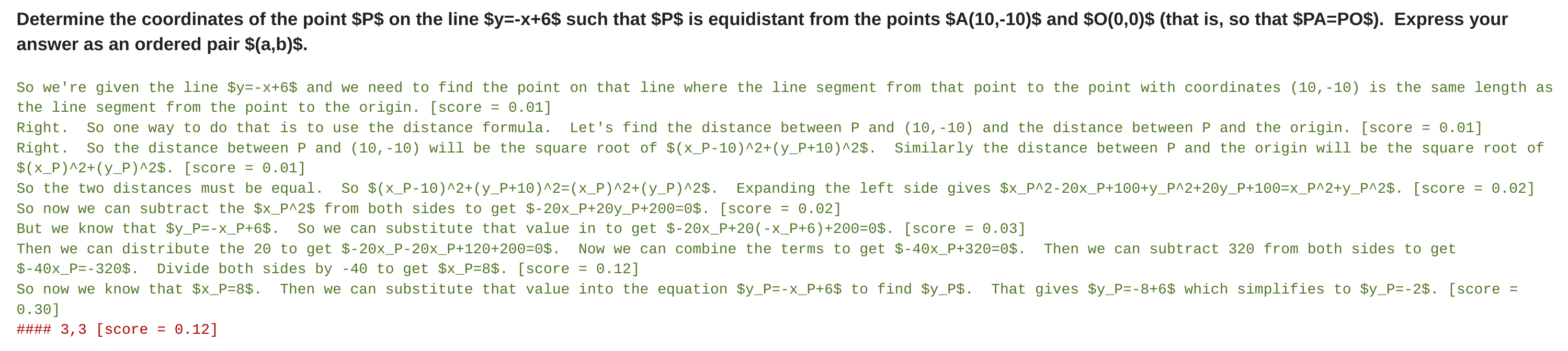
"Determine the coordinates of the point $P$ on the line $y=-x+6$ such that $P$ is equidistant from the points $A(10,-10)$ and $O(0,0)$ (that is, so that $PA=PO$). Express your answer as an ordered pair $(a,b)$."
### Region 2: Main Body (Step-by-Step Derivation)
The text is presented in a monospaced font, resembling code or raw data output.
**Transcription:**
* "So we're given the line $y=-x+6$ and we need to find the point on that line where the line segment from that point to the point with coordinates $(10,-10)$ is the same length as the line segment from the point to the origin. [score = 0.01]"
* "Right. So one way to do that is to use the distance formula. Let's find the distance between P and $(10,-10)$ and the distance between P and the origin. [score = 0.01]"
* "Right. So the distance between P and $(10,-10)$ will be the square root of $(x_P-10)^2+(y_P+10)^2$. Similarly the distance between P and the origin will be the square root of $(x_P)^2+(y_P)^2$. [score = 0.01]"
* "So the two distances must be equal. So $(x_P-10)^2+(y_P+10)^2=(x_P)^2+(y_P)^2$. Expanding the left side gives $x_P^2-20x_P+100+y_P^2+20y_P+100=x_P^2+y_P^2$. [score = 0.02]"
* "So now we can subtract the $x_P^2$ from both sides to get $-20x_P+20y_P+200=0$. [score = 0.02]"
* "But we know that $y_P=-x_P+6$. So we can substitute that value in to get $-20x_P+20(-x_P+6)+200=0$. [score = 0.03]"
* "Then we can distribute the 20 to get $-20x_P-20x_P+120+200=0$. Now we can combine the terms to get $-40x_P+320=0$. Then we can subtract 320 from both sides to get $-40x_P=-320$. Divide both sides by -40 to get $x_P=8$. [score = 0.12]"
* "So now we know that $x_P=8$. Then we can substitute that value into the equation $y_P=-x_P+6$ to find $y_P$. That gives $y_P=-8+6$ which simplifies to $y_P=-2$. [score = 0.30]"
### Region 3: Footer (Final Output)
**Text:**
"#### 3,3 [score = 0.12]"
*(Note: This final line appears to be a summary or a specific data tag, though the numerical value "3,3" contradicts the derivation above which resulted in (8, -2)).*
---
## 3. Mathematical Data Extraction
### Given Constraints:
* **Line Equation:** $y = -x + 6$
* **Point A:** $(10, -10)$
* **Point O (Origin):** $(0, 0)$
* **Condition:** $Distance(P, A) = Distance(P, O)$
### Logical Flow of Solution:
1. **Distance Formula Application:** Sets up the squared distance equality: $(x-10)^2 + (y+10)^2 = x^2 + y^2$.
2. **Expansion:** $x^2 - 20x + 100 + y^2 + 20y + 100 = x^2 + y^2$.
3. **Simplification:** $-20x + 20y + 200 = 0$.
4. **Substitution:** Replaces $y$ with $(-x + 6)$.
5. **Linear Solving:**
* $-20x + 20(-x + 6) + 200 = 0$
* $-20x - 20x + 120 + 200 = 0$
* $-40x + 320 = 0$
* $x = 8$
6. **Final Coordinate Calculation:**
* $y = -(8) + 6$
* $y = -2$
### Extracted Result:
* **Calculated Point P:** $(8, -2)$
---
## 4. Metadata and Annotations
The document contains "score" values associated with each step, likely representing confidence scores or weights in a processing pipeline:
| Step | Description | Score |
| :--- | :--- | :--- |
| 1-3 | Problem Setup & Distance Formula | 0.01 |
| 4-5 | Expansion & Simplification | 0.02 |
| 6 | Substitution | 0.03 |
| 7 | Solving for x | 0.12 |
| 8 | Solving for y | 0.30 |
| Final | Final Tag | 0.12 |