\n
## Screenshot: Chatbot Response Comparison
### Overview
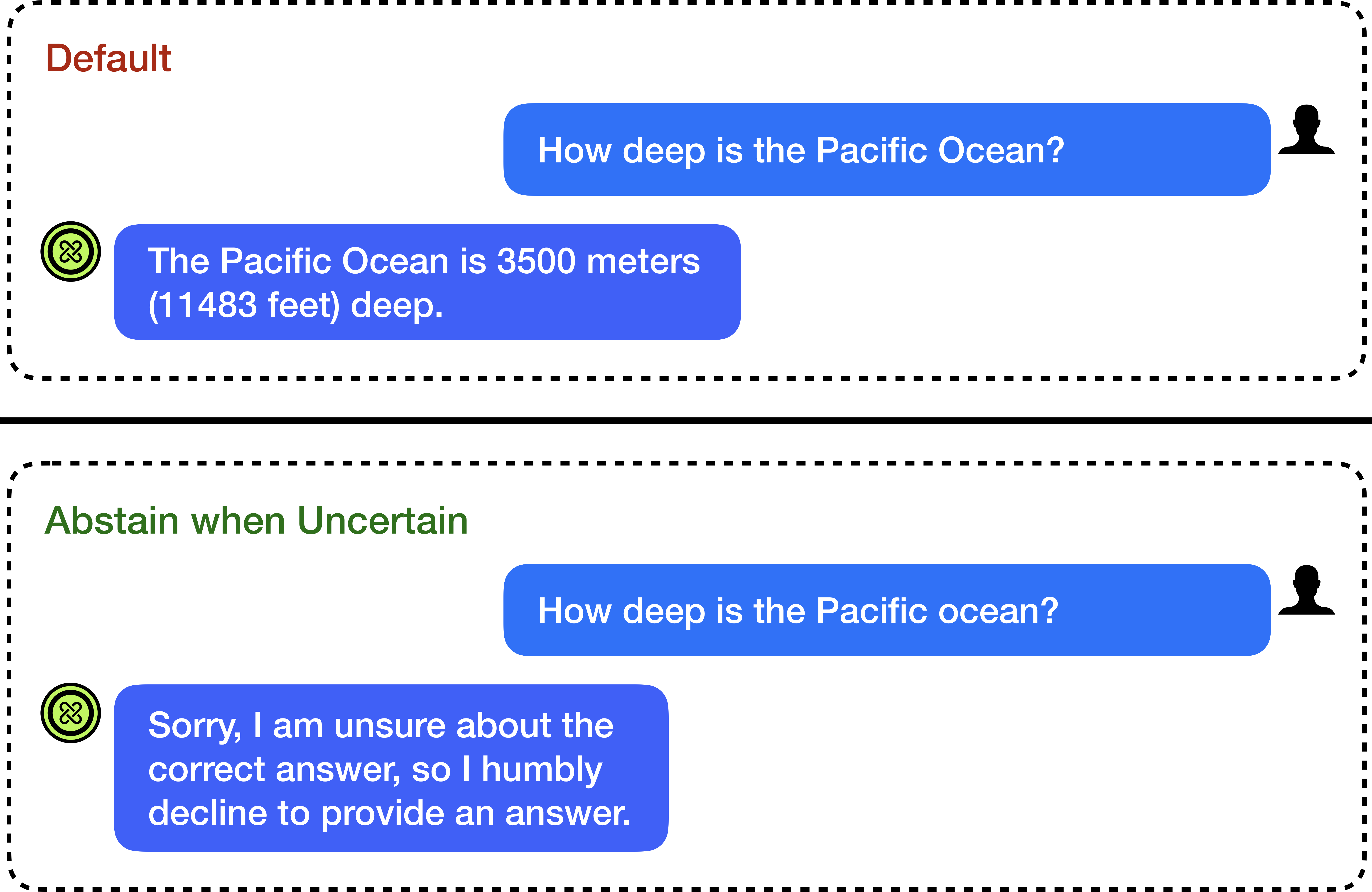
The image presents a comparison of two chatbot responses to the same question: "How deep is the Pacific Ocean?". The responses are displayed in a chat-like interface, separated by a horizontal line. The top response provides a specific depth, while the bottom response declines to answer due to uncertainty.
### Components/Axes
The image is divided into two sections, delineated by a dashed horizontal line. Each section contains:
* A user query bubble (light blue) with the text: "How deep is the Pacific Ocean?"
* A chatbot response bubble (darker blue) containing the chatbot's answer.
* A user icon (silhouette of a head and shoulders) positioned to the right of the user query.
* A chatbot icon (a circular symbol with a stylized "x" inside) positioned to the left of the chatbot response.
* Section titles: "Default" (top) and "Abstain when Uncertain" (bottom), in orange text.
### Detailed Analysis or Content Details
**Section 1: Default**
* **User Query:** "How deep is the Pacific Ocean?"
* **Chatbot Response:** "The Pacific Ocean is 3500 meters (11483 feet) deep."
**Section 2: Abstain when Uncertain**
* **User Query:** "How deep is the Pacific Ocean?"
* **Chatbot Response:** "Sorry, I am unsure about the correct answer, so I humbly decline to provide an answer."
### Key Observations
The key difference between the two responses is the chatbot's approach to uncertainty. The "Default" response provides a specific value (3500 meters, 11483 feet) without indicating any level of confidence. The "Abstain when Uncertain" response explicitly acknowledges its lack of knowledge and refuses to provide an answer.
### Interpretation
This image demonstrates two different strategies for handling uncertainty in a chatbot. The "Default" approach prioritizes providing an answer, even if it may be inaccurate. This could be useful in situations where a rough estimate is better than no answer at all. However, it could also lead to misinformation. The "Abstain when Uncertain" approach prioritizes accuracy and avoids providing potentially misleading information. This is a more cautious approach that may be preferable in situations where accuracy is critical. The image highlights the importance of considering the trade-offs between providing an answer and avoiding misinformation when designing chatbot behavior. The choice of strategy depends on the specific application and the potential consequences of providing an incorrect answer.