\n
## Line Chart: Test Accuracy vs. Communication Round for Federated Learning Methods
### Overview
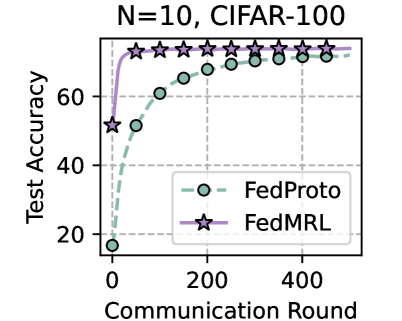
The image is a line chart comparing the test accuracy of two federated learning methods, FedProto and FedMRL, over a series of communication rounds. The chart is titled "N=10, CIFAR-100," indicating the experiment was conducted with 10 clients on the CIFAR-100 dataset.
### Components/Axes
* **Title:** "N=10, CIFAR-100" (Top center)
* **Y-Axis:** Labeled "Test Accuracy". The scale runs from 20 to 60, with major tick marks and grid lines at 20, 40, and 60. The axis extends slightly below 20 and above 60.
* **X-Axis:** Labeled "Communication Round". The scale runs from 0 to 400, with major tick marks and grid lines at 0, 200, and 400.
* **Legend:** Located in the bottom-right quadrant of the chart area.
* A teal circle symbol corresponds to the label "FedProto".
* A purple star symbol corresponds to the label "FedMRL".
* **Data Series:**
1. **FedProto:** Represented by a dashed teal line connecting teal circle markers.
2. **FedMRL:** Represented by a solid purple line connecting purple star markers.
### Detailed Analysis
**Trend Verification & Data Points (Approximate):**
* **FedMRL (Purple Stars, Solid Line):**
* **Trend:** The line shows a very steep initial increase in accuracy, followed by a plateau. It starts at a higher accuracy than FedProto and maintains a lead throughout, though the gap narrows significantly.
* **Data Points:**
* Round 0: ~50% accuracy.
* Round ~50: Accuracy rises sharply to ~68%.
* Round 100: Accuracy is approximately 70%.
* Rounds 200-400: Accuracy remains stable, hovering just above 70% (approximately 71-72%).
* **FedProto (Teal Circles, Dashed Line):**
* **Trend:** The line shows a steady, consistent logarithmic-like increase in accuracy over time. It starts at a much lower point but continuously improves, nearly converging with FedMRL by the end of the observed rounds.
* **Data Points:**
* Round 0: ~15% accuracy.
* Round ~50: ~50% accuracy.
* Round 100: ~60% accuracy.
* Round 200: ~65% accuracy.
* Round 300: ~68% accuracy.
* Round 400: ~69-70% accuracy.
### Key Observations
1. **Performance Gap and Convergence:** FedMRL demonstrates significantly faster initial convergence, reaching near-peak performance within the first 50-100 rounds. FedProto starts much lower but exhibits a strong, sustained learning curve, almost closing the performance gap by round 400.
2. **Final Accuracy:** By communication round 400, both methods achieve very similar test accuracy, in the approximate range of 70-72%.
3. **Stability:** After its initial rapid rise, FedMRL's performance is highly stable with minimal fluctuation. FedProto's performance continues to show slight, incremental gains even in later rounds.
### Interpretation
This chart illustrates a classic trade-off in federated learning optimization between convergence speed and final model performance. The data suggests that for the given task (CIFAR-100 with 10 clients):
* **FedMRL** is highly effective for scenarios requiring rapid model deployment or where communication costs are a primary concern, as it achieves high accuracy with very few communication rounds.
* **FedProto** may be preferable in settings where training can afford more communication rounds, as it demonstrates robust and continuous learning, ultimately matching the performance of the faster-converging method.
* The near-convergence of the two lines by round 400 indicates that both methods are capable of reaching a similar optimum for this specific problem setup. The choice between them would therefore depend on the operational constraints (time vs. communication budget) rather than a fundamental difference in achievable accuracy. The "N=10" parameter is critical context, as the relative performance of these methods could change with a different number of clients.